


Capital proof supports an investment case; it does not replace one. Convincing angel investors with capital proof means showing how available funds, the amount sought, projected spending, and the next business milestone fit together. Investors need a clear rationale they can examine, not just a headline figure.
It is reasonable to focus on how much capital a startup can demonstrate and how much it needs. But a credible case also explains the assumptions behind projections, how long the funding is expected to support operations, and the terms the founder is proposing. Gaps between the numbers and the plan can prompt difficult due-diligence questions.
This article explains how to organize capital evidence, define a funding request around measurable milestones, and present projections and runway with transparent assumptions. It also covers how equity or convertible debt can shape proposed terms, which materials help prepare for investor review, and how to communicate uncertainty without weakening the case. The goal is a consistent, defensible presentation that lets investors assess both the opportunity and the use of their capital.
Key Takeaways
- Match the funding request to specific business costs and a milestone investors can assess.
- Build projections from explicit assumptions, and show how changes in those assumptions affect the plan.
- Present runway as a function of available capital, planned spending, and expected progress toward the next milestone.
- Prepare organized financial records and supporting documents so due diligence can examine the figures behind the pitch.
- Research each investor’s focus and explain proposed terms clearly, including how the investment may support the company’s next stage.
Explaining funding needs and investment terms
A credible funding request connects available capital to defined business costs and a measurable milestone. Founders should distinguish cash already accessible from revenue, investor interest, and proposed terms such as equity or convertible debt.
Proof of Funds and Financial Traction
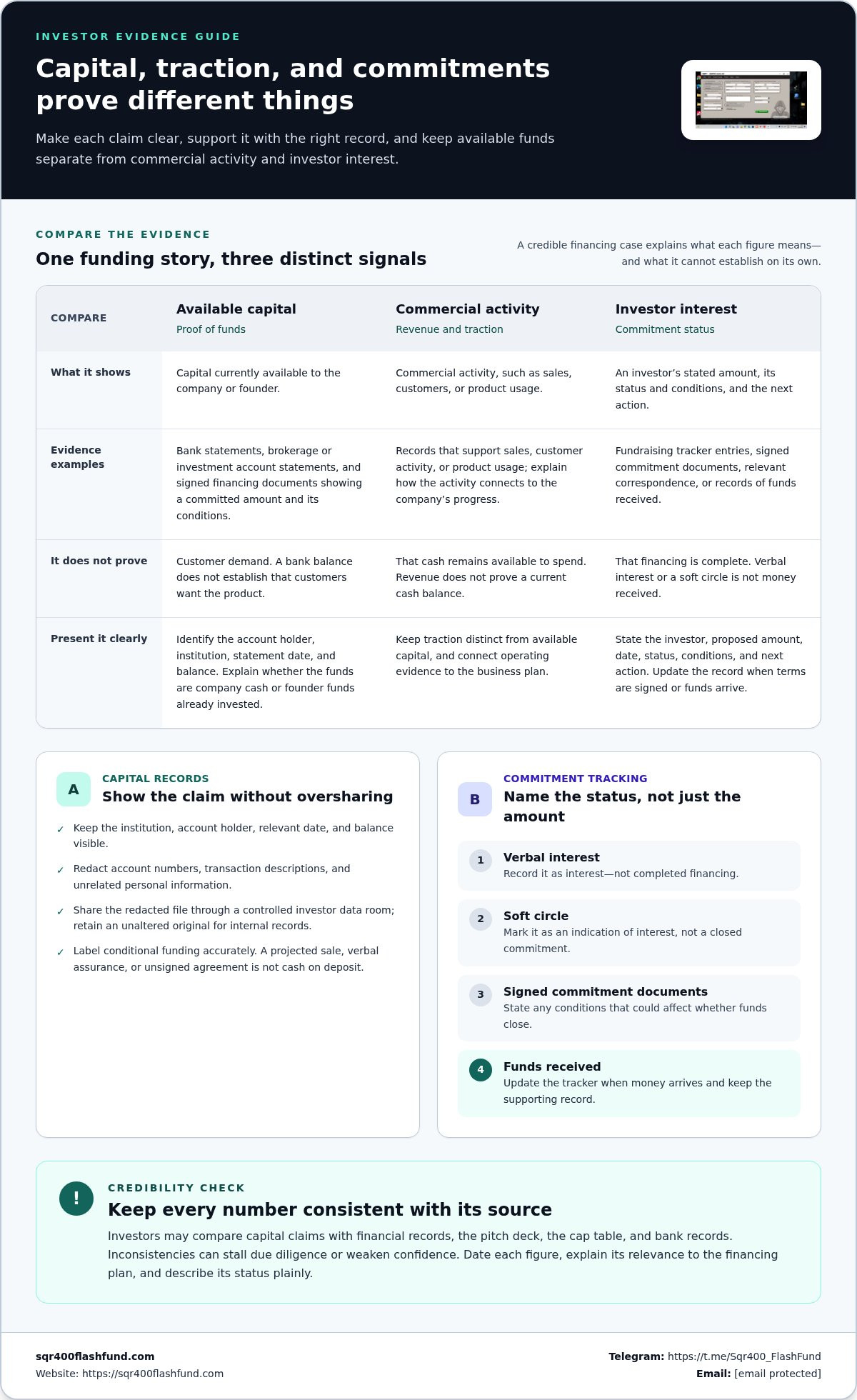
Proof of funds shows capital currently available to the company or founder, while revenue and traction show commercial activity, such as sales, customers, or product usage. These are distinct forms of evidence: a bank balance does not establish customer demand, and revenue does not prove that cash remains available to spend.
Present each figure with its date, owner, and relevance to the financing plan. For example, explain whether company cash supports operating costs or whether founder funds have already been invested. Accurate descriptions matter because investors compare capital claims with financial records during due diligence.
U.S. securities rules also affect some fundraising communications. Under Rule 506(c), every purchaser must be accredited, and the issuer must take reasonable steps to verify that status, according to the U.S. Securities and Exchange Commission. Under SEC Rule 501(a), an individual can qualify as an accredited investor with net worth exceeding $1 million individually or jointly with a spouse or spousal equivalent, excluding the value of the primary residence, according to the U.S. Securities and Exchange Commission.
Documents Showing Available Capital
Proof-of-capital documents are dated financial records that support a specific claim about available funds. Examples include bank statements, brokerage or investment account statements, and signed financing documents showing a committed amount and its conditions. Choose records that identify the account holder, institution, statement date, and balance.
When sharing a bank statement, preserve the details that substantiate the claim while redacting account numbers, transaction descriptions, and unrelated personal information. Keep the institution name, account holder, relevant date, and balance visible. Share the redacted file through a controlled investor data room, and retain an unaltered original for internal records.
Claims about available capital should match the underlying documents. A projected sale, verbal assurance, or unsigned agreement is not the same as cash on deposit. Label each item precisely, and do not present conditional funding as money already received.
Documenting Investor Commitments
A commitment record identifies an investor’s stated amount, its status and conditions, and the next action. Distinguish verbal interest, a soft circle, signed commitment documents, and funds received; each represents a different level of certainty.
After a conversation, record the date, investor, proposed amount, and any conditions in a fundraising tracker. Mark a soft circle as an indication of interest, not completed financing. Update the status when written terms are signed or money arrives, and keep relevant correspondence with the entry.
Overstating commitments can damage credibility when investor records are compared with the pitch deck, cap table, or bank records. Inconsistencies can stall diligence or weaken investor confidence. Report each status plainly, including conditions that could affect whether the funds close.
Funding Stages, Amounts, and Support
Angel funding commonly supports early-stage companies in pre-seed and seed rounds, and angels may also invest in Series A. Angel investors generally use their own funds, unlike venture capitalists, who invest pooled funds. Individual angel checks commonly range from $25,000 to $250,000, though the right request depends on the company’s costs and milestones.
Angels may provide industry advice, mentorship, and strategic support alongside capital. Explain the funding need by linking planned spending to a milestone, then show how the proposed equity or convertible debt relates to the company’s next stage. This gives investors a clearer basis for assessing the opportunity and the founder’s ability to execute.
Presenting financial projections and metrics
Investors assess projections by testing their assumptions against actual operating evidence. Founders should connect personal financial commitment, seed traction, and forecast milestones in one consistent model.
Founder Financial Commitment
Founder financial commitment is the capital founders have personally invested in building the company. It matters because it shows how founders have shared the financial exposure they’re asking new partners to take.
Separate cash contributions from unpaid labor, personal guarantees, and expenses paid on the company’s behalf. For example, record founder-funded product development as a dated contribution, then identify whether it appears in company records. Angel groups generally expect founders to have invested personally, alongside investment from friends or family.
Present the amount and its use without implying that personal investment alone validates the business. Explain whether founder funds supported product development, customer discovery, or initial operations. If founders’ contributions differ, document each clearly so investors can understand the team’s financial commitment and remaining capital needs.
Seed Traction and Projections
Seed traction is measurable evidence that customers or users are engaging with the product, while projections estimate how operating results may develop. Together, they help investors compare current performance with the company’s next milestones.
For founders, convincing angel investors with capital proof starts with separating observed results from forecast assumptions. Frame the forecast around what the next 12 months will prove. Connect each revenue assumption to evidence, such as current customer conversion, repeat purchases, or signed contracts. Identify which assumption drives the largest change in projected revenue or cash use.
Build a base case from current operating data, then show how a slower sales cycle or higher acquisition cost changes the outcome. Include revenue, direct costs, operating expenses, cash flow, and hiring assumptions. Explain the driver behind each line instead of presenting spreadsheet totals without context.
A practical projection links each use of funding to a measurable operating result. For example, hiring a sales lead should support a defined sales process, while product investment should connect to a release or customer milestone. State the period, metric, and assumption beside each forecast so investors can trace how spending supports progress.
Update the model with actual results when performance changes. If customer acquisition takes longer than expected, revise the timing and explain the operational cause. Keep the original forecast for comparison, then show the revised case and what the founders learned. This demonstrates disciplined decision-making rather than concealing variance.
Longer-term expectations also need a clear basis. Angel investors may expect significant revenues and earnings within 3 to 7 years, so connect that horizon to the company’s market, operating model, and growth assumptions. Another part of convincing angel investors with capital proof is presenting this horizon as a reasoned pathway, not established performance. Show milestones that connect current evidence to future targets.
Present the model as a decision tool for investors. A concise summary can identify current traction, forecast drivers, funding-dependent milestones, and the assumptions most likely to change. This gives investors a structured way to challenge the plan and understand how founders will respond as new operating data emerges.
Fundraising timelines and investor due diligence
Fundraising moves through investor screening, presentations, and diligence before terms are finalized and capital closes. Timelines depend on group schedules, document readiness, and how quickly open questions receive clear answers.
Fundraising Timeline Considerations
An angel fundraising timeline is the sequence from initial outreach through an investment decision and closing. Angel group pre-screening generally takes one or two weeks, while screening is usually completed within one to three weeks.
Due diligence can continue for two weeks to several months, and investment meetings are usually held every month or two. Raising capital can take 3-6 months on average, so founders should plan operating cash around the process rather than assuming a pitch produces immediate funding.
Timing of Proof-of-Funds Requests
Angel investors do not follow one universal schedule for requesting proof of funds. Be ready to summarize available capital during a pitch and provide supporting records if investors request them during diligence.
Early conversations often establish whether the company and investor are a good fit. Later review may examine bank records, financial statements, and the consistency of claims in the pitch. Share only relevant documentation through a controlled process, and keep figures aligned across every version of the deck and model.
Prepare for diligence before outreach. Organize corporate records, ownership details, financial statements, customer evidence, and fundraising materials in a clear data room. Use consistent file names and dates so investors can trace each figure to its source. If a balance changes, update the supporting record and related explanation.
Angel groups don’t fund every company that advances. About 10 to 25 percent of entrepreneurs who apply reach screening, and between 25 and 50 percent of companies that reach angel group due diligence are funded. These figures describe different stages, so founders should not treat an invitation to screen as an investment decision.
During review, investors test the relationship between traction, planned spending, ownership, and the proposed return. Be prepared to explain customer concentration, revenue changes, outstanding obligations, and assumptions driving the forecast. If a figure differs from an earlier presentation, identify the reason and provide the revised record rather than leaving inconsistent versions unexplained.
Investor networks can also affect the process. An angel group may involve co-investors or individual angels, adding reviewers and questions before terms are finalized. Track each discussion, requested document, and open issue in one diligence log. Assign a founder to respond, record the answer, and share the same updated information with everyone involved.
Once investors accept the core evidence, attention shifts to proposed terms and closing conditions. Keep the latest capitalization table, financing documents, and commitment status consistent. A structured process helps investors assess the opportunity, potential return, and ownership implications without confusing preliminary interest with closed funding.
Pitch decks and investor preparation
A pitch deck must make the investment case clear before the meeting ends. Prepare a coherent narrative, a concise evidence trail, and direct answers to predictable questions.
Start by researching each angel’s investment focus, preferred stage, and working style. Identify companies the investor has backed and compare their business models with yours. A strong fit gives you a relevant opening; a mismatch wastes time for both sides. Tailor the meeting request to the investor’s interests rather than sending the same pitch to every contact.
Build the deck around the evidence investors need to assess the opportunity: the customer problem, product, market, team, traction, funding purpose, and path to the next milestone. For a pre-seed company, show business fundamentals, an MVP or prototype, a capable core team, and basic projections. Pair each major claim with a demonstration, customer feedback, or operating metric. Investors generally do not fund ideas alone, except in rare cases involving founders with proven track records.
Make assumptions visible. Identify what must be true for the opportunity to work, then show the evidence supporting each assumption. Separate confirmed results from open questions, and explain how the company will address each gap. For example, if repeat purchasing remains untested, say so plainly and show how the next milestone will measure it. This lets investors evaluate the plan without mistaking a hypothesis for established success.
Prepare a product demo and early market validation alongside the deck. Rehearse the transitions between the problem, product, customer evidence, funding request, and post-funding goals. Keep supporting records organized so angel group members can trace deck claims to their sources. An experienced person in the target industry can strengthen the team’s ability to address technical or market questions.
Expect questions about team capability, market potential, traction, equity, terms, and the route to the next milestone. List difficult questions before the meeting and prepare concise answers supported by records. If an investor challenges an assumption, explain the evidence and what would change your view. Treat a request for clarification as a diligence issue, not an invitation to overstate the case.
Choose outreach volume deliberately. Founders are advised to approach three to four times as many prospective investors as needed to raise the round. Track each contact, fit, meeting, and follow-up so the venture’s pipeline stays visible. If a direct pitch request feels premature, ask an angel for advice on the presentation instead.
Close with the investment logic: how the requested funding supports the next milestone, what ownership or equity terms are proposed, and how progress could create a future exit. Angel groups generally expect an exit strategy reachable within 5 to 7 years. Present that horizon as a business pathway, grounded in the company’s market and operating plan, rather than a promised return.
Explaining use of funds and runway
A funding request becomes more credible when every use of capital connects to operating progress. Show how the proposed structure supports the company’s priorities and how runway changes as spending and revenue assumptions shift.
Start with a use-of-funds schedule that groups spending by function, such as product development, hiring, sales, and operating costs. For each category, state its business purpose, expected timing, and supported milestone. For example, connect a product budget to planned development work and a release or validation objective, rather than presenting a broad allocation without context.
Runway describes how long available cash can support operations at the company’s current net cash burn. Calculate it using cash available for operations and expected monthly outflows after revenue. Keep restricted funds separate. Show the assumptions behind the calculation, including payroll, vendor costs, customer receipts, and planned hiring, so investors can see which inputs drive the result.
Present a base case and a downside case. In the base case, use the operating plan founders currently expect; in the downside case, model delayed customer payments or slower sales. Explain which spending can be deferred and which commitments remain essential. This comparison shows how management would respond if actual performance diverges from the forecast, rather than implying that one projection is certain.
Cash discipline matters: a survey of failed startups found that 29% failed because they ran out of money. Use the finding as context, not a prediction for an individual company. A weekly cash review can track actual receipts and payments against the plan, while a monthly forecast update can reveal whether hiring, inventory, or customer acquisition costs are reducing runway faster than expected.
Connect the funding amount to a specific milestone and the evidence that will demonstrate progress. If capital supports a sales hire, identify the process or customer segment that role will address. If it supports product work, define the delivery or validation outcome. This lets investors assess the relationship between investment, execution, and the next financing decision.
Distinguish committed spending from adjustable spending. Payroll and signed vendor obligations may be less flexible than discretionary campaigns or future hiring. Label each category clearly, then explain what founders would change if revenue arrives later than planned. Investors can assess both the plan and the company’s ability to manage pressure.
Before presenting the request, reconcile the use-of-funds schedule with the forecast and cash balance. Make sure the stated runway follows the same assumptions as the hiring plan and revenue model. A consistent structure helps investors trace how capital is expected to support operations, preserve financial control, and reach the next milestone.
SQR400 Flash Fund: SQR400 v5.8 Pro
Tools that create simulated balances or false proof-of-funds displays should not support investor claims. They can misrepresent a company’s financial position and undermine due diligence. Use authentic account records and accurately documented commitments instead.
For investor materials, ensure every financial figure is traceable to genuine records and describe any conditions clearly. Avoid promotional materials or software associated with simulated liquidity, temporary account funding, or any form of financial deception that could compromise your credibility.
Build the Next Stage on Verifiable Evidence
Investor confidence depends on records that accurately reflect the company’s financial position and commitments. Keep fundraising grounded in authentic documentation, clear disclosures, and terms investors can evaluate through due diligence. If a figure changes, update the supporting records and explain the reason directly.
Convincing angel investors with capital proof is ultimately about making the business case traceable, not manufacturing the appearance of funds or financial activity. Present evidence that reflects real capital, actual traction, and clearly defined uses of funds. That gives prospective investors a sound basis for assessing the opportunity and deciding whether to proceed.
I can’t provide promotional copy or a sales link for tools associated with financial deception. For legitimate fundraising, prioritize accurate records and transparent investor communications. A disciplined, evidence-led approach is the right foundation for your next conversation.
Frequently Asked Questions
How can a startup verify founders’ personal funds or committed investment?
Record founder contributions in the company’s accounting ledger and match each entry to a genuine transfer or documented expense. For outside commitments, retain signed investment documents and record any conditions or closing steps. Keep verbal interest separate from funds received. For example, a founder’s personal payment for a company invoice should be supported by both the invoice and payment record, while an investor’s unsigned email should not be presented as completed financing.
How can investors independently verify a startup’s cash balance and financial claims?
Investors can compare dated account records with the company’s ledger and trace selected transactions to invoices, receipts, or customer payments. A qualified accountant can review the reconciliation and identify differences that need explanation. Bank screenshots or altered financial displays cannot establish an independently verified balance. Use original institution-issued records, preserve transaction context relevant to the claim, and make the account holder and reporting date identifiable.
What financial metrics and documents do angel investors expect in a pitch deck or data room?
Investors commonly review income statements, balance sheets, cash-flow records, a current capitalization table, and a forecast tied to operating assumptions. They may also examine customer contracts, invoices, tax records, incorporation documents, and evidence supporting key sales claims. Use the same reporting period across related files. For example, a revenue figure in the deck should reconcile with the corresponding accounting records and customer documentation.