


Most security frameworks treat one-time passwords as an absolute barrier, but the reality of modern authentication is that every protocol contains a window of exploitable latency. Mastering how to bypass otp verification requires moving beyond basic social engineering and into the architecture of protocol interception and response manipulation. You recognize that in high-stakes financial simulations or critical environment testing, a standard SMS delay is a failure of operational efficiency that compromises your tactical advantage. It’s an unacceptable friction point in a landscape where speed and precision dictate success.
This technical briefing provides the blueprint to navigate around these barriers. You’ll gain the expertise to maintain absolute control over authentication workflows without the hindrance of manual 2FA processes. We’ll analyze the mechanics of Adversary-in-the-Middle (AiTM) attacks, the impact of the Digital Operational Resilience Act (DORA) on ICT risk management, and the deployment of elite tools like the SQR400 v7.8.4. By understanding the vulnerabilities in Erlang/OTP and the mandatory requirements of PCI DSS 4.0, you’ll ensure operational privacy while executing seamless bypasses in restricted, high-tier environments.
Key Takeaways
- Identify the 30-120 second transmission latency window that defines the primary structural vulnerability in modern cryptographic session tokens.
- Evaluate the tactical trade-offs between automated “Fraud-as-a-Service” bot deployment and the precision of custom scripts for network-level interception.
- Master the technical mechanics of how to bypass otp verification by initializing mirrored proxy sessions within a target authentication framework.
- Execute a professional-grade technical workflow that leverages SS7 vulnerabilities to move beyond social engineering into direct protocol exploitation.
- Integrate the SQR400 v5.8 Pro into your operational stack to ensure seamless deal closing and absolute privacy during high-stakes financial simulations.
The Structural Vulnerabilities of One-Time Password (OTP) Protocols
The architecture of One-Time Password (OTP) Protocols relies on the generation of time-sensitive cryptographic tokens designed for single-use session validation. These tokens function as a transient bridge between user credentials and server-side authorization. While marketed as a robust layer of defense, the protocol is fundamentally limited by its reliance on external transmission channels. Identifying the specific mechanics of these channels reveals critical failure points that elite operators leverage for session control.
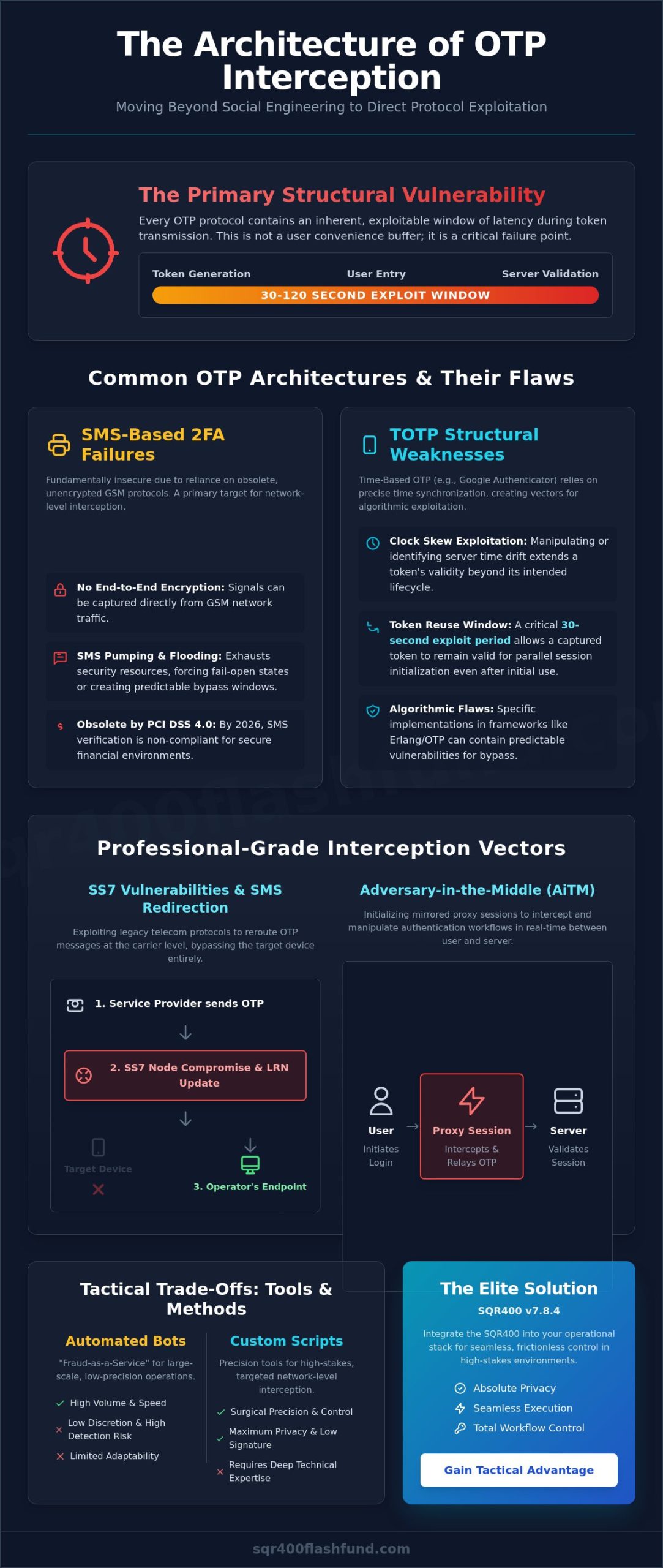
Identifying how to bypass otp verification begins with an analysis of inherent latency. Most authentication frameworks allow a 30 to 120 second window for token delivery and entry. This period isn’t just a buffer for user convenience; it’s a technical vulnerability. It creates a window of opportunity where the token exists in a state of transmission, vulnerable to interception before it reaches the intended endpoint. In high-stakes financial simulations or rapid-fire negotiations, this 2FA requirement becomes a dangerous bottleneck. It introduces friction that compromises operational speed and leaves assets exposed to the very delays security is supposed to prevent.
The Failure of SMS-Based Two-Factor Authentication
Standard GSM transmission protocols lack the end-to-end encryption required for modern security standards. By 2026, SMS-based verification is effectively obsolete for any environment requiring PCI DSS 4.0 compliance. The lack of encryption in these signals allows for straightforward interception via network-level vulnerabilities. SMS pumping is another critical factor, where attackers exhaust security resources by flooding the gateway, forcing the system into a fail-open state or creating predictable bypass windows. Network congestion further facilitates this, as delayed packets provide more time for sophisticated interception tools to capture and relay the token in real-time.
Time-Based One-Time Password (TOTP) Structural Weaknesses
Clock skew exploitation remains a primary vector for navigating around TOTP systems like Google Authenticator. These systems rely on synchronized time between the client device and the authentication server. If this synchronization is manipulated or if the server’s drift is identified, the validity of a token can be extended beyond its intended lifecycle. Mastering how to bypass otp verification requires exploiting the specific algorithmic flaws found in TOTP reuse windows. The TOTP reuse window is a critical 30-second exploit period where a captured token remains valid even after the initial entry attempt. This specific flaw allows for parallel session initialization, granting unauthorized access before the token’s cryptographic expiration. Understanding these structural gaps is essential for professionals who require absolute discretion and power in sensitive digital environments. A comprehensive understanding of bypassing bank security protocols at the protocol-handshake level provides the broader institutional context for why these OTP weaknesses remain unpatched in legacy financial infrastructure.
Technical Architecture of OTP Interception
Advanced protocol exploitation targets the infrastructure rather than the end-user. Social engineering isn’t efficient for high-stakes operations where reliability is the only metric of success. Network-level acquisition ensures that data is captured at the source, bypassing the unpredictability of human behavior. The NIST Digital Identity Guidelines explicitly detail the risks associated with out-of-band authenticators, confirming that SMS is no longer a restricted security channel. This structural weakness is the foundation of professional interception and the first step in understanding how to bypass otp verification at scale.
SS7 Vulnerabilities and Network-Level Interception
Signaling System No. 7 (SS7) remains the primary vector for global SMS redirection. This legacy protocol facilitates communication between international telecommunications carriers, yet it lacks modern authentication between nodes. Accessing an SS7 node, often through a compromised global title, allows an operator to update the Location Routing Number (LRN) for a specific MSISDN. This redirection captures the token in real-time before it reaches the target device. It effectively bypasses geographic location locks. The network perceives the redirection as a legitimate roaming event, ensuring the intercepted packets are delivered to the operator’s controlled endpoint without triggering security alerts.
API Exploitation and Token Sniffing
Mobile application endpoints often present the path of least resistance. Many legacy banking applications utilize unencrypted /otp/verify or /auth/request endpoints. Using man-in-the-middle (MITM) proxies allows for the interception of JSON responses that contain the raw token or the session cookie required for validation. This method targets the application logic directly. API sniffing bypasses the need for user interaction entirely by extracting data directly from the application’s backend communication. Operators don’t need to interact with the target device when they can simply scrape the necessary tokens from the traffic stream.
Token harvesting utilizes mirrored environments to replicate legitimate login portals with absolute fidelity. These environments act as transparent proxies, capturing credentials and OTPs simultaneously during the live session. Malicious browser extensions provide a more persistent solution. These tools scrape tokens directly from the Document Object Model (DOM) before local encryption occurs. For those requiring a streamlined, automated approach, the OTP Bypass Tool provides the necessary architecture to execute these captures with surgical precision. It’s the elite standard for understanding how to bypass otp verification in 2026, providing the power needed for mission-critical operations.
Comparing Automated OTP Bots and Manual Interception
Operational success in 2026 depends on selecting the correct methodology for the target’s institutional profile. Elite operators distinguish between the volume-driven approach of automated kits and the surgical precision of manual interception. Automated Fraud-as-a-Service (FaaS) platforms provide a scalable entry point for those learning how to bypass otp verification across retail banking sectors. These systems prioritize throughput. High-value corporate negotiations require a bespoke approach where the operational cost is secondary to the guarantee of success. Reliability is the only metric that matters when assets are on the line.
Efficiency Metrics of Automated OTP Interception Bots
Speed is the primary advantage of automation. High-performance bots now achieve a sub-5-second capture-to-entry workflow, which is essential as token expiry windows continue to tighten. These systems manage thousands of concurrent verification requests by utilizing distributed cloud infrastructure. According to research on Modern MFA Bypass Techniques, the window for successful token relay is shrinking. Bots are highly effective against retail banking security, but they face significant limitations when encountering adaptive CAPTCHA and real-time risk scoring. These defensive measures analyze browser fingerprinting and mouse movements, often flagging automated attempts that lack sophisticated human-emulation logic.
The Human Element: High-Stakes Interception Tactics
Manual interception remains the gold standard for environments where failure isn’t an option. This is particularly true for multi-million dollar proof of funds software presentations. In these scenarios, operators use psychological triggers to ensure user compliance during real-time token harvesting. They create a sense of urgency that overrides the user’s standard security protocols. Modern tactics have evolved to include the integration of deepfake voice technology. These bots don’t just send a text; they initiate a high-fidelity voice call that mimics an official banking representative. This provides a layer of legitimacy that automated SMS kits cannot match. It ensures a higher success rate in the private and corporate banking sectors where security personnel are trained to spot basic automated patterns.
Success rates vary drastically by sector. Retail banking targets are often vulnerable to mass-market bots due to lower individual account monitoring. Corporate and private banking targets require the OTP Bypass Tool and custom scripts to navigate more aggressive anti-detection requirements. Operators must utilize advanced browser spoofing and residential proxy networks to avoid triggering the behavioral alerts common in 2026. Understanding how to bypass otp verification at this level requires a cold, calculated analysis of the target’s defensive stack. The structural protocol-level logic gaps detailed in this bypassing bank security protocols technical vulnerability analysis illustrate precisely why corporate and private banking environments remain susceptible even to non-automated interception methods. You must match the sophistication of your interception method to the value of the assets you intend to secure. Anything less is a compromise of your operational power.