

A balance that looks convincing on a screen isn’t proof that funds are real or available. Bank account flashing software creates simulated financial displays, not independently verifiable evidence, and presenting a simulation as genuine can put a transaction at risk. Credible proof comes from records issued by the financial institution holding the funds and verified through an appropriate process.
It’s understandable to be unsure what a recipient expects, how much account information to share, or whether you can write the letter yourself. You can prepare a clear request or cover note using accurate, authorized details, but your draft isn’t a bank-issued proof-of-funds letter. Only the institution can confirm information it’s authorized to verify.
This guide explains what a legitimate letter can establish, what it can’t, and how to request one with the right details. You’ll learn how to distinguish a draft from official evidence, verify a document’s source, protect sensitive account information, and submit records through secure, appropriate channels.
Key Takeaways
- Identify what proof-of-funds documentation can demonstrate, and why a personal draft cannot verify an account balance.
- Clarify the recipient’s document and date requirements before requesting official evidence.
- Distinguish a personal cover letter from bank-issued records by comparing who creates each document and how it can be verified.
- Use a privacy-conscious checklist to review names, dates, currency, and stated purpose against original records.
- Recognize why bank account flashing software and simulated balances cannot replace independently verifiable financial evidence.
What a proof-of-funds letter establishes, and what it does not
A proof-of-funds letter is documentation intended to show that funds are accessible for a stated purpose, such as supporting a transaction or application. As the overview of Proof of funds (POF) explains, this documentation is used to demonstrate financial capacity in specific contexts. It does not, by itself, guarantee that a transaction will be approved or that funds will remain available indefinitely.
A self-written draft can help explain what information you’re requesting, but it isn’t confirmation issued by a financial institution. The institution holding the funds must provide or authenticate any evidence presented as its own. Because accepted formats and supporting documents depend on the recipient’s requirements, clarify those details before preparing or sending anything.
Simulated displays are not evidence of real, available funds. Bank account flashing software may show a balance visually, but a display or software-generated document cannot establish that funds exist, belong to you, or are accessible. Base your proof on verifiable records, not appearances.
What can count as legitimate proof of funds?
Depending on the recipient, possible evidence may include a letter issued by the financial institution or an official account statement. The document should be current, attributable to the account holder, and verifiable through appropriate institutional channels. A screenshot or personal draft alone may not meet those conditions.
Check what the balance represents. An available account balance is different from a credit limit, a pending transfer, or projected income. Those figures don’t necessarily show funds that are currently accessible. The evidence should accurately reflect the relevant account and the purpose for which it’s being submitted.
Why does a recipient request proof of funds?
A recipient may request financial evidence during a transaction, application, or business review to assess whether funds are available for a stated purpose. Requirements vary, and the recipient may specify an acceptable document type, issue date, currency, or method for verifying the source.
Review the request before sharing sensitive account information. Confirm what details are required, whether a complete account number is necessary, and how the recipient accepts documents. Use a secure submission method and never send credentials or authentication codes. If the requirements are unclear, ask which document types are accepted and whether sensitive fields can be limited without affecting verification.
How to prepare a legitimate proof-of-funds letter request
Start with the recipient’s requirements, not a template. Ask which documents it accepts, how recent they must be, and whether it requires a particular format, currency, or verification method. Getting these details first helps you request relevant evidence without disclosing more than necessary.
Then contact your financial institution through its official website, app, branch, or another secure channel it provides. Request an institution-issued letter or statement that matches the recipient’s stated requirements. Don’t rely on contact details in an unexpected message; access the institution through a channel you already know is genuine.
What information belongs in your cover letter?
Your cover letter provides context. It does not certify a balance held by a bank. Keep it concise and include:
- Your name and the intended recipient.
- The date and the purpose of the request.
- A clear description of the evidence you’re asking the institution to provide.
- Your preferred contact details for follow-up.
For example: “Please provide an official statement or letter suitable for my application to [recipient], covering [date range, if required].” Describe the requested evidence accurately. Don’t claim that you personally verify or certify a bank-held balance. Rocket Mortgage offers an overview of what a proof of funds letter must include, but the recipient’s requirements should guide your request.
Keep passwords, one-time codes, full card numbers, and unnecessary account credentials out of the letter. Share only information needed for the stated purpose, and use the recipient’s secure submission method for supporting records.
What should the financial institution provide?
Ask whether the institution can issue a formal letter or an official account statement that meets the recipient’s requirements. If the recipient specifies a relevant date range or currency, include that in your request. Don’t assume every institution provides the same format or wording.
Once issued, preserve the record as provided. Don’t edit its figures, recreate its layout, or add institutional branding. Changes can undermine its source and make verification difficult. A request for legitimate documentation should never involve bank account flashing software, simulated balances, or software-generated records presented as real evidence.
Before submitting, check the recipient’s name and delivery instructions. Keep a copy of what you sent and note when and how it was submitted. This record supports follow-up while limiting repeated exposure of sensitive information.
Self-written letter vs. bank-issued evidence: know the difference
The distinction is authorship and verification. A personal letter can explain why you’re submitting documents, but it can’t authenticate an account balance. A bank-issued statement or letter comes from the institution responsible for the account, giving the recipient a source it may be able to verify through its stated process.
Can you write the letter yourself?
Yes, if it’s clearly a request or cover note, not a bank certification. State the purpose, identify the recipient, and refer to any attached records accurately. Keep each claim factual and consistent with the authorized documents. For instance, you can write, “Attached is the account statement requested for my application.” Don’t promise that funds will remain available or make claims about a balance beyond what current evidence supports.
A screenshot or simulated banking interface doesn’t become financial evidence because it looks official. Bank account flashing software and software-generated displays cannot verify that funds exist or are accessible. Don’t present them as substitutes for genuine records.
How can a recipient verify submitted evidence?
Follow the recipient’s stated verification process. If independent confirmation is needed, use the institution’s contact details obtained separately from its official website or another trusted channel, rather than relying only on information printed on the document.
A logo, reference number, screenshot, or protocol label may look convincing, but none proves authenticity on its own. Verification depends on the source and the recipient’s process, not visual polish. Submit only through the requested secure channel, and don’t share login credentials or one-time codes during verification.
A practical checklist for accurate, private, and clear documentation
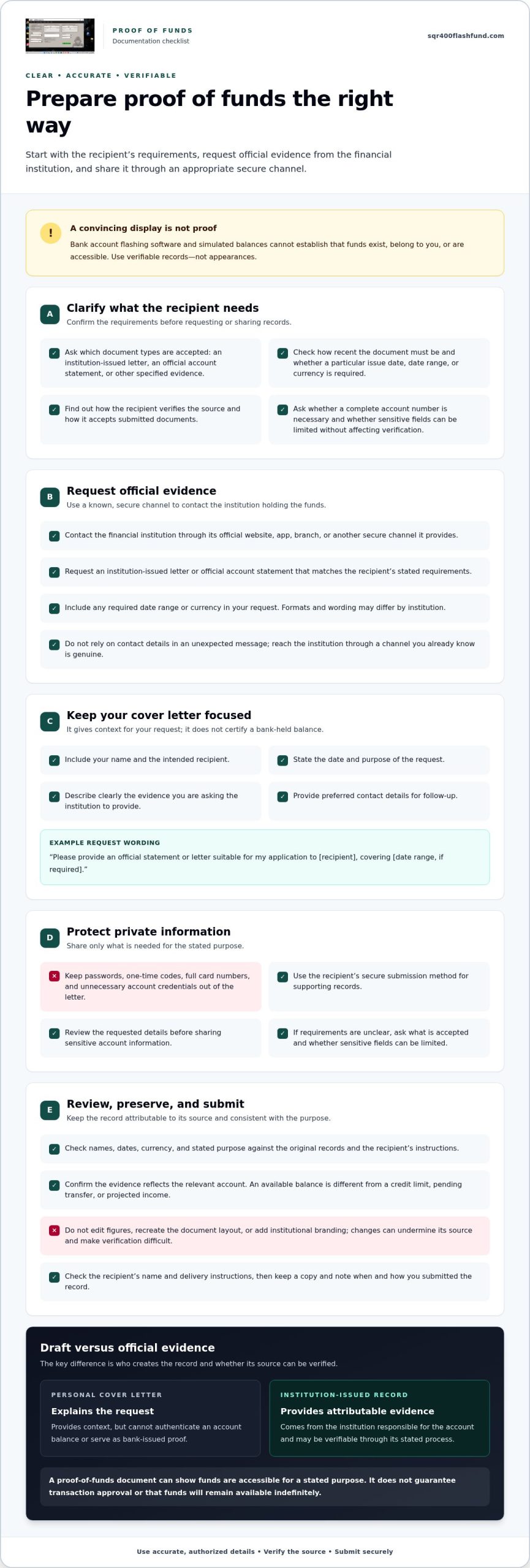
Before requesting or sending financial records, confirm the recipient’s exact requirements. Ask which document types it accepts, how current the records must be, what details need to appear, and how to submit them securely. Requirements differ, so don’t assume a document accepted for one review will meet another’s criteria.
Use this review sequence before submission:
- Confirm the source: Use records issued by the financial institution, not a recreated document or an unsupported personal statement.
- Check key details: Compare the account holder’s name, relevant dates, currency, and stated purpose against the original records and recipient instructions.
- Review completeness: Make sure the document type and date range meet the recipient’s request. Resolve discrepancies with the issuing institution before sending.
- Protect sensitive information: Share only the details required for the review. Redact information only if the recipient permits it, and never change balances, transaction details, or other substantive financial information.
- Use an approved delivery channel: Submit through the recipient’s secure portal or another method it accepts. Avoid public links or broadly shared folders for sensitive files.
- Keep an audit trail: Retain copies of your request and submitted records, along with the date, delivery method, and follow-up communications.
How can you protect account privacy?
Apply data minimization: provide what the recipient needs, not every detail available in your account records. Don’t disclose banking passwords, one-time authentication codes, or remote-access credentials. A legitimate document review should not require access to your online banking session. If a request asks for unusually sensitive information, pause and verify the requirement through a trusted channel before sharing anything.
Check the destination before uploading. Confirm that the portal or delivery address belongs to the intended recipient, and restrict access when the submission method offers that control. Keep your own copy in a secure location.
What common mistakes can delay review?
Outdated or incomplete records, names that don’t match, inconsistent dates, or a format the recipient won’t accept can trigger follow-up. So can relying on a personally written letter to authenticate a bank-held balance. A cover note explains context; it doesn’t replace institution-issued evidence.
Edited screenshots and simulated balances are not substitutes for original financial records. Bank account flashing software may create a convincing-looking display, but appearance cannot establish that funds are real or available. Submit authentic, authorized records and leave their substantive contents unchanged.
What to do next when you need proof of funds
Use a controlled sequence: confirm the recipient’s requirements, request official records from the financial institution, review the documents for accuracy, then submit them through an accepted secure channel. Keep a copy of the request and submission details so you can track follow-up without sending the same sensitive records repeatedly.
- Confirm requirements. Ask the recipient which document types it accepts and whether it has specific date, format, or currency requirements.
- Request official records. Use the financial institution’s official channel and describe the recipient’s stated needs accurately.
- Review before sending. Check names, dates, and other relevant details against the original record. Don’t alter the document to make it appear compliant.
- Submit securely. Use the recipient’s approved delivery method, then record when and how you sent the documents.
If instructions are unclear, ask the recipient directly which document types it accepts and what information must be visible. Avoid guessing. A short clarification can prevent unnecessary disclosure or an avoidable rejection.
What if the recipient rejects your document?
Request a specific explanation: Was the record too old, incomplete, or in an unsuitable format? Ask whether another official document would meet the requirement. If the date or format is the issue, contact the financial institution to request updated or differently formatted evidence. Never edit an issued record, replace its figures, or add institutional branding to make it appear acceptable.
How should you respond to suspicious proof-of-funds requests?
Pause before sharing information or making a payment. Verify the organization and contact person using details you obtain independently from the organization’s official channels. Don’t rely only on a phone number, email address, or link included in an unexpected message.
Don’t pay unexpected processing charges or provide account passwords, one-time codes, or remote-access credentials without independently verifying the request. If it appears fraudulent, contact your financial institution through its official channel and consider reporting it through an appropriate local consumer-protection or institutional reporting channel.
A request involving bank account flashing software, simulated balances, or software-generated financial records should not be treated as a legitimate path to proof of funds. Genuine, independently verifiable documentation keeps decisions grounded in accurate records rather than appearances.
Keep your proof of funds verifiable
A clear request can help you obtain the right documentation, but a personal cover note cannot certify a bank-held balance. Use current records issued by the financial institution, confirm the recipient’s requirements, and submit documents through a secure, accepted channel.
Bank account flashing software and other simulated displays don’t establish that funds are real or available. Rely on institution-issued records and independently verifiable sources instead. Share only the information needed for the review, and pause if a request seems suspicious.
SQR400 Flash Fund develops transaction simulation software and bank account flashing tools, including SQR400 v5.8 Pro. Its simulated financial displays are for visualization, not verification of real balances or a substitute for bank-issued proof. If you need a simulation tool for a clearly identified visualization, explore SQR400 v5.8 Pro and its lifetime license.
For additional safeguards, review the Consumer Financial Protection Bureau’s guidance on recognizing financial fraud. Verify the source of your documents, submit them securely, and share only what the review requires.
Frequently Asked Questions
Can I write a proof-of-funds letter myself?
Yes, you can write a personal cover letter, but it cannot independently verify an account balance. Use it to state your purpose, identify the recipient, and describe the official records you’re providing. Request suitable evidence from your financial institution through its official channel. Keep every statement factual, don’t imitate bank letterhead, and don’t claim that you certify information held by the institution.
What should a proof-of-funds letter include?
First, confirm the recipient’s requirements. Your cover letter can identify you and the recipient, state the purpose and date, and list the official documents attached. Include only accurate details needed for the review. Don’t put passwords, authentication codes, or unnecessary account credentials in the letter. The institution-issued records, not your cover note, should substantiate account information and any balance being presented.
Can I use a bank statement as proof of funds?
A bank statement may be accepted, but acceptance depends on the recipient and the purpose of the review. Before sending one, clarify the required date range, format, account-holder details, and verification process. Obtain the statement directly from your financial institution and preserve its original contents. If privacy is a concern, ask the recipient whether limited disclosure or another official document is acceptable.
How recent does a proof-of-funds letter need to be?
There is no single age requirement for every recipient or transaction. The recipient may specify an issue date or statement period, so ask before requesting records. This helps you obtain evidence suited to the review instead of submitting a document that may be considered outdated. Never change a date on an existing record. If it’s too old, request updated evidence from the issuing institution.
Can a screenshot or simulated balance prove funds are available?
No. A screenshot or software-generated display doesn’t independently establish that funds exist, are accessible, or have been verified by a financial institution. Bank account flashing software may show a simulated balance, but that display isn’t genuine financial evidence. Request original records through authorized channels and follow the recipient’s verification process. Presenting a simulation as a real bank balance can mislead the recipient and create serious risks.
How can I send proof of funds without exposing sensitive information?
Ask the recipient which details it needs and which secure delivery method it accepts. Share only the necessary records, and avoid public file links. Never provide banking passwords, one-time codes, or remote-access credentials to submit financial evidence. Don’t alter substantive information in a statement. If you’re unsure whether redaction is permitted, ask the recipient about an approved alternative before sending the document.
What should I do if someone asks for a proof-of-funds letter urgently?
Verify the request independently before sharing documents. Look up the organization’s official contact details yourself, then confirm the contact person, requested document, purpose, and verification method. Urgency alone doesn’t establish that a request is genuine. Pause if you’re pressured to pay unexpected charges, bypass safeguards, or disclose credentials. Submit authentic records only through a secure channel you’ve verified with the recipient.