

A proof-of-funds document can look polished and still prove nothing. So, what do banks look for in proof of funds? They assess whether the evidence is authentic, tied to the named account holder, and shows money available for the transaction. A screenshot or balance visualization alone cannot establish those facts. Credible proof comes from financial institution records that can be verified through an appropriate channel.
It’s reasonable to question whether a statement is current, altered, or shows assets that aren’t readily accessible. Banks and transaction recipients may request different evidence, so no single format guarantees acceptance. Common records include official bank statements and letters issued by a financial institution, with account and balance information that can be verified through an appropriate bank channel.
This guide explains what credible evidence generally demonstrates, how to verify it using contact details obtained independently, and how to share only the financial information relevant to the request. The distinction matters: owning assets isn’t always the same as having funds available now. Use institution-issued evidence, follow the recipient’s instructions, and protect sensitive account data throughout the process.
Key Takeaways
- Understand what banks look for in proof of funds and why the evidence should match the request’s purpose.
- Review a document’s issuer, date, currency, and account-holder details before relying on it.
- Compare what bank statements, bank letters, screenshots, and wealth dashboards can actually demonstrate.
- Follow a clear process: clarify the request, obtain and verify evidence, then share only what’s needed.
- If a record can’t be independently verified, pause and clarify acceptable alternatives before treating it as proof.
What Banks Look for in Proof of Funds: Authenticity, Ownership, and Availability
Proof of funds is evidence intended to show that financial resources exist for a stated purpose, such as completing a purchase or meeting a financial obligation. A useful starting point is the general definition of proof of funds as evidence of an individual’s or company’s financial ability to complete a transaction or meet a future liability. Exact document requirements vary by bank, transaction, and jurisdiction, so the receiving institution’s instructions control.
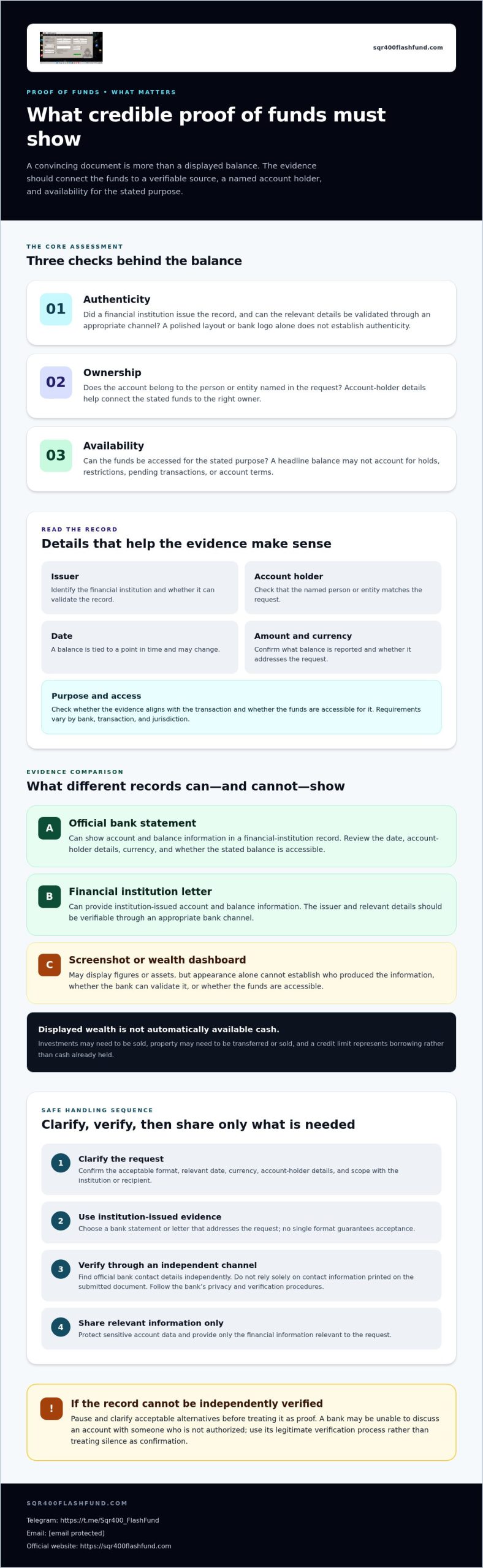
What do banks look for in proof of funds? The assessment usually involves several questions, not just a visual check. Is the evidence authentic? Does the account belong to the person or entity named? What balance does it report, in which currency, and as of what date? Can the funds be accessed for the stated purpose? A document may answer one question without resolving the others.
A displayed balance is not the same as confirmation from its bank. A formatted dashboard or captured screen may show figures, but appearance alone cannot establish who produced them or whether the issuer can validate them. Treat visual presentation separately from institution-originated evidence. Verification depends on the record’s source and the bank’s ability to confirm relevant details through an appropriate channel.
What does credible proof of funds need to establish?
Credible evidence should connect the stated funds to an identifiable account holder and indicate the amount and currency being represented. The date matters because a balance can change. Account details help distinguish one account from another, while the issuer’s identity provides a route for validation. A reviewer may also consider whether the evidence aligns with the transaction’s stated purpose. A logo, letterhead, or polished layout does not prove authenticity by itself.
Why do banks distinguish available funds from displayed wealth?
Displayed wealth may include investments, property, credit facilities, or projected proceeds. These are not automatically liquid cash available for a transaction. Shares or other investments may need to be sold, property may need to be transferred or sold, and a credit limit represents borrowing rather than cash already held. Even a reported deposit balance may be affected by restrictions, pending transactions, or account terms. Availability needs to be assessed separately from the headline figure.
For example, an account statement might show a balance while some funds are subject to a hold or other restriction. A portfolio dashboard may show valuable assets without demonstrating that funds have been converted and are accessible. Neither example determines what a particular bank will accept. Confirm the required format, relevant date, currency, account-holder details, and scope with the institution or transaction recipient. This helps distinguish evidence of assets from evidence of usable funds without assuming a universal threshold or document standard.
How Banks Assess the Source and Authenticity of Proof of Funds
After identifying what a record claims to show, a reviewer may assess who issued it and whether that source can validate it. Checks differ by institution, transaction, and jurisdiction. There is no single verification sequence that applies to every bank. The objective is to establish whether the submitted information has a reliable origin and is consistent with the request.
A bank-confirmed record has a verifiable source; an unverified copy is only a representation of one. A document can be genuine yet insufficient for a particular purpose. An image that looks official does not establish that a bank issued or currently stands behind it. That distinction is central to evaluating what do banks look for in proof of funds.
How can a recipient verify the issuing source?
Use official bank contact details obtained independently, such as information published through the institution’s own website or other established official materials. Don’t rely solely on a phone number, email address, or link printed on the submitted document. Contact the bank through an independently sourced channel and ask what validation it can provide, while respecting its privacy and disclosure procedures.
The bank may be unable to discuss an account with someone who is not authorized. In that case, follow the bank’s legitimate process for verification rather than treating silence or an unanswered message as confirmation. Compare the issuer identity, account-holder name, and stated purpose with the request. A mismatch may need clarification, but does not by itself establish that a document is inauthentic.
What can make otherwise genuine evidence insufficient?
A real statement may still be too old, incomplete, difficult to read, or unrelated to the named account holder or transaction. It may also show a balance at a particular point in time without establishing that the same amount remains accessible. These are possible limitations, not automatic rejection rules. Whether an issue matters depends on the recipient’s requirements and the circumstances of the transaction.
Review the evidence for consistency before relying on it. A statement in one currency may not directly answer a request framed in another. A document showing an individual’s account may not establish that funds belong to a company named in the transaction. Likewise, a record that omits relevant account-holder information may leave ownership unclear. Ask the requesting institution which detail is missing and what alternatives it accepts.
Keep verification separate from presentation. A dashboard or software-generated visualization can display financial information, but it is not a bank-issued confirmation and should not be represented as one. SQR400 Flash Fund offers financial transaction and balance visualization software. Its visualizations are simulations, not bank-issued records, and do not verify funds with a bank. Learn more at SQR400 Flash Fund’s official website.
Bank Statements, Letters, and Dashboards: What Each Can Actually Show
Document format affects what a reviewer can assess, but it does not determine acceptance by itself. A bank statement, bank letter, screenshot, and wealth dashboard have different sources and evidentiary limits. None is automatically sufficient. The requesting institution sets the applicable criteria, so use this comparison to understand what each format may show, not as a substitute for its instructions.
| Format | Issuer and date | Ownership and availability | Independent verifiability |
|---|---|---|---|
| Bank-issued statement | Produced by a bank for a stated account and period | May identify an account holder and report a balance; doesn’t by itself establish current access | The issuing bank may be able to validate it through an appropriate channel |
| Bank letter | Issued by a financial institution, with details and date depending on the letter | May confirm specified account or balance information; scope varies | Can be checked with the named issuer, subject to its procedures |
| Screenshot | Captured from a screen; source and capture date may be unclear | May display account details or a balance, but doesn’t independently establish ownership or availability | Limited unless the underlying information is validated through its issuer |
| Wealth dashboard | Displayed by an aggregation or financial tracking platform | May summarize assets across accounts; doesn’t necessarily show liquid funds available for a transaction | Doesn’t itself equal confirmation from each financial institution |
What information may a bank statement demonstrate?
A statement can record account activity and a balance for a particular period. Its value depends on context: it may show what the account reported at that time, but it doesn’t automatically establish the present balance or prove that funds remain accessible. Banks vary in their document formats and the information they display, so don’t treat any particular field or layout as a universal requirement.
For example, a statement covering an earlier period may be genuine but no longer answer a request about funds available now. Depending on the transaction, the recipient may need a different or more current form of evidence. Confirm the accepted format and scope with the requesting institution rather than assuming a statement alone will meet its criteria.
Why are screenshots and dashboards limited as evidence?
A screen capture can lack issuer confirmation, a clear date, or details tying the display to the specific transaction. A wealth dashboard may organize asset information across sources, but aggregation is not the same as a bank confirming an account balance. Simulated or altered displays are not authentic bank-issued proof, regardless of how convincing they appear.
That distinction matters when considering what do banks look for in proof of funds: they assess evidence in relation to its source and purpose, not merely its visual polish. Formats aren’t interchangeable. A letter might address a specific confirmation request, while a statement records account activity. A dashboard can provide an overview without establishing that funds are immediately available. Ask the recipient which evidence it accepts and whether it needs issuer verification. Submit the original, legitimate record through the requested secure channel, and never present a visualization as bank-issued documentation.
How to Handle a Proof-of-Funds Request Safely
A controlled process protects both the accuracy of the evidence and the account holder’s privacy. Before sending records, establish who is requesting them, which transaction they relate to, what format is acceptable, and how the information will be handled. The answer to what do banks look for in proof of funds depends on the specific request, so don’t send a broad set of financial records when narrower evidence may be enough.
What should you clarify before sharing financial records?
Confirm the requesting party and transaction purpose through a channel you already trust. Ask which evidence formats it accepts, what date range is relevant, and whether specific details may be redacted without making the record unacceptable. Never provide online banking passwords, one-time codes, or account access as a substitute for legitimate documentation.
Use this sequence:
- Clarify the request. Identify the recipient, purpose, accepted evidence, relevant date range, and any limits on redaction.
- Obtain issuer evidence. Request the appropriate record through the financial institution’s official website, app, branch, or another established channel.
- Verify the source. If confirmation is needed, contact the institution using independently obtained official details. Don’t rely only on contact information printed on the submitted document.
- Share securely. Use the recipient’s designated secure document-transfer method. Disclose only information relevant to the request, where permitted, and keep a record of what you sent and when.
Redaction requires care. Removing unrelated transaction details can reduce unnecessary disclosure, but concealing information the recipient needs may make the evidence unusable or raise questions. Get the recipient’s guidance first. Keep an unaltered copy of the original record for your own records, and never edit a document in a way that changes the information it represents.
How should you respond to doubts or inconsistent details?
Pause before relying on a record if names, dates, currency, or account details conflict with the request. Verify the issuer through an official channel, then clarify the discrepancy with the requesting institution. If its criteria call for updated, bank-originated evidence, obtain that evidence directly through the issuer’s legitimate process rather than trying to resolve the gap with a screen capture or recreated visual.
Maintain a concise audit trail: note the request, the recipient, the evidence format supplied, and any follow-up. Store that record securely, and avoid forwarding financial documents through unrelated channels or to people who don’t need them. If verification can’t be completed, ask the recipient what acceptable next step applies. Don’t describe an unverified record as confirmed proof.
SQR400 Flash Fund’s financial transaction and balance visualization software can present simulated financial information, but it is not bank-issued proof and does not verify funds. Visit SQR400 Flash Fund’s website to learn about the software and its licensing options.
When Proof of Funds Cannot Be Independently Verified
If a bank or other relevant issuer can’t validate a submitted record, treat the funds as unconfirmed, not as established available funds. That conclusion is limited: an unsuccessful verification attempt doesn’t, by itself, prove that a document is fraudulent. It means the evidence has not yet been independently substantiated. Pause decisions that depend on it until the issuer and the parties clarify what the record can demonstrate.
When should a transaction participant pause?
Pause if account-holder details conflict with the named party, dates or amounts appear inconsistent, key information is unclear, or the stated issuer can’t validate the record through an appropriate channel. These are reasons to seek clarification, not grounds to label a document fraudulent without reliable verification. Avoid making a transaction decision based on an unconfirmed balance while the relevant institution or parties resolve the discrepancy.
Use proportionate next steps:
- Pause reliance. Don’t treat the record as confirmed proof or proceed on the assumption that funds are available.
- Contact the issuer independently. Use official contact details obtained separately from the submitted document, and follow the institution’s process for validation.
- Clarify the evidence gap. Ask the issuer or requesting party what can be confirmed and what information remains unresolved.
- Discuss acceptable alternatives. Ask the relevant bank or transaction professional what other legitimate, issuer-originated evidence may meet the request.
How can legitimate financial information be shared more carefully?
Authenticity and privacy can be addressed together. Send records only through the bank’s official secure channel or a protected transfer method approved by the recipient. Limit access to people with a legitimate role in the request. Where permitted, disclose only the details needed for that purpose, and ask which unrelated information can be withheld without undermining the evidence.
Don’t send banking passwords, one-time codes, or account access to establish a balance. Don’t replace missing verification with a simulated display, edited image, or other visual representation; none is bank-issued proof. If the receiving party needs direct confirmation, use the issuer’s legitimate procedure and share only what that process requires.
Keep a minimal record of the request, the steps taken to verify the issuer, and any guidance received. Store it securely, and don’t circulate sensitive attachments more widely than necessary. If the record remains unverifiable, ask the relevant bank or transaction professional to explain the acceptable next step before relying on it. That approach preserves financial privacy while keeping the evidence standard clear: uncertainty is not confirmation.
Make Your Next Verification Step Deliberate
Before sending financial records, ask the institution requesting them to state its accepted format and verification process. The key question, what do banks look for in proof of funds, is answered by the specific transaction requirements, not a document’s appearance alone. Use the bank’s official channel for that guidance, and limit sensitive account information to what the request requires.
SQR400 Flash Fund offers financial transaction and balance visualization software. These visualizations are simulations, not bank-issued proof, and they do not verify funds. Keep that distinction clear when preparing your response. Visit the official website to learn more about the software.
Explore the software: Visit SQR400 Flash Fund’s website, or send software questions via Telegram or email. For proof-of-funds requirements, rely on the relevant bank’s official instructions and use legitimate, verifiable records.
Frequently Asked Questions
What do banks look for in proof of funds?
Reviewers may assess whether the record comes from an identifiable financial institution, matches the account holder and stated purpose, and reports a relevant balance, date, and currency. What do banks look for in proof of funds can vary with the transaction, so no checklist guarantees acceptance. For a business purchase, clarify whether the requested evidence should identify the business, an individual, or both before requesting documentation.
Can a screenshot count as proof of funds?
A screenshot may help show what appeared on a screen, but it shouldn’t be treated as conclusive evidence by itself. For example, it might help a recipient identify a discrepancy to resolve, but it doesn’t establish that the bank issued or still confirms the information. Ask the requesting institution whether it accepts a screen capture or requires a record delivered or validated through a bank channel.
How recent does proof of funds need to be?
There’s no single freshness period that applies to every request. The recipient may specify a date range or ask for evidence that reflects the relevant point in the transaction. A statement prepared before a large withdrawal, for example, may no longer represent the current situation. Ask for the required date range before obtaining documents, and make sure the record’s issue date or covered period is visible.
Is a bank statement the same as proof of available funds?
Not necessarily. A statement records account information for a period, but it may not address a later request about access to funds. For instance, a transaction could be pending after the statement period ends. Ask the recipient whether the statement answers its specific question or whether it needs separate confirmation. Don’t assume a reported balance alone resolves questions about the timing or availability of funds.
Can a wealth dashboard or investment portfolio prove funds to a bank?
A dashboard can organize financial data, but it may combine account balances with investments or other assets that aren’t immediately accessible. A portfolio valuation, for example, doesn’t establish that sale proceeds have settled into an account. Ask the recipient which evidence it accepts for the particular request. Simulated displays aren’t bank-issued proof. Questions about SQR400 Flash Fund software can be sent via Telegram or email; these contacts don’t verify funds.
What should I do if someone sends proof of funds I cannot verify?
Don’t make a decision that depends on the claimed funds until the source is clarified. Preserve the original message and document, avoid forwarding them widely, and contact the purported issuer using independently obtained official details. A failed verification attempt doesn’t alone prove fraud, but it leaves the claim unconfirmed. Ask the sender and recipient what legitimate alternative evidence could resolve the issue, and keep the discussion on an appropriate channel.
Should I share my full bank account details when providing proof of funds?
Share only the details required for the stated purpose, and use a transfer method approved by the recipient. Before redacting information, ask whether the change would make the document unacceptable; keep a complete original securely for your own records. Never disclose a banking password, login credential, or one-time code to prove a balance. If the request asks for account access, contact your bank through an official channel before responding.