


A low fee does not make a flash-fund transaction ethical. In blockchain lending, a flash loan must be repaid within the same block or the transaction is canceled, and it requires no collateral. The ethical considerations of using flash funds go beyond whether a transaction succeeds: borrowing limits, fees, risk, and transparency all matter.
It’s reasonable to focus on the immediate cost and potential gain, especially when pursuing a defined financial goal. But a sound decision also accounts for who bears the risk, whether the transaction’s purpose and costs are clearly disclosed, and whether the borrowing limit discourages harmful or manipulative use. This article explains how those factors interact, what transparent reporting should communicate, and how U.S. rules may affect promotions. The result is a practical framework for assessing flash-fund decisions without confusing technical execution with ethical judgment.
Key Takeaways
- Judge a flash-fund transaction by its purpose, risk allocation, and transparency, not by its potential return alone.
- Compare borrowing limits and transaction fees with the intended goal; both can influence whether the decision is proportionate and responsible.
- Look for clear disclosures explaining costs, transaction failure conditions, and how funds are used.
- For U.S. promotions, distinguish general product claims from claims that could imply a regulated financial offering, and assess the applicable rules carefully.
- Remember that the Internal Revenue Service requires disclosure for quid pro quo contributions of $75 or more when a donor receives something of value in return.
What disclosures and transparency should flash fund providers offer?
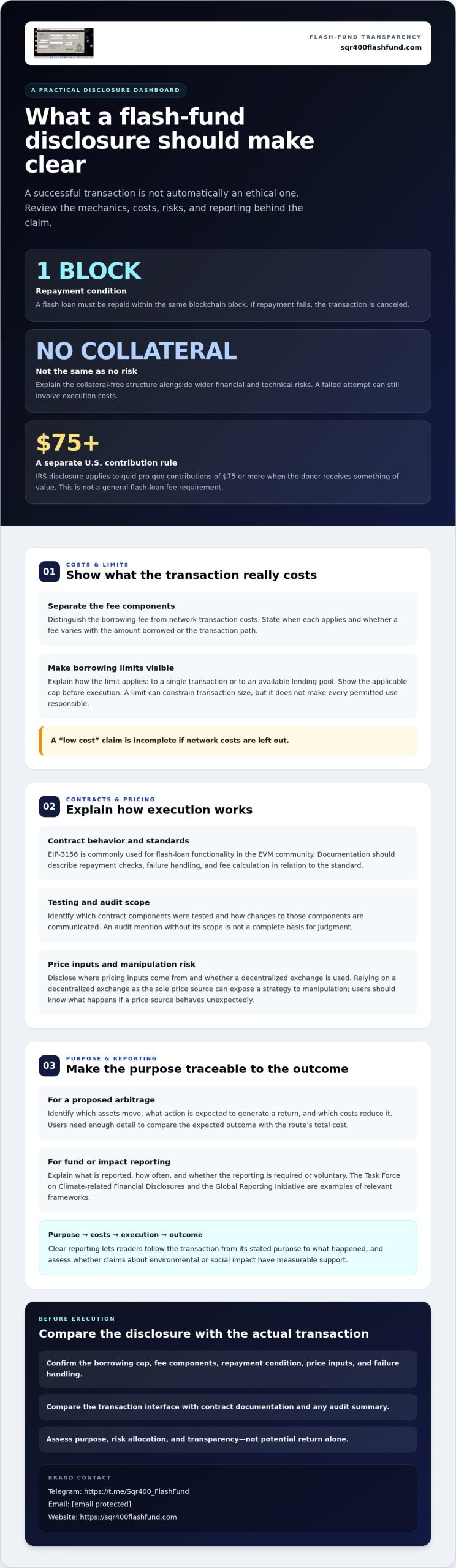
Transparent disclosures about flash funds should let readers trace a transaction from its stated purpose to its outcome. A provider should explain the borrowing limit, transaction fee, repayment condition, and consequences of failure in plain language. For example, someone evaluating a proposed arbitrage should be able to identify which assets move, what action is expected to generate a return, and which costs reduce it. These details help users judge whether a transaction serves their goal or creates avoidable harm.
Start with the mechanics. A flash loan must be repaid within the same blockchain block; if repayment fails, the transaction is canceled. It requires no collateral. These features should be explained together, not presented as proof that a transaction is risk-free. A failed attempt can still involve execution costs, and a successful one can affect other participants. Clear disclosures distinguish repayment mechanics from wider financial and technical risks.
Fees also need precise explanation. Disclosures should distinguish the borrowing fee from network transaction costs and state when each applies. They should also explain whether a fee varies with the amount borrowed or the transaction path. Someone comparing two possible routes needs to understand each route’s total cost before assessing its expected outcome. Calling a fee “small” without explaining its role does not provide enough information.
Borrowing limits carry ethical weight. A stated limit can constrain transaction size and reduce the potential scale of abusive activity, but it does not make every permitted use responsible. Providers should explain how the limit applies, whether it concerns a single transaction or an available lending pool, and how users can see the applicable cap before execution. Clear limits help users judge whether a proposed transaction is proportionate to its purpose.
Technical disclosures should identify the relevant contract behavior and standards. In the EVM community, EIP-3156 is commonly used for flash-loan functionality. Users benefit when documentation explains the contract’s repayment checks, failure handling, and fee calculation in relation to that standard. A provider should also describe testing and audit practices in specific terms. For example, documentation can identify which contract components were tested and how changes to those components are communicated.
Price information requires particular care. A flash-loan strategy that relies on an exchange price can expose users and other market participants to manipulation. Providers should disclose how pricing inputs are obtained and whether the protocol relies on a decentralized exchange for price information. Avoiding reliance on a decentralized exchange as the sole price source is a recognized defense against oracle manipulation. Users need to know which price source informs execution and what happens if that source behaves unexpectedly.
Reporting can also extend beyond individual transactions. Ethical investors should understand what a fund reports, how often it reports, and whether it follows a recognized framework. The Task Force on Climate-related Financial Disclosures and the Global Reporting Initiative are examples of frameworks relevant to transparency. Providers should distinguish required disclosures from voluntary reporting and explain what each report covers. This helps readers assess whether environmental or social claims have measurable support.
Do not confuse blockchain lending disclosures with charitable contribution rules. In the United States, Internal Revenue Service rules require disclosure for quid pro quo contributions of $75 or more when a donor receives something of value in return. That rule concerns contributions and donor disclosures, not a general flash-loan fee requirement. Keeping the categories separate prevents users from treating a donation rule as proof of a lending provider’s compliance.
For a practical review, compare the published terms with the transaction interface before execution. Confirm the borrowing cap, fee components, repayment condition, price inputs, and what happens if the transaction fails. Then compare the interface with contract documentation and any audit summary. If a promotion says “low cost” but omits network costs, or mentions an audit without describing its scope, it does not yet provide a complete basis for judgment. This comparison makes the ethical considerations of using flash funds practical rather than abstract.
Ethical investors should understand fund reporting and disclosure requirements, including mandatory and voluntary standards such as the Task Force on Climate-related Financial Disclosures and the Global Reporting Initiative. This helps them compare reported impacts with a provider’s stated purpose and judge whether disclosures support informed decisions.
How do U.S. consumer-protection and securities rules apply to flash fund promotions?
A promotion’s label does not settle how a financial product should be understood. In 2025, flash loans remained in a regulatory grey zone, and most jurisdictions had not defined how atomic, uncollateralized lending fits existing financial laws. For U.S. readers, the practical point is to assess the transaction’s structure and the claims made about it. Calling an offer a “flash fund” does not explain its terms, risks, or regulatory treatment.
Messages aimed at consumers should distinguish documented features from expected outcomes. “Repayment occurs within one blockchain block” describes a transaction mechanism. A claim that a user will earn a return describes an outcome that depends on execution conditions and market behavior. Promotions should not present a possible result as assured or imply that technical execution removes financial risk. An arbitrage example, for instance, should identify its assumptions about price, liquidity, and transaction costs.
Review the entire message, not just its headline. A prominent promise of rapid profit can create a different impression from risk language buried below it. Ethical review considers the headline, graphics, examples, and terms together. If a promotion illustrates a transaction, it should label the example as hypothetical and explain the assumptions behind the result. Readers should be able to distinguish an illustration from evidence of typical performance.
Securities analysis requires attention to what a promotion offers and what rights a purchaser receives. Relevant questions include whether funds are pooled, whether purchasers receive an ownership or repayment interest, and whether returns depend on another party’s managerial work. These are factors to analyze, not a shortcut to a legal classification. A software demonstration, a lending arrangement, and an investment solicitation can create materially different expectations, even when all use blockchain terminology.
The U.S. Securities and Exchange Commission is one example of an oversight body relevant to investors assessing jurisdictional frameworks. The European Securities and Markets Authority is another, but its role concerns a different jurisdiction. A promotion reaching people across borders should not imply that one regulator’s presence establishes universal approval. Readers should consider where an offer is directed, what activity it describes, and which legal framework may apply.
Promotional materials should make the relationship between software, funds, and outcomes explicit. If a product simulates a transaction, say so. If a promotion describes actual lending, explain the transaction flow and who controls each stage. Avoid imagery or terminology that could make a simulated balance look like money available for withdrawal. For example, clearly identify a displayed account balance as illustrative when it does not represent funds the user can access.
Performance and security claims need evidence. A promotion describing audited contracts should identify the audit’s scope and the contract version it covered. A general security label does not tell readers what was tested. Claims about supported protocols should also name them accurately and explain their relevance to the advertised function. Protocol compatibility does not establish bank approval, regulatory authorization, or guaranteed transaction completion.
Before relying on a promotion, compare its claims with the transaction terms and technical documentation. Separate confirmed features from projections, then examine the stated fees, failure conditions, and each party’s responsibilities. Keep dated copies of the promotion and terms if you may need to compare them later. A record can help clarify whether a dispute concerns a changed offer, an omitted condition, or an assumption the original message did not support.
The ethical considerations of using flash funds include how promotional language shapes decisions, not only whether a transaction executes. Clear distinctions between software, lending, and investment claims help readers assess an offer without mistaking a demonstration for an available financial return. Strong promotions state what the system does, identify material limitations, and avoid implying that oversight in one jurisdiction automatically applies elsewhere.
Ethical investors should learn which regulatory framework and oversight apply in their jurisdiction, including the roles of bodies such as the U.S. Securities and Exchange Commission or the European Securities and Markets Authority. This jurisdictional focus helps investors identify the relevant framework before relying on claims, rather than treating oversight as interchangeable across borders.
SQR400 Flash Fund: SQR400 v5.8 Pro
SQR400 Flash Fund and SQR400 v5.8 Pro are relevant only to readers assessing transaction-simulation software. Keep any simulation within an authorized, controlled environment, and never present simulated balances or transaction records as real funds or completed transfers. This distinction protects users from misleading claims and helps separate technical demonstrations from financial activity.
Before using transaction-related software, define its permitted purpose, access controls, and boundaries. Do not use tools to bypass authentication, alter account records, or mislead a financial institution or another person. For legitimate analysis, focus on transparent demonstrations and accurate documentation, not claims of real-world financial outcomes.
For information about SQR400 v5.8 Pro, visit the official software website.
Make Your Next Decision Deliberate
The ethical considerations of using flash funds matter at every stage, from evaluating a promotion to setting transaction boundaries. Make transparency an operating standard: clarify the intended use, distinguish simulations from real financial activity, and avoid claims that could mislead others. A disciplined approach supports sound decisions and keeps technical capabilities within responsible limits.
For readers assessing software options, SQR400 Flash Fund offers SQR400 v5.8 Pro, SQR400 v5.8 Lite, and SQR400 v7.8.4. Review the available information and consider which offering aligns with your legitimate requirements.
Explore SQR400 Flash Fund software information, or contact the team through Telegram at https://t.me/Sqr400_FlashFund or by email at support@sqr400flashfund.com. Continue with a clear purpose and make each next step an informed one.
Frequently Asked Questions
What steps can users take to evaluate a flash fund offer and protect themselves?
Pause before sharing credentials, connecting a wallet, or installing software. Independently inspect the transaction record on the relevant blockchain explorer, and confirm that any displayed balance corresponds to assets you control. Treat requests for extra payments to unlock supposed funds as a serious warning sign. Keep demonstrations separate from real financial records, and never present simulated balances as proof of actual funds. These safeguards put the ethical considerations of using flash funds into practice by limiting exposure and preventing misrepresentation.