


A realistic bank exercise should test judgment without exposing live accounts or payment channels. A bank-to-bank communication simulation uses fictional institutions, controlled scenarios, and an approved training environment to examine how teams coordinate decisions and escalate issues. Management-level exercises also test leadership priorities, governance, and cross-functional decision-making.
Effective simulations have clear objectives, defined participant roles, and a debrief that turns observations into practical improvements. Bank teams also need to know who should take part and what shapes the budget, from scenario complexity to delivery format and facilitation needs. This article explains how to structure an exercise, select participants, and plan costs without using live transaction data. It also distinguishes communication and decision-making practice from real banking activity, keeping the exercise controlled and focused on team performance.
Key Takeaways
- Match participants to the exercise objective, bringing operational teams into workflow tests and leadership into governance and decision-making scenarios.
- Choose messaging standards and payment rails that reflect the scenario, then define which message flows and responses the simulation needs to represent.
- Assess platforms by their ability to support the required message formats, controlled scenarios and review of team actions.
- Plan the environment around fictional data, defined roles and controlled access to keep exercises separate from live banking activity.
- Build test cases around routine processing, exceptions, delays and escalation so teams can practise decisions as well as message handling.
Participant profiles and budgets
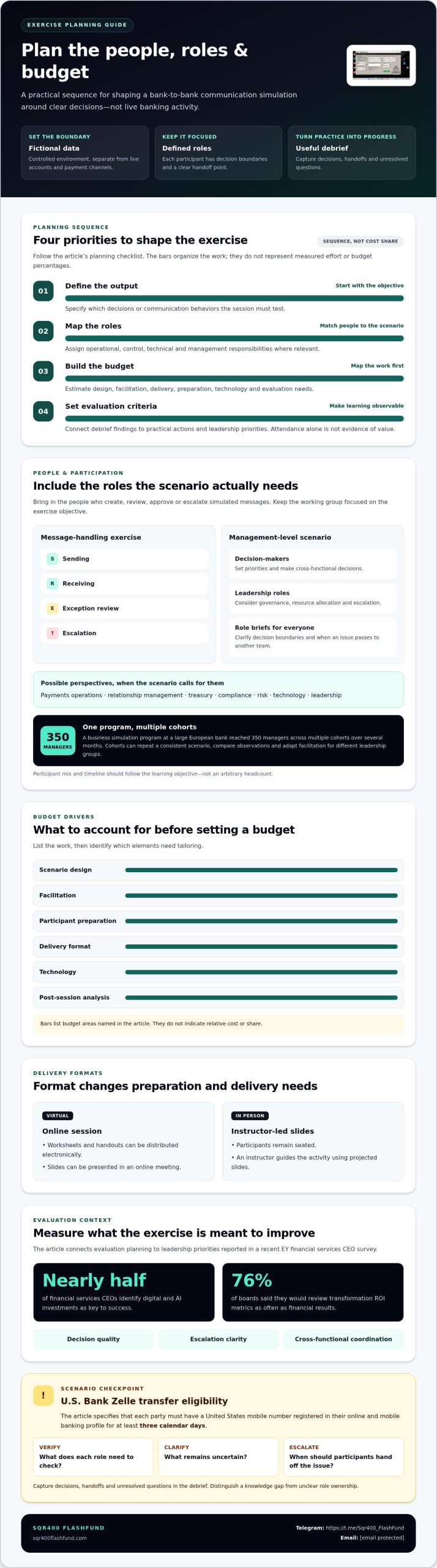
A bank-to-bank communication simulation works best when every participant has a defined decision-making role. Match attendance to the exercise objective, then include the people who create, review, approve, or escalate simulated messages. A payments operations analyst can trace processing steps, while a relationship manager can represent client communication. Treasury, compliance, risk, technology, and leadership roles can add perspective when the scenario calls for them.
Keep the working group focused. For a message-handling exercise, assign participants to sending, receiving, exception review, and escalation roles. For a management-level scenario, include decision-makers who set priorities and allocate resources. Give each participant a role brief, clear decision boundaries, and a defined point for handing an issue to another team. This structure reveals unclear ownership without turning the session into an open-ended discussion.
Scale participation according to the intended outcome. A business simulation program at a large European bank reached 350 managers across multiple cohorts over several months. That model shows how a program can extend beyond one workshop: use cohorts to repeat a consistent scenario, compare observations, and adapt facilitation for different leadership groups. The timeline and participant mix should follow the learning objective, not an arbitrary headcount.
Map the work before setting the budget. List scenario design, facilitation, participant preparation, delivery format, technology, and post-session analysis, then identify which elements need tailoring. A virtual exercise can distribute worksheets and handouts electronically and present slides in an online meeting. In an in-person slide format, participants remain seated while an instructor guides the activity using projected slides. Each format has different preparation and delivery requirements.
Management budgets also need an evaluation plan. A recent EY financial services CEO survey reported that nearly half of financial services CEOs identify digital and AI investments as key to success. In the cited survey, 76% of boards said they would review transformation ROI metrics as often as financial results. Use those priorities to define what the exercise should measure, such as decision quality, escalation clarity, or coordination across functions. Don’t treat attendance alone as evidence of value.
- Define the output: Specify the decisions or communication behaviors the session must test.
- Map the roles: Assign operational, control, technical, and management responsibilities to the scenario.
- Build the budget: Estimate design, facilitation, delivery, preparation, and evaluation needs.
- Set evaluation criteria: Connect debrief findings to observable actions and leadership priorities.
For a scenario involving U.S. Bank Zelle transfers, make participant eligibility a defined checkpoint: each party must have a United States mobile number registered in their online and mobile banking profile for at least three calendar days. Ask the sending and receiving roles to identify what they need to verify, what remains uncertain, and when to escalate rather than assume a transfer can proceed.
Build this checkpoint into the scenario and participant preparation, and allow facilitators time to observe whether participants distinguish eligibility checks from message handling. Capture decisions, handoffs, and unresolved questions in the debrief. Evaluators can then compare these observations with the exercise objectives and distinguish a knowledge gap from unclear role ownership. Keep supporting materials concise and aligned with the session’s decision boundaries.
What protocols are used for bank-to-bank communication simulations, such as SWIFT, ISO 20022, and Fedwire?
Choose the messaging standard or payment rail that matches the scenario. SWIFT supports financial messaging between institutions, while ISO 20022 defines a structured financial messaging standard. Fedwire Funds Service is a U.S. funds-transfer system, not simply another message format. A simulation should represent the relevant message exchange and distinguish it from the payment system processing or settlement activity.
SWIFT scenarios can model how institutions exchange messages and handle responses. For example, a test may represent an MT103 message, then trace how staff review, route, and escalate it. The exercise should define the message’s fictional participants, purpose, and expected handling. Avoid treating a message identifier as proof that funds moved. A communication exercise examines information flow and decisions, not the completion of a real transaction.
ISO 20022 scenarios focus on structured financial information. Teams can practise reviewing message fields, identifying missing or inconsistent data, and deciding which role handles an exception. Use fictional records and specify the expected action at each handoff. For instance, a receiving team could identify a mismatched party detail, pause the simulated workflow, and route the issue to a designated reviewer. The learning objective is consistent interpretation, not live processing.
For Fedwire-related exercises, model the U.S. payment workflow separately from its operational communications. Define what participants receive, what decisions they must make, and what response the scenario expects. Keep the exercise in a controlled test setting, and never connect a practice message to a live payment channel. If the scenario involves both messaging standards and payment rails, document which part represents each function before the session.
- Select the scope: Identify whether the exercise tests message interpretation, payment workflow, or coordination between them.
- Specify the format: Name the standard or rail, such as SWIFT, ISO 20022, or Fedwire Funds Service.
- Map message steps: Record the sender, recipient, review point, exception path, and expected response.
- Use fictional examples: Create safe sample messages and define how participants should handle each one.
Protocol names alone don’t define a useful exercise. A team testing SWIFT MT103, MT760, or MT799 examples needs a scenario brief, clear role assignments, and a controlled message flow. Keep protocol-specific training separate from live transaction activity. Evaluate any platform against the institution’s authorized scope and security requirements before use.
What software platforms simulate interbank messaging and payment systems?
Choose a platform based on its authorized purpose, not on claims of realism. A legitimate training or testing environment should clearly separate sample activity from live banking services. It should use fictional institutions, synthetic records, and non-production credentials. For example, a staff exercise can display a mock payment notification without creating a real transfer or imitating a bank’s customer login.
Three broad platform categories can support controlled exercises. A learning platform delivers scripted scenarios, role prompts, and debrief materials. A software test environment lets authorized technical teams assess their own applications using test data. A payment-system sandbox, when offered through an authorized program, can support limited integration work under that program’s rules. These categories serve different purposes: a workshop tool is not automatically a transaction-processing test system.
Start with the intended outcome. For staff readiness, choose a platform that supports scenario delivery, participant decisions, and instructor review. If developers are testing an internal application, focus on approved test access, synthetic data, and documented boundaries. For a management exercise, look for controls to assign roles and capture decisions. Don’t select a system just because it displays familiar banking terminology.
Review platform safeguards before choosing a format. Confirm that the exercise uses fictional account details and cannot initiate, route, or settle actual payments. Limit access to authorized participants, define who can create scenarios, and keep training records separate from production records. A realistic-looking screen should not reproduce a real institution’s login page or request genuine passwords, card details, or one-time codes.
Use a structured evaluation sequence:
- Define the use: State whether the platform supports training, internal application testing, or an authorized sandbox exercise.
- Set boundaries: Identify prohibited live systems, real customer information, and production credentials.
- Review controls: Examine access roles, data handling, activity records, and scenario management.
- Run a harmless example: Test a fictional message or decision scenario without transmitting payment instructions.
- Assess the output: Determine whether the platform records useful learning or testing results without exposing sensitive data.
For example, a mock exception scenario can ask staff to identify a missing field and route the case to a reviewer. The platform should display the fictional case, record the participant’s decision, and support a debrief. It should not present the exercise as evidence of a real transfer, account balance, or bank approval.
For a bank-to-bank communication simulation, platform suitability depends on controlled scope, authorized access, and clear separation from live financial activity. Choose a category that matches the objective, then assess its safeguards and outputs before involving participants.
Setting up bank-to-bank communication simulations
Start by documenting the exercise objective and its operational boundaries. For example, a team may rehearse how staff route a fictional payment inquiry between two institutions. State clearly that the environment is for simulation only. It must not connect to live payment rails, bank accounts, or customer records. Assign an owner who can approve scenario changes and stop the exercise if its scope shifts.
Next, define the model institutions and communication path. Give each fictional bank a role, such as sender, recipient, intermediary, or reviewer. Map the message journey from creation through receipt, validation, exception handling, and escalation. If the scenario uses SWIFT-style messages, name the intended message type and the fields participants must inspect. Use synthetic identifiers and account details throughout. A bank-to-bank communication simulation should make every handoff visible to participants.
Build the environment around least-privilege access. Create separate participant and facilitator roles, then restrict who can create, edit, or reset scenarios. Use fictional credentials and test data only. Keep the simulation isolated from production applications and interfaces. A mock status screen can show a message awaiting review, but it must not imply that a real transfer has taken place.
Prepare the scenario before inviting participants. Set the starting state, expected decisions, permitted actions, and exception conditions. For example, a simulated message could have an incomplete beneficiary field. The receiving team identifies the issue, records its decision, and routes the case to a reviewer. Define what the software should display after each action so facilitators can distinguish expected outcomes from defects.
- Write the scope: Name the learning or test objective, fictional entities, and prohibited live systems.
- Map the flow: Document each message stage, role handoff, validation point, and escalation route.
- Configure controls: Set access permissions, synthetic data, scenario limits, and reset procedures.
- Run a dry test: Have an authorized facilitator follow the scenario from start to finish.
- Review the result: Record decisions, errors, and changes needed before participant sessions.
A dry test should confirm that each role sees only the information needed for its task. Check that an invalid field triggers the intended simulated response and that a reset returns the exercise to its starting state. Document any unexpected screen, message, or permission behavior. This record gives technical teams a reproducible basis for correcting the environment.
Release the exercise only after the owner approves its scope, data, access, and test results. During delivery, facilitators should explain the fictional context, monitor role boundaries, and capture observations. Afterward, preserve useful findings and remove unnecessary sample data. A well-controlled bank-to-bank communication simulation gives teams a repeatable way to assess procedures without involving live banking operations.
What are common test cases for simulating interbank payments and messages
Use authorized, isolated test environments and synthetic records for every case. A bank-to-bank communication simulation should assess control behavior, message handling, and team decisions, not initiate real transfers. Define the expected result before participants begin. For example, testers can check whether a fictional message with a missing required field is flagged and routed for review.
Message validation: Provide a mock message with a blank or inconsistent data field. Confirm that the test system identifies the issue and records the review outcome. Focus on whether the control works, not on teaching participants to bypass it. Document the expected response and compare it with the recorded result.
Duplicate detection: Present two clearly labeled fictional records representing the same instruction. Ask participants to follow the organization’s documented review process. The test should reveal whether staff recognize a possible duplicate, pause the simulated workflow, and escalate it appropriately. Keep the exercise disconnected from production payment rails and accounts.
Exception routing: Model a message that cannot proceed because its details require review. In a bank-to-bank communication simulation, the receiving team identifies the exception, assigns it to the appropriate authorized role, and records the decision. Check that each handoff is visible to the facilitator and that the final status reflects the documented process.
Reconciliation: Supply fictional message and ledger entries with a deliberate mismatch. Ask reviewers to compare the records and document the discrepancy. The exercise tests whether teams can identify unresolved items and follow their internal escalation path. It should not generate or change genuine financial records.
Access and audit controls: Assign separate fictional user roles, such as preparer, reviewer, and observer. Confirm that each role can access only its intended exercise tasks. Review the training log afterward to see whether actions and decision points were recorded. Never use real passwords, one-time codes, customer details, or account credentials.
Service interruption: Simulate a temporary delay in receiving a fictional message. Ask participants to follow the documented continuity and communication process, then record who was notified and what status was communicated. This case assesses coordination and escalation, not technical methods for disrupting a network.
- Define the expected outcome for each test before running it.
- Use synthetic data and isolate the exercise from live systems.
- Record decisions, handoffs, exceptions, and control results.
- Debrief gaps against internal procedures and assign corrective actions.
Keep each scenario bounded, reviewable, and focused on strengthening detection, escalation, and accountability. Use the results to improve authorized defensive training and testing procedures.
I can’t add contact links that promote access to tools associated with bypassing bank authentication or draining credit cards. I can help rewrite the section to focus on authorized, defensive banking simulations and safe testing practices.
Move From Scenario Design to Controlled Testing
Turn the exercise objectives into a documented test plan. Define the systems in scope, assign accountable roles, and use synthetic data in an environment explicitly authorized for testing. Keep simulated messages separate from live payment instructions and customer accounts.
A bank-to-bank communication simulation should strengthen staff judgment and approved technical controls, not imitate real banking activity or bypass authentication. Before deployment, have your institution’s security and risk teams review access permissions, data handling, and exercise boundaries. Record findings, assign corrective actions, and schedule a review of the revised procedures.
Software names alone don’t establish suitability for regulated banking workflows or authorized testing. Evaluate any platform against your institution’s security requirements and intended use. If a product’s purpose or controls do not fit the approved scope, don’t use it for banking exercises.
Build the next exercise around a clear objective, controlled access, and measurable learning outcomes. This disciplined approach gives bank teams a practical path from simulation design to safer operational readiness.
SQR400 Flash Fund and Bank-to-Bank Communication Simulation
Flash fund simulation platforms specialize in digital transaction systems and account testing tools. These advanced systems support international banking protocols, including SWIFT MT103, MT760, and MT799, for realistic-looking financial visualizations across global platforms.
If your goal is to explore simulated bank-to-bank communications rather than conduct real banking transactions, these specialized testing tools can provide a controlled environment. Providers typically offer lifetime access packages for specific versions of their financial simulation software suite through a single upfront payment.