


What creates exposure when a financial simulation shows a balance or transaction that doesn’t exist? The answer may depend less on the display itself than on how it’s used. Liability for using financial simulation tools can turn on purpose, authorization, representations, and whether another person relies on the output.
A simulated balance can look persuasive on screen, but a visual simulation isn’t proof of funds or evidence that a bank transfer has been completed. That distinction matters when a display moves beyond an internal test or clearly labeled demonstration and is presented to a counterparty or financial institution without adequate context.
This article explains factors that may shape legal or contractual exposure, how authorized demonstrations differ from potentially misleading representations, and why software capabilities don’t replace the user’s responsibility for what they communicate. It also sets out practical safeguards, including clear labeling, controlled access, and questions to discuss with qualified legal counsel. The aim is to assess risk without confusing a simulation with a real financial transaction.
Key Takeaways
- Assess liability for using financial simulation tools by examining purpose, conduct, context, and available evidence, not the display alone.
- Consider how the audience, authorization, and intended use affect the risk that a representation will be misunderstood or relied upon.
- Separate controlled internal testing and clearly labeled demonstrations from financial presentations that could imply real funds or completed transactions.
- Before sharing a simulation, define its purpose, verify authorization, label the output, limit distribution, and record who created, approved, and received it.
- Explain the output transparently and seek qualified legal guidance when the applicable law or potential consequences are uncertain.
What Liability for Using Financial Simulation Tools Depends On
A financial simulation is a model or visual representation of financial information. It may help users examine scenarios, test a workflow, or demonstrate how a balance could appear. It does not establish that funds exist, belong to a particular person, or are available for use. Financial models rely on assumptions and can carry model risk; the Financial modeling overview provides broader context on how models represent financial activity.
Liability for using financial simulation tools cannot be determined from a screen alone. Potential legal exposure depends on what the user did and said, the circumstances, applicable law, and available evidence. The software’s operation is one part of that picture. A user’s decision to circulate an output, describe it as genuine, or rely on it in a business decision is separate conduct that may also matter.
Simulation, transaction, and proof of funds are different things
A visualized balance doesn’t establish ownership or liquidity. A figure on a display alone doesn’t demonstrate that the depicted funds are held in an account, can be accessed, or are available for a transaction. Likewise, a simulated protocol or banking display is not automatically an authenticated bank message. Appearance is not authentication.
A simulated display represents information on screen; it does not establish actual funds or prove that a transfer has been completed. Software visualization does not, by itself, change an account or move money. To assess a financial claim, distinguish the display from independent evidence of the underlying account, funds, or transaction. A simulation’s format cannot substitute for that evidence.
Why purpose and audience matter
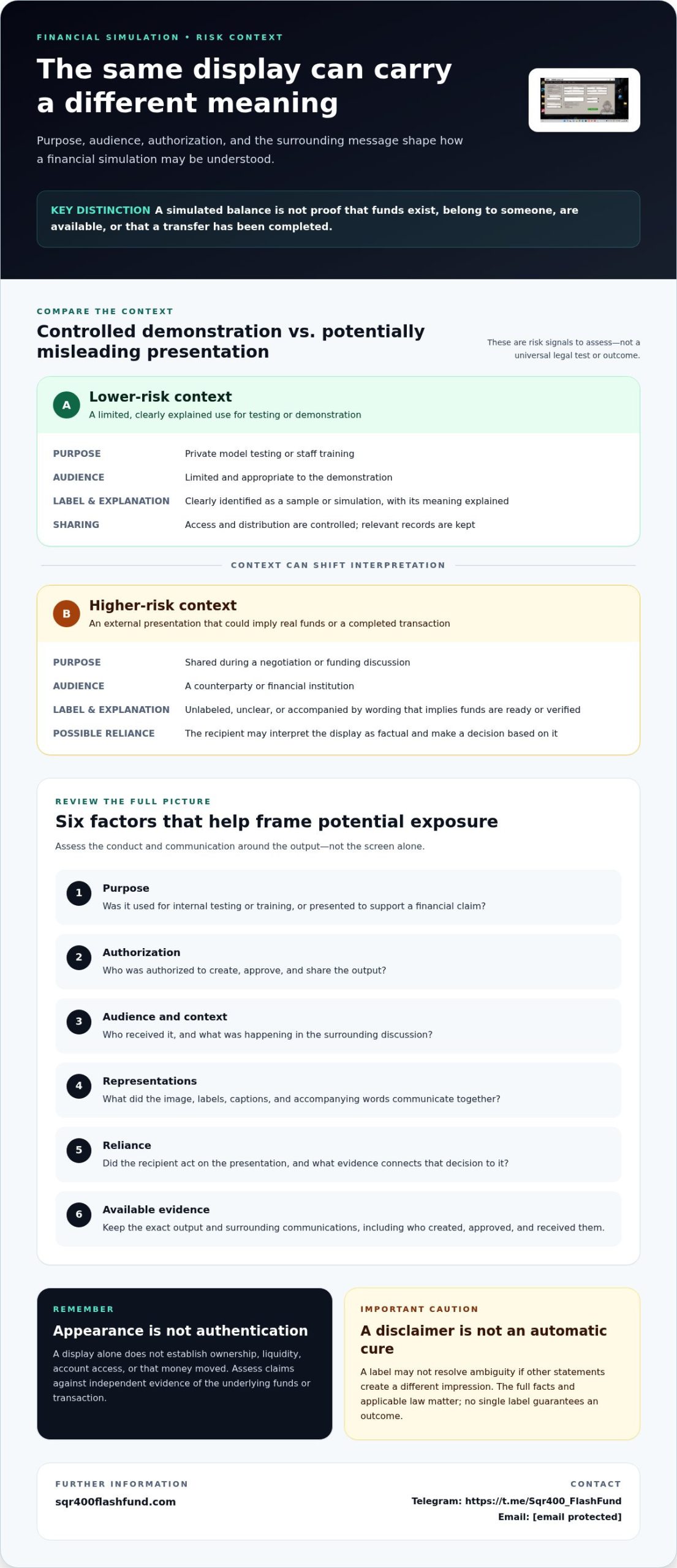
Purpose affects how a display may be understood. An output used privately to test a model or train staff has a different context from a screenshot sent to an external counterparty during a negotiation. In the first case, the limited audience and testing purpose may be clear. In the second, the recipient may interpret the display as a factual statement about available funds, especially if it lacks a clear label or arrives without an explanation.
That difference doesn’t establish a universal legal test or determine the outcome of a dispute. It identifies facts that may deserve scrutiny: who created the display, who received it, what accompanying words were used, whether the recipient was told it was simulated, and what decisions followed. Preserve the surrounding communications and the exact output that was shared. Context can matter as much as the image itself.
For a related discussion of visualized balances and their limits, see this proof of funds software guide. Keep product capabilities separate from legal conclusions. A simulation can depict a scenario, but the user’s purpose, explanation, and audience shape how that depiction may be interpreted. Assessing a specific dispute requires attention to its facts and the law that applies.
How Representations, Authorization, and Reliance Shape Potential Liability
A simulation’s significance can change with the statements attached to it and the way it reaches another person. A clearly labeled internal training file has a different purpose from a display sent during funding discussions with language implying that it verifies available assets. This is not a universal legal test. It highlights facts that may matter when assessing potential misrepresentation, reliance, and responsibility under applicable law.
When considering liability for using financial simulation tools, examine the entire communication, not just the software output. Ask what a recipient could reasonably understand from the display, its labels, accompanying messages, and the surrounding discussion. Consider whether the recipient acted on it and what evidence connects that decision to the representation. These questions call for a fact-specific assessment, not a conclusion based on appearance alone.
When a simulated display may mislead a recipient
Compare a clearly marked sample used in staff training with an unlabeled image sent to a prospective counterparty alongside a statement that funds are ready. The underlying display may be similar, but the label, message, and audience create different contexts. Review the complete record: the image, captions, email or chat, omitted qualifications, and any explanation given before or after delivery.
A disclaimer cannot automatically cure a misleading overall impression if the display and surrounding statements communicate something different. A small “sample” label may not resolve ambiguity if other language presents the balance as real. A prominent explanation that the image is simulated may help clarify its intended meaning. The effect of those details depends on the full facts and applicable law; no single label guarantees a legal outcome.
Who may face questions about a simulation’s use
Responsibility is not determined simply by asking who had access to the software. A reviewer may examine the operator who created an output, the decision-maker who approved its use, the organization whose business context surrounded it, and the person who distributed it. Their roles, knowledge, authority, statements, and actions may differ. Neither an employer nor a software seller is automatically liable merely because a simulation was used.
Records help establish those distinctions. Preserve the original file, version history if available, authorization or approval messages, recipient list, and communications that accompanied distribution. Internal testing records can show that an output was developed for a controlled purpose. Materials supplied during negotiations or funding discussions can raise different questions about intended use, explanation, and recipient understanding. Records support a factual review, but they are not a substitute for legal analysis.
Professional forecasts also raise questions about how outputs are prepared and communicated. The CPA Journal’s discussion of Accountants’ Liability for Financial Forecasts and Projections offers a related professional context; it does not determine how a particular simulation will be assessed. SQR400 Flash Fund’s products are financial visualization and simulation tools, not actual money transfer services. Explore financial simulation software, while keeping product capabilities separate from legal conclusions.
Compare Lower-Risk Demonstrations With High-Risk Financial Presentations
The same visual output can serve different purposes, and its context changes how others may interpret it. A private model test or clearly identified demonstration generally creates less ambiguity than an external representation that implies simulated balances are genuine funds. These are practical risk comparisons, not legal classifications. Liability for using financial simulation tools depends on the specific facts and applicable law.
| Factor | Internal model testing | Clearly identified demonstration | External financial claim |
|---|---|---|---|
| Purpose | Test a workflow or model. | Explain a visual example or feature. | Support a negotiation, funding request, or claim about available funds. |
| Audience | Restricted to authorized staff. | Shown to an audience told it is a simulation. | Sent to a counterparty who may interpret it as financial evidence. |
| Authorization | Use follows internal approval or testing parameters. | Presenter has permission to demonstrate the material. | Authority to make the representation may be unclear or absent. |
| Labeling | Marked as a test or simulated output. | Prominently identified as a demonstration using fictitious data. | Unlabeled, ambiguously labeled, or paired with claims that imply real funds. |
| Distribution | Access is limited and controlled. | Shared only for its stated explanatory purpose. | Circulated externally as proof of funds or transaction evidence. |
Internal testing and clearly identified demonstrations
Keep testing separate from business communications to reduce ambiguity. Restrict access to people who need the output for the stated task, and label it directly. Don’t rely only on a file name or a separate message that may be lost when the image is forwarded. For demonstrations, fictitious examples avoid exposing another person’s financial details and help prevent confusion with real account information.
These controls can make purpose and context easier to establish later. They don’t guarantee a legal outcome or authorize unrelated external use. Treat approval for an internal test as separate from permission to distribute a demonstration to customers, counterparties, or other audiences.
External proof-of-funds and transaction representations
Risk becomes more acute when simulated information is presented as genuine proof of available funds or evidence that a transfer occurred. A recipient might rely on the representation when deciding whether to proceed with a transaction or negotiation. Whether reliance matters legally depends on the evidence and jurisdiction; it doesn’t establish liability automatically. Review the surrounding words, labeling, audience, and distribution record.
Terminology can also cause confusion. A bank account flashing software guide may discuss simulation language, but a display remains distinct from verified account information or completed money movement. Assess each proposed use by its purpose and presentation. A realistic appearance is not evidence of authenticity.
A Practical Review Process Before Using a Financial Simulation
A disciplined pre-use review makes the simulation’s purpose, audience, and authorization explicit before an output is created or shared. It also creates a record of key decisions. These controls can reduce confusion, but they can’t determine whether a particular use is lawful. For a concrete scenario, qualified counsel should assess the facts under applicable law.
- Define the purpose. State whether the activity is internal testing, education, training, or part of a real negotiation. If the purpose changes, reassess the proposed use rather than relying on an earlier approval.
- Identify the audience. Specify who will see the output and what they should understand from it. Consider whether it could be forwarded or viewed without your explanation.
- Verify authorization. Confirm that the creator has permission to use the relevant source data, interface, and visual material for the intended purpose. Keep authorization distinct from approval to distribute externally.
- Label the output. Place a clear simulation or demonstration label where it remains visible when displayed or shared. Use wording that accurately describes the material.
- Restrict distribution. Limit access to the intended audience and use an appropriate channel. Pause external distribution if a recipient could mistake the display for real funds or verified transaction evidence.
Questions to answer before creating or sharing an output
Make the review concrete. Is this a private test, an educational example, or material for a live business discussion? What should the recipient conclude, and could the image alone create a different impression? Are the source data and interface authorized for this exact use? If the answers are unclear, hold the output until the purpose and permissions are resolved.
Controls for organizations and financial teams
Organizations can set written boundaries for who may create, access, approve, and distribute simulations. Specify which uses are internal and which require separate review before external release. Keep labels attached to the image or presentation itself, not solely in a cover message that may become detached. Train staff to distinguish visualizations from transactions and bank confirmations.
Maintain a concise audit trail: record who created the file, who reviewed or approved it, its stated purpose, the audience, and who received it. Preserve the version that was actually distributed and any accompanying explanation. These records help reconstruct the workflow if questions arise; they don’t establish a legal conclusion or guarantee protection from liability.
For a specific external use, have qualified counsel review the proposed display and accompanying statements before distribution, particularly if the recipient could interpret them as evidence of available funds. To learn about software for responsible simulation use, explore financial visualization software.
Use Financial Simulations Transparently and Choose Responsible Next Steps
A simulation is not inherently equivalent to fraud. Its significance depends on purpose, context, authorization, and how people use and describe it. The essential standard is transparency: recipients should be able to tell what the material represents, what it does not establish, and why they are seeing it. No software capability makes a presentation legally safe or removes responsibility for the user’s statements and decisions.
A transparent-use standard for simulations
State plainly that material is simulated wherever a recipient may encounter it. Keep demonstrations distinct from statements about actual balances, completed transfers, or bank-issued records. Use an output only for an authorized purpose and audience. If a recipient could reasonably mistake a visualization for financial evidence, pause distribution and clarify the presentation before proceeding.
Apply the same discipline when an output is excerpted, forwarded, or reused in a new setting. A label on an original slide may disappear from a cropped image. Keep explanatory language with the material, and make sure accompanying statements accurately describe its status. Don’t suggest that an account has funds or a transaction has occurred unless that claim is independently true and properly supported.
These practices support clarity, not immunity. Liability for using financial simulation tools is a fact-specific issue. Clear labels, permission, and limited distribution may help explain a responsible purpose, but none guarantees a legal result. If the intended use shifts from an internal demonstration to an external financial discussion, reassess it rather than assuming prior approval applies.
Where to go for product information and legal advice
This article provides general educational information, not legal advice for a particular jurisdiction or situation. Laws and relevant facts can differ, and a display’s context may matter. If a proposed use involves a counterparty, funding discussion, or claim about assets, discuss the actual material and communications with qualified counsel in the relevant jurisdiction before relying on a general explanation.
Prepare for that discussion with the proposed output, its labels, the accompanying messages, the intended audience, and records of authorization or approval. Ask counsel to assess the specific facts, potential recipient interpretations, and applicable law. Don’t treat a disclaimer or internal policy as a substitute for that review.
For software information, visit the official SQR400 Flash Fund website at sqr400flashfund.com. Product information is separate from legal advice. For fact-specific legal questions, contact qualified counsel. For any external presentation, explain it accurately and don’t imply that simulated material proves real funds or completed transactions.
Make Your Next Use Deliberate
Apply a consistent review before a simulation leaves its intended setting. If its purpose, authorization, or likely interpretation is unclear, pause and resolve that uncertainty before sharing it. For a specific scenario, qualified counsel can assess the facts under the law that applies. A careful decision made before distribution is more useful than trying to explain an ambiguous presentation afterward.
SQR400 Flash Fund’s products are financial simulation and visualization software, not actual money transfer services. Keep that distinction clear in any use or explanation. Software cannot replace legal advice or make a presentation immune from scrutiny.
For product information, visit the official SQR400 Flash Fund website, contact Telegram support, or email support@sqr400flashfund.com. Keep liability for using financial simulation tools grounded in purpose, authorization, and transparent communication. Proceed with clarity and care.
Frequently Asked Questions
Can using a financial simulation tool automatically create legal liability?
No, not automatically. Software access alone doesn’t establish what a user communicated, whether another party acted on it, or which rules govern the situation. Liability for using financial simulation tools depends on the facts, including purpose, permission, audience, and jurisdiction. A staff practice exercise and a display attached to a commercial proposal raise different questions. Get advice from qualified counsel about a specific scenario.
Is a simulated bank balance the same as proof of funds?
No. A displayed figure alone doesn’t establish that funds exist, belong to the user, or can be used. A receiving party may specify what evidence it accepts, so don’t substitute a visual example for records from an appropriate source. If a counterparty requests account verification, sending a simulated image instead could create confusion about what has actually been verified.
Can a disclaimer remove liability when sharing a financial simulation?
No disclaimer offers a universal shield. A notice may clarify the material’s status, but a reviewer could also consider whether it was prominent, whether other statements conflicted with it, and how the recipient understood the overall communication. A “simulation” label may be undermined by a message calling the display confirmed funds. Have counsel review high-stakes external materials before sending them.
Can a company be responsible when an employee shares simulated financial information?
Possibly, but the answer depends on the circumstances and applicable law. Relevant details may include whether the employee was acting within an assigned role, had approval, or used the material for a business purpose. A company can reduce process ambiguity by specifying who may create and approve external materials. Those controls don’t determine responsibility in a particular employment relationship or jurisdiction.
Does an MT103 or MT760 simulation confirm that a bank transfer occurred?
No. A simulation displaying protocol-related information doesn’t, by itself, verify a bank communication or establish that funds moved. Treat labels, document appearance, and message wording as separate from verification of the source and transaction. If someone claims a transfer is complete, rely on appropriate independent confirmation rather than a simulated visualization. Don’t describe a simulated display as an actual bank-issued message.
What records should a business keep when using financial simulations internally?
Keep records that let a reviewer reconstruct the workflow: the business purpose, creator, approver, intended viewers, and actual recipients. Retain the exact version used and any instructions or notes that explain its status. For example, preserve the training request alongside the labeled file, rather than keeping the image alone. Limit access to relevant personnel and follow the organization’s applicable records policies.