


Underfunding is not always the problem; sometimes the challenge is how employees interpret what they can see. Avoiding the perception of being underfunded starts with explaining priorities, inviting candid feedback, and showing progress through meaningful outcomes, not budget figures alone. This gives employees a clearer understanding of available resources and what they support.
It’s reasonable to expect employees to notice constraints when teams face shifting priorities or limited tools. Silence can leave those gaps open to interpretation, while specific, consistent communication helps distinguish deliberate choices from a lack of investment.
This guide offers practical steps for discussing budgets and capacity, gathering employee perspectives, and assessing progress alongside financial results. Learn how to explain resource decisions, respond to concerns without defensiveness, and show what the organization is achieving.
Key Takeaways
- Present budgets, cash flow, and runway with clear context so employees can understand how resources support priorities.
- Use consistent, evidence-based updates to communicate financial strength without overstating what the organization can deliver.
- Invite employee feedback to identify where limited resources affect work, morale, or confidence.
- Assess hiring, workspace, branding, and product quality by the signals they send, not by appearance alone.
- Make financial claims precise and supportable, and use qualitative outcomes to show progress beyond spending figures.
How should organizations present budgets, cash flow, and runway?
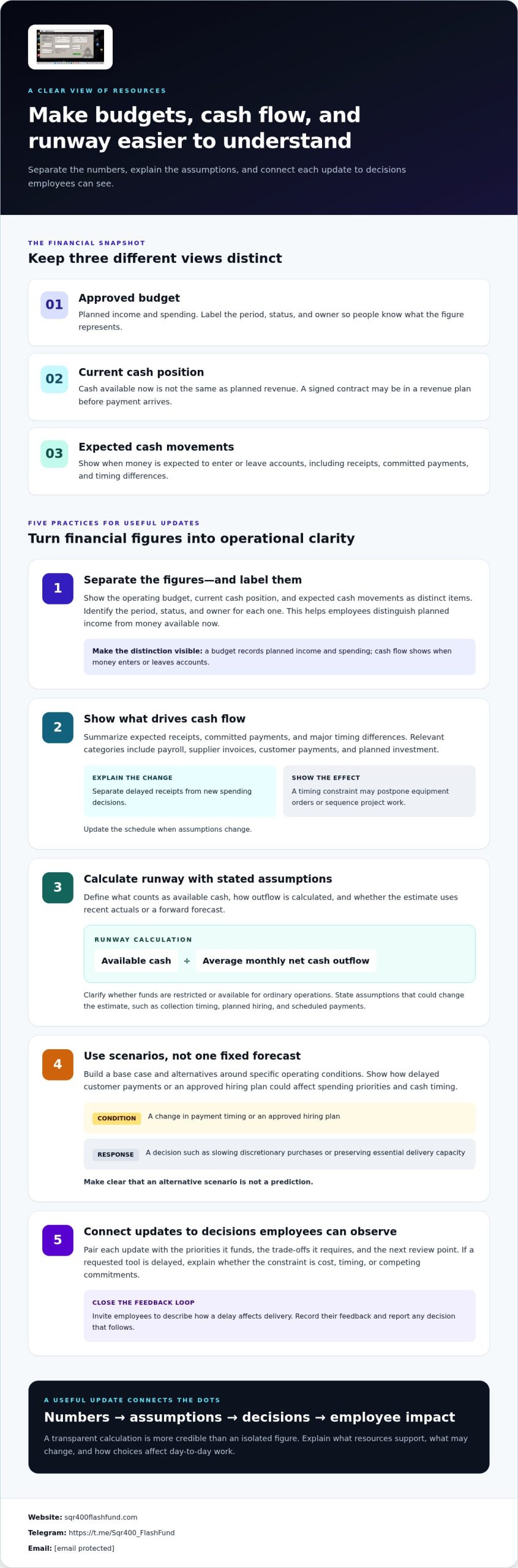
- Separate approved budget from actual cash. Present the operating budget, current cash position, and expected cash movements as distinct figures. A budget records planned income and spending; cash flow shows when money enters or leaves accounts. For example, a signed contract may appear in a revenue plan before payment arrives. Label each figure with its period, status, and owner. This helps employees distinguish planned revenue from cash available now and understand resource decisions.
- Show the drivers behind cash flow. Summarize expected receipts, committed payments, and major timing differences. Identify categories such as payroll, supplier invoices, customer payments, and planned investment. Explain which changes reflect delayed receipts and which reflect new spending decisions. A clear schedule shows why an approved budget may not provide immediate purchasing capacity. Update it when assumptions change, and identify operational effects, such as postponing equipment orders or sequencing project work.
- Calculate runway using stated assumptions. A practical calculation divides available cash by average monthly net cash outflow. Define what counts as available cash and how you calculated the outflow. For example, distinguish restricted funds from cash available for ordinary operations. State whether the estimate uses recent actuals or a forward forecast. Show assumptions that could change the result, including collection timing, planned hiring, and scheduled payments. A transparent calculation is more credible than an isolated figure.
- Present scenarios instead of one fixed forecast. Build a base case and alternatives around specific operating conditions. For instance, show how delayed customer payments or an approved hiring plan would affect spending priorities and cash timing. State the decision attached to each scenario, such as slowing discretionary purchases or preserving essential delivery capacity. Make clear that an alternative is not a prediction. Scenarios explain how leaders may respond to changing conditions; an unexplained forecast can create false certainty.
- Connect financial updates to decisions employees can observe. Pair each budget update with the priorities it funds, the trade-offs it requires, and the next review point. If a team cannot get a requested tool immediately, explain whether the constraint is cost, timing, or competing commitments. Invite employees to describe how the delay affects delivery. Record their feedback and report any resulting decision. This makes financial communication part of daily management, not a polished presentation detached from operations.
How can a business show financial strength without overstating its resources?
- Show verifiable operating evidence. Replace broad claims such as “well-funded” with evidence employees and partners can assess. For example, describe a completed product release, a signed customer contract, or a funded project milestone. Separate completed work from plans. If a project is still in development, identify it as work in progress. This shows execution without implying that future revenue, investment, or delivery is secured. Avoiding the perception of being underfunded starts with claims that match documented reality.
- Connect capabilities to specific commitments. Explain what the organization can deliver with its current team, systems, and operating capacity. For example, state which service channel the support team handles instead of implying unlimited availability. Match each public commitment to the people and processes responsible for fulfilling it. If capacity is constrained, describe active work, upcoming priorities, and scheduling decisions. Precise scope signals control and helps employees and customers understand what the organization can deliver now.
- Use operational indicators alongside financial claims. Show progress through evidence such as completed implementation stages, recurring customer use, or product defects addressed. Define each measure. For example, distinguish a feature released to users from one still being tested. Pair the indicator with its period and context, then explain how it informs decisions. Operational measures demonstrate execution without implying unlimited financial capacity. They give stakeholders tangible evidence beyond general claims about organizational strength.
- Describe investment as a capability, not a guarantee. Explain how existing resources support current priorities rather than promising outcomes that depend on future funding. For example, describe a team’s current ability to maintain a product, while keeping expansion plans separate. Identify conditions behind planned work, such as hiring approval or customer demand. Avoiding the perception of being underfunded does not mean presenting uncertain plans as secured resources. “The current team is focused on reliability improvements” is more precise than “We can scale instantly.”
- Keep messages consistent across audiences. Compare what leaders tell employees, customers, and partners about delivery dates, staffing, and priorities. If a customer presentation describes a feature as available, internal teams should share that release status. Assign someone to update shared statements when plans change. Before publishing an investor update or recruitment page, compare each claim with current operating evidence. Consistency supports credibility; contradictions can make an organization seem less prepared than its resources warrant.
What are the risks of appearing underfunded to customers, employees, or partners?
- Identify customer confidence risks before they affect renewals. A customer who sees delayed support, repeated delivery changes, or unavailable features may question whether the business can meet its commitments. If a launch date shifts, for example, explain why and clarify the revised delivery scope. Silence may lead customers to infer that the organization lacks capacity. Track recurring concerns in support conversations, renewal discussions, and implementation reviews, then address the service gaps customers identify.
- Assess how resource signals affect employees. A hiring freeze, outdated equipment, or constant reassignment can make employees believe their roles and projects lack investment. That perception may weaken engagement, reduce confidence in leadership, or prompt valued staff to consider other opportunities. For example, a team expected to maintain a product without tools to resolve recurring defects may feel unsupported. Discuss constraints directly, invite practical feedback, and explain how priorities shape resource decisions.
- Protect partner confidence with clear operating commitments. Suppliers, contractors, and strategic partners may reconsider collaboration if invoices, approvals, or project decisions repeatedly stall. A partner waiting for an approval may question whether the organization can sustain the agreement. Set clear owners and decision paths for shared work. If timelines change, explain which deliverable is affected and state the next agreed action. Reliable coordination can keep a temporary resource constraint from seeming like a broader failure of financial control.
- Watch for a credibility loop. A perceived funding problem can prompt customers to delay purchases, employees to disengage, and partners to limit commitments. These reactions can make delivery and growth harder, reinforcing the original concern. If prospective customers repeatedly ask whether a service will continue, for example, review the messages, support evidence, and continuity information they see. Separate substantiated concerns from assumptions, then address the communication or operational issue causing uncertainty.
- Respond to the signal, not just the appearance. Review complaints, missed milestones, employee feedback, and partner escalations together. Look for recurring causes, such as unclear ownership, slow approvals, or a capability gap. Assign an accountable leader to each issue and define a visible corrective action. If the concern reflects a genuine resource limit, adjust commitments rather than making unsupported assurances. If resources are adequate but the work is poorly explained, clarify the plan and show evidence of progress.
Resource decisions can also affect whether employees see opportunity and support as fair. Employees can examine their beliefs and preconceptions to understand the roots of personal bias. Managers should not judge employees’ motivation or leadership qualifications based on a preference for written communication. If younger employees exclude older coworkers from informal Friday drinks, for example, those colleagues may start meeting separately. Everyday exclusion can affect workplace relationships.
Recruitment practices can send another visible signal. Employers can reduce assumptions during recruitment by removing applicants’ names, photos, and other personal details from applications. They can assess capabilities through work samples, such as writing samples, code snippets, or design portfolios. Representation matters too: Eighty-nine percent of law firm partners are white. Reviewing how opportunities and decisions are handled can help distinguish concerns about fairness from concerns about available funding.
How do hiring, office space, branding, and product quality affect perceptions of funding
- Make hiring signals reflect real capacity. A long list of open roles can suggest rapid growth, but unanswered applications or repeatedly reposted vacancies can imply instability. Publish roles tied to approved needs and describe responsibilities accurately. Use consistent, job-related criteria to assess applicants rather than relying on a preferred image of a candidate. Where practical, remove names and photos during initial review and assess relevant work samples. These steps make hiring appear disciplined and fair, not like a performance of expansion.
- Match office choices to the work. Employees and visitors may read a neglected workspace as a sign that basic operations lack support. An expensive office can also create a misleading impression if teams lack essential equipment. Review visible conditions, such as broken meeting-room screens, unreliable shared tools, or inaccessible work areas. Prioritize fixes that affect daily delivery and employee needs. If the organization operates remotely, make onboarding, meeting access, and equipment arrangements clear so the workplace model feels intentional.
- Use branding that matches the actual offer. A polished identity can provide clarity, but grand claims and elaborate visuals may invite skepticism if the service experience is inconsistent. Compare website promises, sales materials, and customer support language. If a brand presents itself as highly responsive, for example, customers should be able to find accurate support routes and realistic service expectations. Keep design consistent across the website, proposals, and product interface. Specific, honest language is a stronger credibility signal than unsupported superlatives.
- Demonstrate product quality through observable performance. Customers assess reliability through the product itself, not just its packaging. Document testing, release status, known limitations, and how reported defects are handled. For example, distinguish a feature available to users from one still being tested. A clear demonstration, working sample, or accurate product walkthrough lets prospective customers assess capabilities directly. Do not present a prototype as a finished release. Precise descriptions protect confidence when development priorities or delivery schedules change.
- Review the combined impression across touchpoints. Hiring, office conditions, brand claims, and product performance form one operational picture. Ask a new employee to review the recruitment page and onboarding process, then ask a customer to compare a product demonstration with actual use. Record mismatches, such as advertised capabilities that are difficult to access or promised support without clear ownership. Address the underlying gap first. Coordinated signals help stakeholders see deliberate choices rather than evidence of inadequate resources.
What legal and ethical rules apply to claims about an organization’s financial health
- Substantiate every factual statement before publication. Link each claim to current documents, such as approved financial reports, signed contracts, or completed milestones. For example, describe a contract as signed only after authorized parties have executed it. Keep the supporting evidence with the statement and identify who approved its use. This helps prevent outdated figures or informal expectations from appearing as established financial facts in recruitment materials, customer presentations, or partner updates.
- Separate present facts from forecasts. Label projections, targets, and plans clearly, and state the assumptions behind them. A forecast based on expected customer renewals is not the same as cash already received. Explain the difference in plain language wherever both appear together. For example, say that a hiring plan depends on anticipated revenue instead of describing those roles as funded positions. Clear labels help readers assess what exists now and what depends on future events.
- Use precise language about resources and commitments. Avoid absolute claims such as “fully funded” or “financially secure” unless the organization can define and substantiate them. Replace vague statements with bounded descriptions, such as identifying which project phase has approved resources. Match claims about payment capacity, product delivery, or continued operations to evidence and actual commitments. If records do not support a statement, revise or remove it before it reaches employees, customers, investors, or business partners.
- Apply consistent review before distributing claims. Assign a responsible reviewer to compare each financial statement with its supporting records and intended audience. Check presentations, recruitment pages, internal updates, and sales materials for conflicting descriptions. For example, a product marked as available in a sales deck should not appear as still under development in another public document. Record the version reviewed and correct discrepancies promptly. Consistent review reduces confusion and supports accountable communication across teams.
- Escalate high-impact statements for jurisdiction-specific review. Claims about solvency, investment, fundraising, debt, or future returns can have different implications depending on their audience and location. Before distributing such statements, identify who will receive them, how they will be used, and which evidence supports them. Have qualified legal counsel review material that could influence investment or contractual decisions. Ethical communication also means correcting a material error directly rather than allowing an inaccurate impression to persist.
Requirements can differ among funders: one prospective funder required audited financials for organizations with budgets of $2M+. Well-established organizations have advantages in grantmaking, including dedicated grant writers, extensive track records, and the capacity to navigate complex requirements. Clear criteria can help reviewers assess evidence consistently rather than treating polished documentation as proof of stronger financial health.
Ethical review should also consider how judgments about people and organizations form. Workplace perception bias is an unconscious bias in which a person’s view is skewed by inaccurate, overly simple assumptions about a group someone belongs to. It can involve stereotypes about age, gender, and appearance. Hiring managers can challenge it by examining how accurately their judgments about a candidate are based on evidence. Grantmakers can identify grassroots organizations by partnering with community hubs and attending events or town halls. These practices widen participation while keeping claims grounded in evidence.
SQR400 Flash Fund: SQR400 v5.8 Pro
SQR400 v5.8 Pro is software, not evidence of an organization’s financial health. Simulated transaction outputs cannot establish actual cash, verified revenue, or available funding. Use authentic financial records for those claims, and clearly label any simulation so it cannot be mistaken for proof of real funds or payment capacity.
For software information, visit the official website, or contact SQR400 Flash Fund through Telegram or email.
Make credibility an operating discipline
A credible financial impression comes from decisions people can verify, not appearances meant to conceal limitations. Treat avoiding the perception of being underfunded as an ongoing leadership practice: ensure public statements reflect actual operations, and correct mismatches before they shape expectations. If financial updates use simulations or illustrative materials, label them clearly and never present them as evidence of real funds, revenue, or payment capacity.
Choose a practical next step: assign someone to review the language in an important communication with employees, customers, or partners. Ask whether each claim is accurate, understandable, and supported by records. Then update the communication process to prevent recurring confusion. For financial representations that could influence investment or contractual decisions, seek advice from qualified legal counsel.
Progress depends on consistent, supportable communication. Make it part of everyday leadership so stakeholders can judge the organization by what it does and can substantiate.
Frequently Asked Questions
How can a startup avoid appearing underfunded to investors?
Show investors a coherent operating plan supported by verifiable evidence. Prepare a concise data room with current corporate documents, product status, customer agreements, and clearly labeled financial forecasts. Make sure founders can explain how each requested resource advances a defined milestone. For example, connect a hiring request to a specific capability gap and delivery objective. Consistent answers across presentations, documents, and meetings help investors assess execution without relying on image or spending signals.
How can an organization build credibility when it has limited funding?
Build credibility by making commitments that fit current capacity and meeting them consistently. A small organization can document completed work, publish clear service boundaries, and give customers a named contact for project decisions. For example, a team can share a working demonstration and a realistic delivery sequence instead of implying it operates at a larger scale. Invite customers or community partners to describe specific outcomes they observed, with permission, and keep those accounts accurate and attributable.