


Available money and its origin are separate questions. Proof of funds for a large asset purchase shows that the required assets exist and are accessible; source-of-funds evidence explains how the money was obtained. Liquid assets such as cash, deposits, and readily available investments are the clearest evidence that funds are available for a purchase.
A statement or letter can establish a balance, but it does not necessarily explain the transaction history behind it. This distinction matters in a property purchase or major investment, where a buyer may need to demonstrate both financial capacity and a credible origin for the funds.
This guide explains which assets can support a proof-of-funds package, what documents can demonstrate them, and how to distinguish proof of funds from source-of-funds records. It also covers practical preparation, including confirming that the evidence reflects funds that can actually be used for the transaction.
Key Takeaways
- Separate proof of funds, which demonstrates available assets, from source-of-funds evidence, which explains where the money came from.
- Prioritize liquid assets that can be accessed for the transaction; investments that need to be sold may not be immediately available.
- Use clear, recent financial records that identify the account holder and show the balance and currency.
- Keep supporting records that trace the origin of funds, especially when a large deposit or transfer needs an explanation.
- Match the evidence to the purchase: property sellers, lenders, and investment counterparties may require different documents.
Additional verification for high-value transactions
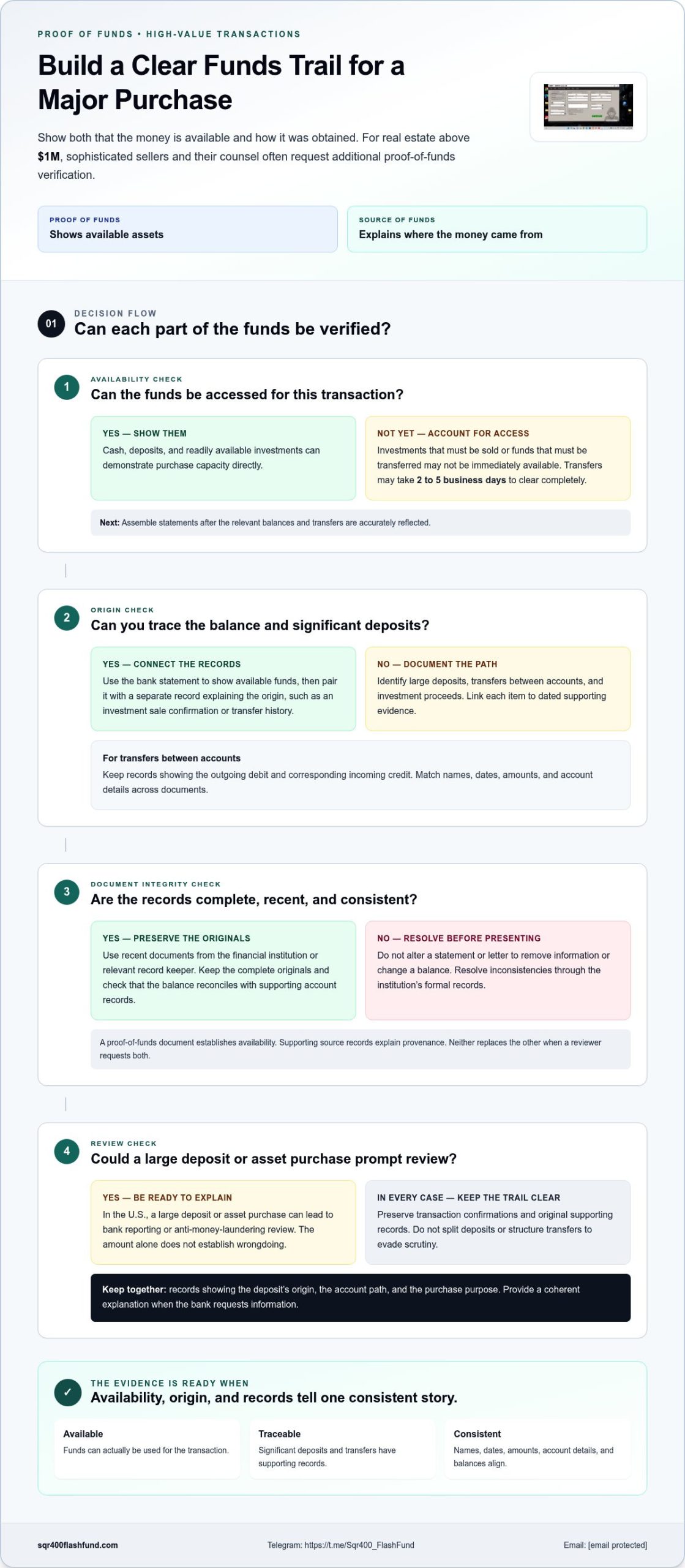
For a high-value transaction, assemble evidence that establishes both available assets and their documented origin. For real estate above $1M, sophisticated sellers and their counsel often request additional proof-of-funds verification.
-
Verify Funds and Their Source
Match each balance to its account holder and trace significant deposits to their origin. A bank statement can show available funds, while a separate record, such as an investment sale confirmation or transfer history, can explain how a deposit entered the account. Keep names, dates, amounts, and account details consistent across the records. A proof-of-funds document establishes availability; source records explain provenance. Neither replaces the other when a reviewer requests both.
Use recent documents issued by the financial institution or other relevant record keeper, and preserve the complete originals. Don’t alter a statement or letter to remove information or change a balance. If a document appears inconsistent, resolve the discrepancy through the institution’s formal records before presenting it. For a mortgage file processed through Desktop Underwriter, follow the lender’s asset-verification instructions and provide the records it requires. A system output does not replace the underlying evidence.
-
Verify Deposits and Assets
Reconcile the balance on the proof-of-funds document with the supporting account records. Identify large deposits, transfers between accounts, and investment proceeds, then link each item to dated evidence. For example, a transfer between two accounts should have records showing the outgoing debit and corresponding incoming credit. This makes the funds’ path clear and helps distinguish a genuine available balance from money with no documented explanation.
Confirm that assets are liquid and accessible for the transaction. Cash, deposits, and readily available investments can demonstrate capacity more directly than assets that must first be sold or transferred. If funds are being consolidated across accounts, allow for clearing time: transfers may take 2 to 5 business days to clear completely. Assemble the statements only after the relevant balances and transfers are reflected accurately.
-
Consider Reporting and Anti-Money-Laundering Checks
Yes. A large deposit or asset purchase can lead to bank reporting or anti-money-laundering review in the U.S. The amount alone does not establish wrongdoing, and no single document explains every transaction. Keep records showing the deposit’s origin, the account path, and the purchase purpose, and provide a coherent explanation when the bank requests information.
Don’t split deposits or structure transfers to evade scrutiny. Instead, preserve transaction confirmations and supporting records in their original form, then respond accurately to bank inquiries. A reviewer may compare a deposit with the account history and the stated source. Clear documentation links available funds to their origin without confusing proof of funds with source-of-funds evidence.
What Is a Proof of Funds Letter for a Real Estate Purchase?
A proof-of-funds letter documents a buyer’s available financial capacity for a real estate transaction. It supports an offer, but it does not commit a bank to lend or guarantee the transaction.
- Identify the funds required for the transaction before requesting documents. A seller may want evidence that you can cover the down payment and closing costs, while a cash purchase requires evidence of funds for the purchase itself. Match the requested amount to the transaction, and don’t include assets that aren’t accessible for the purchase. A letter confirms financial capacity at a point in time; it is not loan approval or a promise that funds will be transferred.
-
Request the Letter from a Bank
Ask the bank holding the relevant account to issue a proof-of-funds letter for the real estate purchase. Provide the account holder’s exact name and clarify which balance the document should reflect. Banks typically provide these letters within 1 to 2 business days. Request an original bank-issued document, not a self-created statement or an edited copy.
- Use current evidence for the offer and any later review. Sellers commonly want a letter dated within 30 days of an offer, and many won’t accept one older than 60 days. Proof-of-funds documents are generally expected to be recent, with a recency window of 30-90 days; some mortgage closings call for documents no older than 30 days. Because a seller or lender may apply a tighter window, use the date they require for that transaction.
A bank statement may also serve as evidence of funds. It should come from the account holder’s bank and carry an authorized employee’s signature. A statement can support the letter, but make clear which document provides the requested balance and account details. Keep both documents intact so their dates and figures remain consistent.
-
Structure the Letter’s Contents
Review the finished letter for the account holder’s full name, a partially masked account number, the balance, and currency. It should also show its issue date and carry a bank signature or seal from a verifiable signatory. A real estate proof-of-funds letter is typically a single page. Check every detail against the account records before submitting it.
- Present the letter without changing its wording or figures. A readable, single-page format helps the recipient quickly find the account holder, balance, currency, and issue date. Confirm that the document identifies a real, regulated, traceable financial institution and a signatory whose authority can be verified. If you include a bank statement, ensure both records show compatible account details and balances. This keeps the evidence clear without suggesting that the bank has approved financing.
Proof of funds for property purchases and large investments
Match the evidence to the transaction, the assets involved, and the date the funds must be accessible. A property offer and a private equity investment may require different financial records.
- Calculate the funds needed for the specific property contract. For a $350,000 U.S. home purchase with 10% down, the example requires $35,000 for the down payment, $10,500 in closing costs, and a $3,500 earnest money deposit. These amounts together represent the funds needed for the purchase. The example recommends showing about $55,000 as a cushion.
Separate the amount needed to complete the purchase from any extra reserve. Earnest money, down payment, and closing costs serve different purposes in a transaction, so label each amount in your planning records. A funds letter should reflect assets available for the purchase, not a larger figure that includes inaccessible holdings.
- Map investment proceeds to their settlement schedule before making an offer. Selling stocks typically takes 2-3 business days before funds become available, according to SEC trading-settlement guidance. A retirement-account withdrawal used for a home down payment may take 7 to 10 business days to process. These timelines affect whether an investment balance is usable on the contract’s required date.
If an offer depends on investment proceeds, sell the investment and move the money into a bank account at least two weeks before making offers. Retain the brokerage transaction record and the receiving account statement. Together, these records link the asset sale to the cash balance shown in a funds letter.
- Prepare evidence for the investment opportunity itself. Private equity deals and major stock purchases may require proof that the investor holds sufficient liquid assets. Companies entering a large business venture or joint partnership may also request records showing that each party has the capital needed to proceed.
For a corporate transaction, align financial documents with the proposed contribution and contract terms. Certified financial statements from an accountant or auditor may support corporate proof of funds. Investment or brokerage statements can document portfolios, while a bank statement can show cash or deposit balances.
- Understand what a funds letter establishes before treating it as approval. A real estate proof-of-funds letter demonstrates financial capacity; it does not commit a financial institution to lend or guarantee completion. For a major investment, distinguish evidence of assets from any separate approval, subscription, or contractual commitment the transaction requires.
Build a transaction file with the relevant letter, account records, and investment sale documentation. For example, a buyer using cash from a brokerage account should retain the brokerage statement and the bank record showing the settled proceeds. This links the stated assets to funds accessible for the purchase.
Acceptable evidence of available assets
For retirement accounts, trusts, or overseas accounts, provide records identifying ownership, balance, and access to the funds. Pair the account evidence with documents showing who controls the assets and how they can be used for the purchase.
- Choose evidence that matches the asset type. Savings-account balances and investment-account statements can document financial assets, while mutual fund holdings show investment positions. For a property or legal transaction, an escrow letter from an escrow company or attorney may document funds held for the transaction. Choose records that clearly show the asset rather than relying on a general summary that omits account-level detail.
For example, if a buyer holds cash in savings and investments in a brokerage account, organize each statement separately. Identify the institution, account holder, reported balance, and statement date. This helps the parties distinguish cash from investments and assess which assets are accessible for closing.
- Document retirement assets with the account statement and information establishing the account holder’s rights. A visible balance alone does not show that the full amount can be used immediately. If the purchase depends on a withdrawal, include records linking the planned withdrawal to the funds expected for the transaction. Separate the account’s total value from the amount intended for the purchase.
For a trust, provide records identifying the trust and the person authorized to direct or distribute funds. Support the stated amount with a trust account statement or other account record. The evidence should make clear whether the buyer controls the assets or needs an authorized trustee to release them.
- Present overseas account evidence that clearly connects the account holder to the reported assets. Include the financial institution’s statement and preserve the original account details, balance, currency, and reporting date. If funds must move to another account before closing, retain records showing each transfer and the resulting credited balance.
For example, a buyer using a foreign deposit should link the statement to the account holder and the funds intended for the purchase. Keep the transaction trail intact. Don’t combine separate accounts into one unexplained total, which obscures which institution holds each asset and who can access it.
- Use business records when assets belong to a company or partnership. Certified financial statements from an accountant or auditor may support corporate proof of funds. Match the reported assets to the entity named in the contract, then document the relationship between that entity and the party responsible for funding the purchase.
Before submitting the package, arrange each statement, escrow letter, or certified report by asset type. Mark the relevant balance and account holder without changing the original document. A reviewer can then trace the funds from the named institution or entity to the purchase, while the parties retain a secure record of the evidence supporting the transaction.
Eligible liquid assets and excluded funds
For proof of funds for a large asset purchase, classify each asset by ownership, liquidity, and access on the payment date. Cash, deposits, and readily available investments provide clearer evidence than assets requiring further approval or transfer.
- Count funds the account holder can use for the purchase. Cash and deposit balances provide direct evidence when the statement identifies the holder and financial institution. Readily available investments can also support a funds package, but distinguish their current value from cash already settled in an account. Sellers need to assess funds available for payment, not just the size of an asset portfolio.
For example, list a savings balance and a brokerage holding separately. Show the source statement for each, the named owner, and whether the balance is accessible for closing. Don’t combine different assets into one total without retaining the records behind that figure. This makes proof of funds for a large asset purchase easier to trace to specific accounts.
- Exclude assets the account holder cannot access for the transaction. A balance held by another person or entity is not the buyer’s available money simply because the buyer expects to receive it. Funds subject to a restriction, pledge, or required approval should not be presented as immediately spendable. Identify the actual holder and any access conditions before including an amount.
For instance, if a company owns an investment but an individual is named on the purchase contract, the company’s statement alone does not establish that individual’s personal funds. Keep ownership distinct. Include an asset only when the records show who controls it and how it can support the payment.
- Separate investments that can be converted from proceeds already available. A brokerage statement may show a portfolio, while a bank statement may show settled cash after a sale. For a purchase due at closing, don’t treat an investment as cash if its sale and transfer are incomplete. Link the investment record to the subsequent deposit record when the proceeds fund the transaction.
Apply the same test to retirement accounts, trusts, and overseas accounts. The account value alone does not establish immediate access. Include evidence of the account holder’s authority and the steps needed to release funds, then distinguish the accessible portion from the total reported balance.
- Prepare a concise asset schedule before sending documents to sellers or other parties. Label each entry as cash, deposit, or investment; name the financial institution and account holder; and indicate whether the funds are accessible for the required payment. Exclude unavailable assets from the available-funds total.
Finally, reconcile the schedule against original statements. If an amount differs, correct the schedule rather than editing the institution’s document. This creates a traceable basis for proof of funds for a large asset purchase and prevents a portfolio valuation, third-party balance, or pending payment from being mistaken for liquid funds.
SQR400 Flash Fund: SQR400 v5.8 Pro
Proof of funds must reflect genuine assets held by the named account holder. Simulated transaction visuals or altered financial records cannot establish that money exists, is accessible, or belongs to the buyer. Don’t use software to create or modify bank statements, funds letters, balances, or transaction histories for a property purchase or investment.
Use original records issued by the relevant financial institution, and preserve their details for verification by sellers or other transaction parties. If a document needs correction, obtain an accurate replacement from its issuer rather than editing it. This keeps the evidence tied to real assets and supports a clear, traceable review.
Prepare a Verifiable Funds File Before You Commit
Before signing or submitting an offer, assemble a transaction file that connects each asset to its owner and intended use. Keep original institution-issued statements, transfer records, and evidence explaining unusual deposits together. Separate cash available now from investments or other assets that still require a sale, release, or transfer.
Credible proof of funds for a large asset purchase depends on real assets and verifiable records. Never create or alter a bank statement, balance, funds letter, or transaction history to make the evidence appear stronger. If a record contains an error, request a corrected document from the institution that issued it.
Use the buyer’s name consistently across the purchase documents and financial records. Before delivery, confirm that the evidence is current for the transaction and that sensitive account details are appropriately protected while remaining verifiable. Acceptance requirements can differ by seller, lender, and transaction.
Take the next step with a clear, traceable file. Accurate documentation gives the parties a sound basis for reviewing available funds and moving forward.
Frequently Asked Questions
Proof of Funds vs Source of Funds: What’s the Difference?
Proof of funds establishes that money or eligible assets are available; source of funds explains how the money was obtained. For example, a bank statement may show a balance, while a sale confirmation and deposit record can document investment proceeds entering the account. A reviewer may need both: current capacity to pay and a traceable explanation for a particular deposit or transfer.
What Does a Clean Sample Proof of Funds Letter Contain?
A clear sample shows the document’s basic layout without replacing the issuing bank’s own format. It identifies the account holder, masks part of the account number, states the balance and currency, and displays the issue date. The issuing bank’s authorized signature or seal completes the record. Keep the letter concise, typically one page, and don’t alter a bank-issued version to imitate a sample.
What counts as proof of funds for a large purchase in the United States?
In the United States, proof can include bank statements, deposit balances, and statements for readily available investments. The evidence should connect the assets to the buyer or purchasing entity and show funds relevant to the transaction. A portfolio’s total value may not equal cash available for payment, so distinguish settled balances from assets that still need to be sold or transferred.
Which documents are accepted as proof of funds for a major asset purchase?
Commonly used records include savings-account statements, investment or brokerage statements, mutual fund holdings, and bank-issued funds letters. For business transactions, certified financial statements from an accountant or auditor may support corporate evidence. Property or legal transactions may use escrow letters issued by an escrow company or attorney. Match each document to the asset owner and the funds involved.
How recent must bank statements or proof-of-funds letters be?
Requirements vary by transaction. Proof-of-funds documents are generally expected to fall within a 30-90-day recency window. Sellers and lenders commonly want statements dated within 30 to 60 days; real estate sellers may request a letter dated within 30 days of an offer, and some won’t accept one older than 60 days. Use the tighter timeframe relevant to the purchase.
How do you get a proof-of-funds letter from a bank or brokerage?
Ask the bank holding the funds for a letter tied to the account and intended transaction. Banks typically provide proof-of-funds letters within 1 to 2 business days. A brokerage statement can document investment holdings, but it isn’t automatically a bank-issued funds letter. Keep the brokerage record and any bank record showing settled proceeds together when an investment sale contributes to payment.
What information should a proof-of-funds letter include?
A strong letter identifies the account holder by full name and includes a partially masked account number, balance, currency, and issue date. It should also carry a bank signature or seal from an authorized signatory. Check that the name matches the buyer or purchasing entity in the transaction documents, and that the stated balance reflects the relevant account rather than an unrelated portfolio total.
Does proof of funds need to show the full purchase price or include closing costs?
For a cash purchase, the evidence generally needs to demonstrate funds for the purchase amount. A financed property purchase may require evidence for the down payment and closing costs instead. Estimated home-purchase closing costs are typically 2% to 5% of the price, while earnest money deposits are usually 1% to 3%. The amount to document depends on the transaction structure and funds due.