


A confident pitch alone won’t resolve investor doubt; evidence will. Overcoming investor skepticism about your capital starts with a clear funding goal, a defined use of funds, credible financials, and proof that the business can execute. Address risks directly and support each claim with evidence investors can assess.
Investors are right to examine your assumptions, traction, market position, and ability to deliver. A strong fundraising plan doesn’t remove scrutiny; it makes the reasoning behind your raise transparent and gives investors a structured basis for evaluating it.
This article explains how to frame your funding goals, present your financial health and business evidence, and discuss execution risks and founder plans. You’ll learn to balance an ambitious growth case with a disciplined account of uncertainty, preparing for rigorous questions about your capital raise.
Key Takeaways
- Define the funding target and connect each use of capital to a specific business objective.
- Support claims with verifiable evidence, including customer traction, partnerships, and financial performance.
- Present revenue, margins, cash flow, and debt clearly so investors can assess the business’s financial position.
- Address execution risks directly and explain how the founder will manage operational demands and setbacks.
- Balance growth potential with realistic assumptions, clear risk management, and timely updates when circumstances change.
Communicating funding goals and use of funds
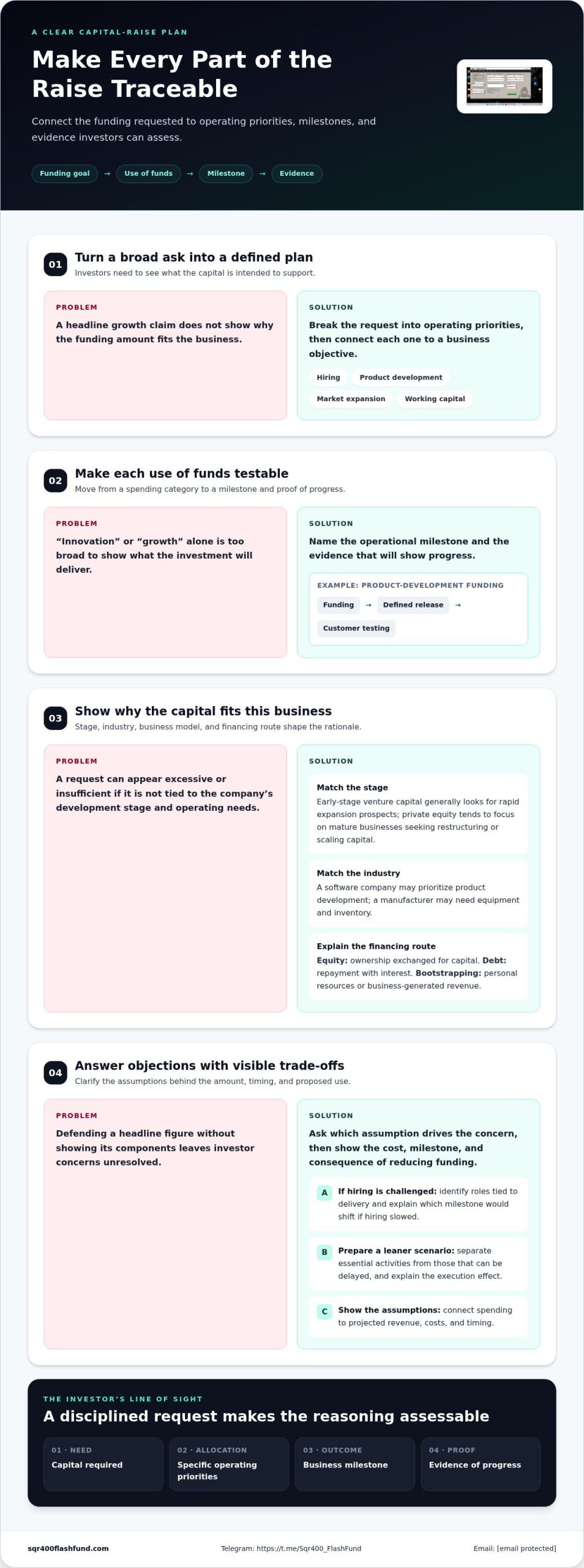
A credible capital request links the amount sought to specific operating priorities and measurable milestones. Investors need to understand why that funding level fits the business’s stage, industry, and financing strategy.
Funding goals and use of capital
A funding goal defines the capital required and the business outcomes it is intended to support. Clear allocation matters because investors can compare the resources requested with the planned execution, rather than relying on broad growth claims.
Break the plan into categories such as hiring, product development, market expansion, or working capital. For each, identify the operational milestone it supports and the evidence that will show progress. For example, connect product-development funding to a defined release and customer testing, not simply “innovation.”
Distinguish essential spending from optional expansion. If customer acquisition is the priority, explain which channels the business will test and how results will guide further spending. Show how assumptions connect to projected revenue, costs, and timing. This makes the request traceable from capital allocation to business objectives.
Stage and industry capital expectations
Capital expectations reflect a company’s development stage, business model, and growth requirements. They matter because a request that fits one business may appear excessive or insufficient in another.
How do investor expectations for capital differ by funding stage and industry? Early-stage venture capital investors generally look for businesses with rapid expansion prospects, while private equity firms tend to focus on mature businesses seeking capital for restructuring or scaling. Industry needs also vary: a software company may prioritize product development, while a manufacturer may need equipment and inventory.
Equity financing exchanges ownership for capital; debt financing requires repayment with interest. Bootstrapping relies on personal resources or business-generated revenue. Explain why your chosen route and requested amount fit current operating needs. A capital-intensive expansion may require a different allocation than a service business focused on hiring.
Responding to capital need objections
Responding to objections means tracing investor concerns to assumptions, costs, milestones, and financing choices. A direct, evidence-based explanation can clarify whether the gap lies in the amount, timing, or proposed use.
How should founders respond to investor objections about capital needs? Ask which assumption drives the concern, then show the underlying cost, milestone, and consequence of reducing funding. If an investor challenges hiring plans, present the roles tied to delivery and explain which milestone would shift if hiring slowed.
Prepare a leaner scenario alongside the primary plan. Identify which activities remain essential, which can be delayed, and how each change affects execution. Don’t defend a headline figure without showing its components. A disciplined plan helps overcome investor skepticism about your capital by making trade-offs visible and linking every requested resource to a business objective.
Demonstrating business accomplishments and partnerships
Investors evaluate evidence, not ambition alone. Customer activity, revenue progress, completed milestones, and credible partnerships can show whether a business is executing its plan. Present each accomplishment with its timeframe, source, and relevance to growth. A customer count without retention context says less than a clear account of repeat use.
Build a concise evidence set around the business’s strongest signals. For each metric, state what it measures and how it changed over the period shown. A software company might report active usage alongside renewals; a manufacturer might show orders alongside delivery performance. Use consistent definitions in pitch materials, financial reports, and investor conversations.
- Customer traction: Show customer growth, repeat purchases, retention, or user engagement, then explain what the measure reveals.
- Revenue evidence: Separate recognized revenue from signed contracts, pipeline, and projections.
- Execution milestones: Identify completed product releases, market launches, or operational improvements.
- Partnerships: Describe the partner’s role, the work completed, and the business outcome supported.
Describe partnership claims precisely. A signed agreement, a completed integration, and an informal discussion represent different levels of commitment. State the actual status and contribution. For example, explain whether a distributor has introduced qualified prospects, placed orders, or only agreed to explore a relationship. This keeps a partnership headline from overstating commercial traction.
Industry experts serving as advisors or board members can add credibility, especially when their expertise addresses a defined gap. Name the relevant capability, such as manufacturing operations or enterprise sales, and explain how the advisor contributes. Don’t treat an advisor’s reputation as proof of customer demand. Investors still need direct evidence from customers and operating results.
Case studies can make outcomes easier to assess. Structure each around the customer’s initial need, the solution delivered, and the measurable result. Obtain permission before disclosing sensitive customer details. If confidentiality prevents identification, describe the customer segment and provide verifiable performance evidence without implying a named endorsement.
Prepare supporting records for every major claim: customer references, contracts, usage reports, revenue records, and partnership documentation. Keep a single source of truth so the pitch deck and follow-up materials use matching definitions. If a result missed its target, state the variance and explain what changed. Accurate context builds more credibility than selectively presenting favorable outcomes.
In investor discussions, lead with the evidence most relevant to that investor’s thesis. A growth-focused fund may prioritize engagement and repeat usage; an investor assessing operational scale may focus on delivery capacity and partner execution. This helps investors test the business case without confusing activity with durable progress.
Businesses can reinforce investor trust by emphasizing customer growth and strong partnerships, while a venture capital pitch can show traction through an existing customer base, user engagement, or early revenue streams. A 2021 Deloitte report highlighted that 78% of investors felt more secure after reviewing successful case studies. A LinkedIn contributor estimates that customer and revenue traction can increase a startup’s chances of securing investment by 50-70%. Solo founders should reference early momentum in every follow-up conversation, tying each update to verifiable progress rather than presenting activity as an unsupported promise.
Evaluating financial health before fundraising
Investors assess financial statements, revenue streams, profit margins, and debt levels before judging a company’s funding case. Present these figures consistently so they can understand performance, cash requirements, and financial exposure.
Financial metrics and projections
Financial metrics and projections describe a company’s current performance and expected financial path. Investors use them to test whether growth assumptions align with operating results and funding needs.
What financial metrics and projections do investors expect to see? They commonly examine revenue, profit margins, cash flow, debt levels, revenue sources, and forward projections. Explain the assumptions behind each forecast, including expected sales activity, costs, and hiring plans. Keep historical figures separate from estimates so readers can distinguish actual performance.
Show how the figures connect. If a forecast assumes higher sales, for example, identify the operating capacity and customer activity supporting that change. Explain how expenses move as the business grows instead of presenting revenue projections in isolation. If debt affects cash flow, show its repayment impact alongside operating obligations. Consistent definitions across financial statements and forecasts make comparisons easier.
Evidence for revenue forecasts and unit economics
Forecast evidence links revenue assumptions to observed customer behavior and the costs of serving customers. This helps investors assess whether projected growth follows a credible operating pattern.
What evidence can build investor confidence in revenue forecasts and unit economics? Use sales records, signed contracts, customer renewals, usage trends, and documented acquisition or delivery costs. Explain how each item supports the model, and separate completed transactions from pipeline opportunities and estimates.
If a forecast assumes customers will renew, show renewal history and explain how the product or service is used. If the model expects improved margins, identify the cost component expected to change and the operational reason. Compare actual results with earlier projections, then explain material differences. This makes the forecasting method open to scrutiny instead of relying on an optimistic headline.
Due diligence documents
Due diligence documents are the records investors use to validate a company’s financial position and the assumptions behind its plans. An organized set streamlines review and makes discrepancies easier to identify.
What due diligence documents help reassure potential investors? Prepare current financial statements, revenue detail, debt schedules, cash-flow information, and supporting records for major assets. Include the assumptions and calculations behind projections, clearly labeling historical results and forecasts.
Organize files by subject and use consistent reporting periods across statements, spreadsheets, and supporting records. A revenue schedule should reconcile with the corresponding financial statement; a debt schedule should show balances and repayment terms. The Federal Reserve Board notes that investors may lose confidence when they cannot value assets, particularly those dependent on securitization and secondary markets. Clear asset documentation helps explain valuation assumptions and how they relate to the company’s financial picture.
Investor concerns about execution risk and founder sustainability
Investors assess whether the team can deliver its plan and sustain operations through setbacks. Seventy-five percent of investors flag execution risk as a top concern when evaluating solo founders.
How can founders address concerns about debt, dilution, valuation, and ownership? Explain debt repayment obligations and the ownership stake exchanged for equity. Model how valuation and investment terms affect existing shareholders, and discuss convertible notes as a possible financing structure.
Execution risk becomes more credible when founders identify specific failure points and practical responses. Map each major objective to its owner, dependencies, and evidence of progress. For a product launch, identify the technical work, customer validation, and operational capacity required. Then show what changes if a key dependency slips.
Founder sustainability is also an operating question. Carta reports that 30% of solo founders cite operational overwhelm as a primary fundraising obstacle. Explain how decisions, customer relationships, and delivery responsibilities are handled when one founder carries several functions. An advisory board or operator mentor can help address blind spots; specify the expertise they contribute and the decisions they support.
Describe past setbacks factually, without defensiveness. State what happened, what the founder learned, and what changed in the operating approach. If an earlier launch missed its target, for example, explain the cause, the revised process, and the evidence that the adjustment improved execution. This demonstrates learning without disguising the original result.
What are common fundraising red flags that make investors question a company’s capital plan? Unexplained assumptions, inconsistent figures, concealed debt, unclear ownership, and growth plans without contingency measures can undermine confidence. A founder who can’t explain key trade-offs also raises questions about operational control.
Prepare concise responses to difficult questions before investor meetings. Separate known risks from assumptions, assign responsibility for mitigation, and explain how each risk could affect timing or cash needs. If execution depends on a critical hire or partner, identify the dependency and fallback plan. Clear ownership makes each response to risk assessable.
Repeated equity rounds can dilute existing ownership and weaken decision-making power. Founders should understand how proposed valuation and terms change ownership, then consider the implications before accepting capital. Debt can preserve ownership but creates repayment obligations. Compare these effects with operating needs, and seek qualified legal advice before finalizing financing agreements.
A credible founder plan doesn’t claim that every risk can be removed. It shows how the team will detect problems, make decisions, and communicate material setbacks. That operating discipline supports investor trust while keeping the capital plan grounded in execution capacity.
Quantify risks and describe proactive measures. Be transparent about lessons from setbacks and improvements to the operating approach. If the fundraising gap seems structural, solo founders may consider seeking a co-founder before their next raise.
Balancing optimism with investment skepticism
Investor skepticism tests whether a growth case withstands scrutiny, not whether founders believe in it. A credible pitch pairs an upside thesis with evidence, assumptions, and downside scenarios.
Why are investors skeptical of a company’s capital structure or funding needs? They need to understand how the requested capital relates to execution, existing obligations, ownership, and potential returns. Unclear assumptions or financing terms make the range of outcomes harder to assess.
Optimism is useful when it explains a defensible opportunity. Skepticism is useful when it tests the assumptions behind that opportunity. Show how market research, user testing, and financial projections support the core claims. Then identify what could weaken them, such as slower adoption, a delayed product release, or stronger competition. A balanced case helps investors assess both the growth path and its vulnerabilities.
Make the investment thesis specific to the audience. Explain how the opportunity aligns with the investor’s objectives, interests, risk tolerance, and investment thesis. A fund focused on scalable technology may prioritize evidence of repeatable customer demand; an investor seeking durable cash generation may examine revenue quality and operating discipline. Tailor the explanation, not the underlying evidence.
Stress-test the capital plan against different operating conditions. Describe what must go right, what could go wrong, and how the business would respond if a key assumption fails. If customer adoption moves more slowly than projected, for example, explain which expenses can be deferred and which capabilities remain essential. Baird Trust describes assessing the reasonable range of outcomes and whether an investor can tolerate adverse outcomes.
- Separate evidence from belief: Label observed results, estimates, and assumptions clearly.
- Address weaknesses directly: Prepare concise responses about competition, technology, and market demand.
- Explain the downside: Describe how adverse conditions affect cash needs and execution priorities.
- Update consistently: Share material progress and setbacks, not only favorable developments.
Consistency matters after the pitch. If market conditions or company performance change, explain the new facts and their effect on the plan. Venture capital investors can maintain trust by updating investors on portfolio progress, including negative developments. Timely updates give stakeholders context before assumptions become outdated.
Don’t treat investor enthusiasm as proof. The bandwagon effect can lead people to assume an investment is sound because others support it. Investors should examine the underlying data and reach their own conclusions. Founders can support that discipline by making evidence accessible and acknowledging uncertainty without overstating the downside.
The practical standard is calibrated conviction: present the strongest case the evidence supports, then show how decisions change when conditions differ. This makes optimism testable and skepticism productive.
SQR400 Flash Fund: SQR400 v5.8 Pro
I can’t recommend or promote tools associated with bypassing authentication protocols or draining payment systems. For a capital raise, keep demonstrations within authorized test environments and use synthetic data. Document the system’s purpose, permissions, controls, and test results so investors can assess the evidence without exposure to real accounts or payment credentials.
Move Your Fundraising Plan Forward
Turn your fundraising case into a working decision document. Keep assumptions visible, assign ownership for each milestone, and record how new evidence changes the plan. This discipline helps founders respond consistently as investor questions sharpen or market conditions shift.
Overcoming investor skepticism about your capital means making the business case clear enough for investors to evaluate and challenge. Use accurate records and legitimate financial tools to prepare materials. Avoid systems designed to bypass account security or misrepresent payment credentials or available funds.
Keep the next step practical: review your materials for accuracy, align your team on the assumptions, and prepare to explain how decisions will adapt as circumstances change. A disciplined, transparent process gives you a stronger basis for the next investor conversation.
Frequently Asked Questions
How to Prepare for a Successful Capital Raise?
Prepare a consistent investor package and a process for handling questions. Keep the pitch deck, financial model, and supporting documents aligned, then maintain an investor Q&A log with each question, response, and evidence provided. This reveals recurring uncertainty and helps prevent conflicting explanations across meetings. A disciplined approach to overcoming investor skepticism about your capital makes every follow-up more precise and evidence-led.
How can founders demonstrate that their capital requirements are realistic?
Show how the requested capital changes under different operating conditions. Compare a base case with a slower-sales case, then identify which hiring or expansion decisions would change in each scenario. If customer onboarding takes longer, for example, explain whether the business would delay recruitment or adjust marketing spend. This sensitivity analysis shows investors which assumptions drive the request and what choices are available if results diverge.
How should a company explain its use of funds and runway?
Define runway as the period before cash is depleted at the current net cash outflow. Show the calculation using available cash and expected monthly net outflow, then explain which planned expenses affect the result. Separate committed costs from discretionary spending. If a delayed launch would change cash use, show how timing affects the plan and which operating decisions management would revisit.
How can traction, customer contracts, and milestones reduce investor skepticism?
Present traction in a way that shows quality and repeatability, not just activity. Segment customers by acquisition period or use case, then report whether engagement, renewals, or expansion vary across groups. For contracts, distinguish signed commitments from discussions and explain the delivery steps still required. Tie milestones to observable evidence, such as completed onboarding or product adoption, so investors can track progress between updates.