


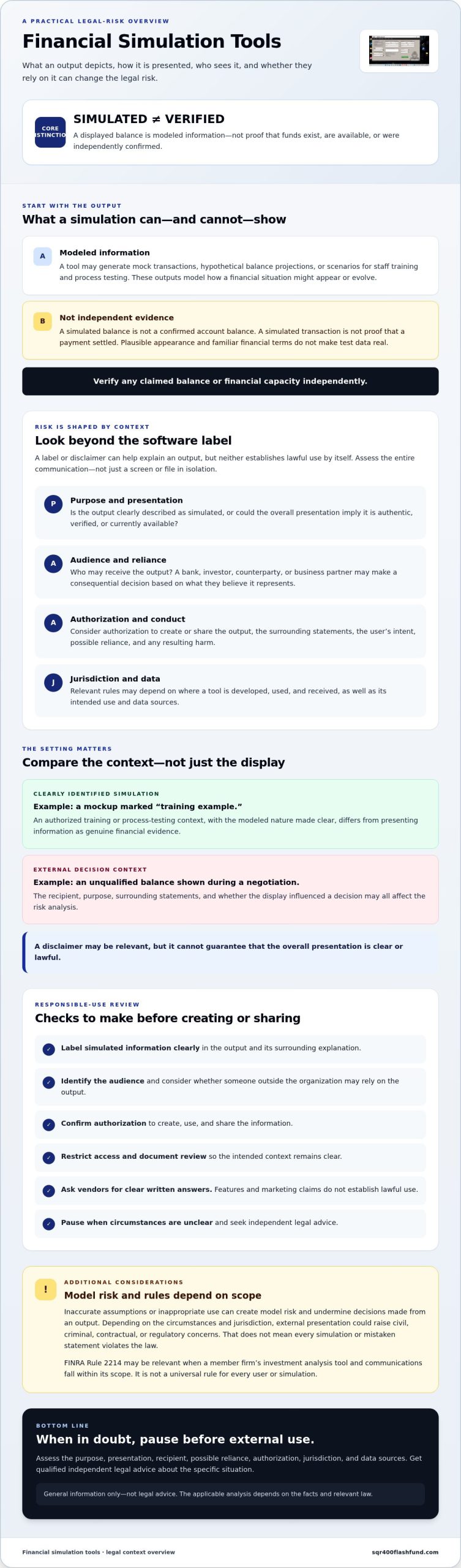
What turns a financial simulation from an internal scenario into a legally risky representation? The answer may have less to do with the software’s label than with what it depicts, how it’s presented, who sees it, and whether anyone relies on it. That’s the central issue behind the legal implications of financial simulation tools.
A clearly labeled simulation may be distinguishable from a real account record, but a label or marketing claim alone doesn’t establish lawful use. A display of simulated balances isn’t evidence of funds, a bank-confirmed balance, or valid proof of funds. Presenting it to a counterparty, investor, or institution can change the risk analysis.
This 2026 guide explains how purpose, claims, audience reliance, authorization, jurisdiction, and data handling can raise legal concerns. It also outlines why the rules that may apply depend on the circumstances, including where a tool is developed, used, and received. You’ll find practical checks for deciding when to pause and seek independent legal advice. This is general information, not legal advice. Consult qualified counsel about your specific situation.
Key Takeaways
- Assess a simulation by its purpose and presentation, not by its label alone.
- Identify who may receive or rely on the output, and whether you have authorization to create or share it.
- The legal implications of financial simulation tools can vary with jurisdiction, intended use, data sources, and recipient.
- Label simulated information clearly, restrict access, document review, and independently verify any claimed balance or financial capacity.
- Vendor features and marketing claims don’t establish lawful use. Get clear written answers and seek independent legal advice when risks are uncertain.
What are financial simulation tools, and why does their legal context matter?
Financial simulation tools generate or display modeled financial information. Depending on the setting, outputs may include mock transactions, hypothetical balance projections, or scenarios for staff training and process testing. These outputs can illustrate how a financial situation might appear or evolve. On their own, they don’t establish that money exists, moved, or is available.
Simulated data is modeled information, not independently verified evidence of funds or a completed transfer. A displayed balance is not a confirmed account balance, and a simulated transaction is not proof that a payment settled. Inaccurate assumptions or inappropriate use can also create model risk, which may undermine decisions made from the output.
What counts as a financial simulation?
Examples include mock transactions in an authorized training environment, hypothetical balance projections, and practice scenarios that help users understand financial workflows. The defining feature is that the information is modeled rather than independently confirmed as a real account event. Test data remains test data even if it looks plausible or uses familiar financial terminology.
Keep that distinction visible in both the environment and the explanation around it. A test scenario should not be confused with a genuine account record, verified balance, or completed transfer. This section does not describe ways to alter real banking records or interfaces.
Why does the setting change the legal analysis?
Purpose and audience matter. An authorized demonstration that is clearly identified as simulated presents a different context from information supplied to an external decision-maker as genuine financial evidence. Banks, investors, counterparties, and business partners may make consequential decisions based on what they believe an output represents.
The software’s label alone doesn’t settle the question. The legal implications of financial simulation tools may depend on conduct, intent, how the output was described, whether the recipient relied on it, and the relevant jurisdiction or jurisdictions. A disclaimer cannot automatically resolve a misleading presentation, just as a simulation label does not establish that every use is lawful. Assess the entire communication, not only a screen or file in isolation.
This article provides general information, not legal advice for any jurisdiction. If a proposed use could influence an outside party’s financial decision, or if the relevant locations and rules are unclear, pause and seek advice from qualified independent counsel.
When can financial simulation become misleading or legally risky?
Risk can arise when modeled information is presented, explicitly or by implication, as authentic, verified, or currently available. The distinction may turn on the full communication: the display, accompanying statements, stated purpose, and what the recipient was expected to understand. A simulation is not evidence of funds unless independently verified.
This caution applies even when the software is described as a simulation tool. A disclaimer may be relevant, but it cannot guarantee that the overall presentation is clear or lawful. The legal implications of financial simulation tools depend on the facts and applicable law, so no single label settles the analysis.
What changes when a third party relies on a display?
Consider the difference between a mockup marked “training example” and an unqualified balance shown during a negotiation. The recipient, purpose, surrounding statements, and whether the display influenced a decision may all matter. Counsel may also examine the user’s intent, authorization to create or share the output, reliance, and any resulting harm. These are factors for assessment, not a formula that automatically establishes liability.
Depending on jurisdiction and circumstances, external presentation could raise civil, criminal, contractual, or regulatory concerns. That does not mean every simulation or mistaken statement violates the law. For financial professionals, FINRA requirements for investment analysis tools may be relevant when a member firm’s tool and communications fall within Rule 2214’s scope. It isn’t a universal rule for every user or simulation.
Why labels and disclaimers are not automatic protection
A clear disclosure can help explain what an output represents, but it may not resolve contradictory statements or conduct. If an output is labeled as simulated while other materials imply that the balance is verified or available, a recipient could interpret the combined presentation differently. Preserve the full context, including labels, messages, intended audience, and authorization records. Seek independent legal advice before sharing outputs externally if their meaning or permitted use is uncertain.
Terms such as “proof of funds” can carry implications beyond a visual demonstration. For terminology context, review this proof-of-funds software overview; it is not legal guidance or an endorsement. If assessing a vendor, you can also review its published product information as claims to verify, not as proof of legality or authorization.
This section is general information, not legal advice. Relevant legal tests vary by jurisdiction. Consult qualified counsel about the specific facts before relying on or presenting simulated financial information.
Which legal and compliance questions should users assess?
Start with the facts around a tool, not its marketing language. Before relying on an output, map the jurisdictions, intended use, recipient, data sources, and permissions involved. These details help qualified counsel determine which rules and risks warrant closer review. The legal implications of financial simulation tools cannot be evaluated accurately from a product label alone.
Which jurisdiction’s rules may apply?
Identify where the user, software provider, recipient, and any affected financial institution are located. If activity crosses borders, more than one jurisdiction may be relevant. Don’t assume the vendor’s or device’s location settles the question.
Ask counsel to assess whether financial-crime, fraud, consumer-protection, or financial-services rules could apply to the specific conduct. The analysis depends on the facts and current law. Check primary legal sources and obtain advice from qualified counsel rather than treating a vendor’s assurance as a legal conclusion.
What data, access, and contractual terms matter?
Review what information enters the tool and who can access it. A test environment may involve real account data, personal information, or third-party credentials, each of which raises distinct authorization, privacy, and cybersecurity questions. Confirm that access and use are permitted. Possessing data or software does not necessarily grant permission to use it for every purpose.
Read the software license and acceptable-use terms alongside any privacy or security documentation. Establish who may use the tool, what outputs may be shared, and whether restrictions apply to external presentation. If the terms leave these points unclear, pause and seek independent legal review.
- Jurisdiction: Where are the people, provider, recipient, and affected institution located?
- Intended use: Is the purpose training, testing, internal analysis, or external communication?
- Recipient: Who will see the output, and what decision could they make from it?
- Data source: Is the information synthetic, or does it include real personal or account data?
- Authorization: Do permissions and written terms cover the access, use, and sharing planned?
Protocol-related terminology also needs careful interpretation. SWIFT, MT103, and MT760 may describe financial messaging concepts or formats, but seeing these terms in a simulation does not establish that funds moved, a message was authenticated, or a transaction was completed. For terminology only, consult this MT103 simulation protocol guide. It is not transaction validation or legal advice.
Before proceeding, verify legal questions against current primary sources and ask qualified counsel to assess the specific jurisdictions and facts. Vendor descriptions can help you frame questions, but they cannot determine whether a proposed use is authorized or lawful.
How can organizations evaluate financial simulation tools responsibly?
Use a documented review before a simulation is created, displayed, or shared. Assign an accountable owner and define the boundaries in advance. A practical control process should specify the permitted purpose, approved audience, data source, access permissions, labeling standard, and review requirements.
What should a pre-use review cover?
Record the approved use, responsible owner, intended recipients, and required internal approvals. Confirm that the data is synthetic or that its use is appropriately authorized and protected. Check the relevant license and internal policies before granting access or allowing an output to leave a controlled environment.
Make the simulated status clear on every demonstration and supporting document. Disclosures should be prominent and consistent, not confined to a separate note that recipients may miss. Limit distribution to the approved audience, and preserve enough review documentation to show what was authorized and why.
- Define the purpose: State whether the activity is for training, testing, or another approved internal use.
- Control access: Limit use and sharing to authorized people and approved environments.
- Label outputs: Identify modeled information clearly wherever it appears.
- Document review: Record approvals, recipients, and decisions without retaining unnecessary sensitive financial data.
- Verify claims separately: Don’t treat a simulated display as confirmation of funds, payment, or financial capacity.
Verify financial claims through the relevant institution or an authorized independent process. A simulation cannot independently confirm an account balance, completed payment, or available funds. If an outside party could mistake modeled information for independently confirmed facts, stop the external presentation until its meaning and authorization are clear.
When should users pause and seek independent advice?
Pause if a tool is marketed for bypassing verification or presenting simulated funds to outside decision-makers. That framing warrants review before use. Escalate unclear cases to qualified legal, compliance, and information-security professionals. They can assess the facts, applicable rules, data exposure, and contractual limits without relying on vendor assurances.
Maintain a proportionate audit trail of approvals and decisions. Record what was reviewed and who authorized it, but avoid keeping sensitive account information that isn’t necessary for that purpose. These controls can help organizations manage the legal implications of financial simulation tools, but they don’t establish that a particular tool or use is lawful. Seek independent advice for the specific circumstances.
What should buyers and businesses do before relying on a vendor’s claims?
Evaluate the vendor’s documented terms and your organization’s proposed use separately. Product features, protocol terminology, a lifetime license, and confident marketing describe neither legal authorization nor suitability for external proof-of-funds use. None establishes that simulated information is genuine, independently verified, or acceptable to a recipient.
Request written answers before purchase or deployment. Clear documentation gives legal, compliance, and information-security reviewers material they can assess, rather than leaving them to rely on sales language or verbal assurances. The legal implications of financial simulation tools depend on the specific use, recipients, data, contract, and relevant jurisdictions.
What questions should a buyer ask the vendor?
Ask what scenarios the product is designed and contractually permitted to support. Request the applicable license terms and written details on data handling, authorization requirements, access, retention, and any restrictions on sharing or external representations. Clarify what support the vendor actually provides and what remains the customer’s responsibility.
Seek specific answers. If a vendor makes broad claims about legality, compliance, privacy, or security, ask for the basis and documentation behind each claim. Treat unsupported statements as unresolved questions for independent verification, not as assurances that the proposed use is lawful or authorized.
- Purpose and limits: What uses are expressly permitted or prohibited by the contract?
- Disclosure: How must modeled outputs be identified, including in accompanying materials?
- Data handling: What information is processed, who can access it, and what controls or retention terms apply?
- Authorization: What permissions must the buyer obtain before using data or sharing outputs?
- Support and restrictions: What support is included, and what limits apply to external presentation?
How can a business make a defensible decision?
Document the proposed purpose, vendor responses, applicable internal policies, approvals, and independent legal review. Record material uncertainties and who accepted or rejected the risks. If the intended presentation depends on a recipient mistaking simulated information for verified financial facts, reject that use. Don’t rely on a disclaimer to make a misleading representation acceptable.
Where proof of funds, payment, or financial capacity is required, use institution-issued records or another independently verifiable form of evidence accepted by the recipient. A simulation cannot substitute for verification. Before purchasing or presenting a tool, obtain advice from qualified counsel familiar with the relevant jurisdictions and facts. This is general information, not legal advice.
Make the next decision with clear evidence
The central issue is not simply whether software generates simulated financial information. Purpose, presentation, authorization, recipient reliance, data handling, and jurisdiction shape the legal implications of financial simulation tools. A label or vendor assurance cannot establish that an output is genuine, verified, or suitable as proof of funds.
Before any external use, confirm the permitted scope, document approvals, and obtain independent, jurisdiction-specific legal advice. Verify claims about balances, payments, or financial capacity through the relevant institution or another authorized, independently verifiable process. If the facts or intended presentation remain unclear, pause.
For context, review the software’s stated scope and disclosures, then assess those materials independently. A disciplined review helps you make a more informed decision and protect the integrity of financial communications.
Frequently Asked Questions
Are financial simulation tools legal to use?
There is no universal answer. Legality depends on jurisdiction, authorization, purpose, and how outputs are presented. A controlled training or testing environment can raise different questions from presenting a display to a bank, investor, or counterparty as genuine evidence. Software labels and disclaimers don’t settle the issue. The legal implications of financial simulation tools require an assessment of the specific facts and locations. Consult qualified counsel rather than relying on a general online explanation.
Can simulated bank balances be used as proof of funds?
No. A simulated display doesn’t independently confirm that money exists, is available, or has been transferred. Presenting it as verified evidence may create legal or commercial risks, depending on the facts and applicable law. If a recipient requires proof, ask what institution-issued records or independently verifiable documentation it accepts. Don’t substitute a simulated balance for that evidence, even if the display uses financial terminology or appears plausible.
Is using financial simulation software considered fraud?
Not automatically. Legal classification depends on the conduct, intent, representations, recipient reliance, potential harm, and applicable law. An authorized internal test differs from knowingly presenting modeled information as genuine funds, but the distinction is fact-specific and doesn’t determine the outcome by itself. Don’t rely on broad online summaries to classify a particular use. If external presentation or disputed conduct is involved, pause and consult qualified counsel familiar with the relevant jurisdiction.
What happens if a business partner relies on simulated financial information?
Possible consequences depend on what was represented, how the partner relied on it, whether harm resulted, any relevant contract, and the applicable jurisdiction. A dispute could raise civil, contractual, regulatory, or criminal questions, but none follows automatically from every simulation. Stop any use that may mislead, preserve relevant communications and records, and seek independent legal advice promptly. Don’t alter or destroy potentially relevant evidence, and avoid making further claims until the facts are reviewed.
Do SWIFT or MT103 labels prove that a payment is real?
No. A protocol name, message format, or visual representation alone doesn’t prove that a financial institution authenticated a message or completed a transfer. Treat protocol terminology as a description, not confirmation of settlement, available funds, or bank approval. To establish payment status, verify it through the relevant financial institution or an authorized verification channel. Don’t rely on a simulated display as a substitute for independently confirmed transaction evidence.
Can a disclaimer make a financial simulation lawful?
No disclaimer guarantees lawful use. A disclosure may help clarify that information is simulated, but its significance depends on placement, wording, audience, surrounding statements, intent, and local law. It may not resolve contradictory claims or unauthorized data use. Before relying on a disclaimer, have qualified counsel review the specific output, accompanying materials, intended recipients, and relevant jurisdictions. Clear labeling matters, but it doesn’t independently establish that a proposed use is authorized or lawful.