


A convincing balance display isn’t proof that funds are real, available, or cleared. If you’re wondering how to avoid red flags with proof of funds, focus on evidence that a counterparty can verify directly with the financial institution, not on how polished a document or screen looks.
It’s reasonable to demonstrate financial capacity without handing over sensitive banking details. Provide enough legitimate evidence for verification while keeping passwords, one-time codes, and account access private. A screenshot, including a simulated banking display, doesn’t establish that funds are held in an account or confirmed by a bank.
This guide explains how recent bank statements and formal bank letters differ from a displayed balance, what counterparties may need to confirm, and why accessible funds matter. You’ll also learn how to handle large unexplained deposits, account-name mismatches, gifted funds, and requests to verify documents at the source. The standard is straightforward: genuine records, a secure verification process, and no reliance on appearance alone.
Key Takeaways
- Learn which records can demonstrate funds held with a financial institution and why screenshots or simulated balance displays cannot confirm financial capacity.
- Use a secure preparation process: confirm the recipient and evidence requirements, then obtain documents through the institution’s official channels.
- Understand how to avoid red flags with proof of funds by treating pressure, unusual intermediaries, and unverifiable documents as reasons to pause and check.
- Verify an issuer through independently sourced contact details, while recognizing that banks may require account-holder consent before confirming information.
- If evidence raises concerns, pause payments, transfers, or sensitive disclosures until the questions are resolved.
What Counts as Genuine Proof of Funds, and What Does Not?
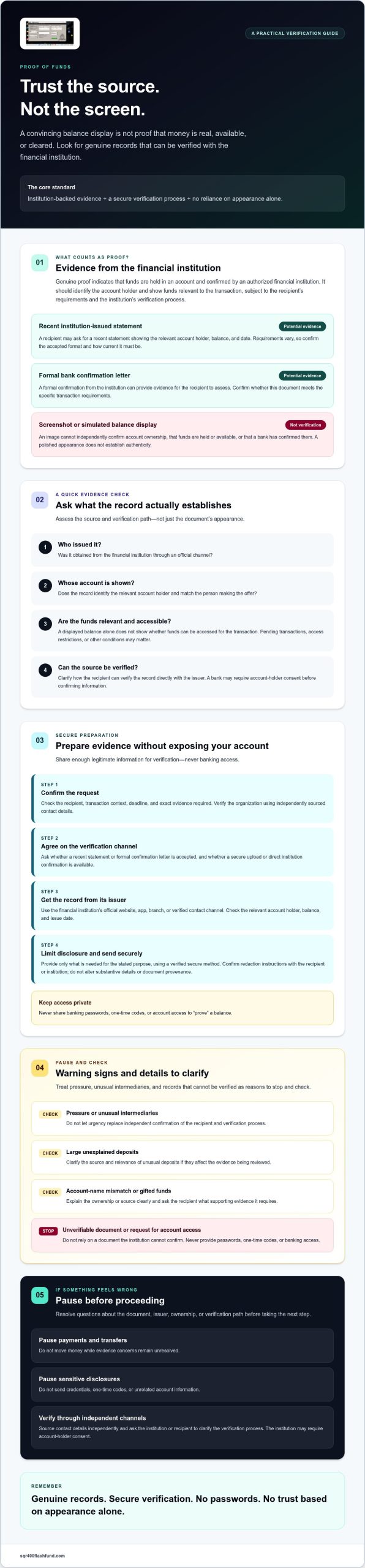
Genuine proof of funds is evidence that money is held in an account and confirmed by an authorized financial institution. It should identify the account holder and show funds relevant to the transaction, subject to the institution’s verification process and the recipient’s requirements. The key distinction is this: proof of funds is institution-backed evidence of financial assets; a visual representation of a balance is only an image of what an interface appeared to show.
The Proof of funds (POF) overview describes common uses and document types, but the recipient must still assess whether a particular record meets the transaction’s requirements. A bank-issued statement or formal confirmation letter is different from a screenshot, an edited file, or a simulated balance display. A document’s professional appearance cannot establish that the funds exist, belong to the person making the offer, or can be accessed for the transaction.
What evidence may a recipient reasonably request?
Common evidence includes a recent statement issued by the financial institution or a formal confirmation letter from it. The record may need to show the account holder, relevant balance, and date while limiting exposure of unrelated account details. Acceptable evidence depends on the transaction, recipient, institution, and applicable requirements. Before sharing anything, ask the requesting organization which format it accepts and how current the document must be.
Why a displayed balance is not verification
A screenshot captures an interface at a moment in time. It doesn’t independently confirm that the account belongs to the person presenting it, that the displayed funds are available, or that they can be transferred. Access restrictions, pending transactions, or other conditions may affect what a displayed balance means for a specific transaction.
Simulated or altered displays are not bank-issued evidence. They don’t establish actual funds or a bank-confirmed transaction, even if they resemble a banking interface. Recipients should assess the source and verification path, not just the image. Presenters should provide documentation obtained through their financial institution’s official channels and never share passwords, one-time codes, or account access to “prove” a balance.
For anyone asking how to avoid red flags with proof of funds, the standard is direct: use genuine, institution-issued records and clarify how the recipient can verify them. If a request calls for evidence that the institution cannot confirm, pause and resolve the requirement with the requesting organization before relying on the document.
How to Prepare Verifiable Proof of Funds Without Exposing Your Account
Prepare evidence through a controlled process. The goal is to meet a legitimate verification requirement without giving another party access to your banking credentials or unrelated financial data.
- Confirm the request. Verify the recipient, transaction context, deadline, and precise evidence type required. Contact the organization using established details you source independently, such as its official website or a known phone number. Don’t rely only on contact information in an unexpected message or on a document you’re being asked to verify.
- Ask about the verification channel. Confirm whether the recipient accepts a recent statement or an institution-issued confirmation letter. Ask if it offers a secure upload portal or can arrange direct confirmation with your financial institution. Requirements vary; Rocket Mortgage outlines what qualifies as proof of funds for real estate, but confirm the exact requirements with your own recipient.
- Obtain the record from its issuer. Request or download the document through your financial institution’s official website, app, branch, or verified contact channel. Check that it reflects the relevant account holder, balance, and issue date. Don’t use screenshots or software-generated displays as a substitute for institution-issued evidence.
- Limit disclosure and send securely. Share only the information needed for the stated purpose, using the recipient’s verified secure method. Follow redaction instructions only after confirming them with the recipient or institution. Never change substantive figures, dates, ownership details, or document provenance. Ask the institution how to handle information that isn’t necessary to disclose.
- Keep access credentials private. A verification request should not require your online banking password, one-time code, recovery phrase, or remote access to your device. Don’t provide them, even if a requester claims they’re needed to confirm a balance.
Confirm the recipient before sending records
Pause if the request arrives unexpectedly, uses a new payment or communication channel, or pressures you to act before you can verify it. Contact the organization using independently sourced details and confirm the request with a known representative. A secure portal or authorized institution-to-institution process can reduce unnecessary exposure, but verify the channel before uploading documents.
Protect the source of verification
Verification should use contact details sourced independently of the document being checked. A phone number printed on a letter may be part of the record, so confirm the institution’s contact information through its official channels. This separation helps protect document integrity and account security. It’s a practical control for anyone assessing how to avoid red flags with proof of funds.
Proof-of-Funds Red Flags: Warning Signs to Treat Seriously
A warning sign isn’t proof of fraud. It is a reason to pause, protect account security, and verify the evidence through an independent channel before acting. A request to accept a screenshot instead of issuer-confirmable documentation, pressure to proceed immediately, or reliance on an unusual intermediary deserves scrutiny. Don’t let urgency replace verification.
An impressive format is not a substitute for confirmation from the institution that supposedly issued it. A document may appear formal and still fail to establish who owns the funds, whether they’re available, or whether the record is authentic. For context on documentation used in real estate transactions, Rocket Mortgage explains what a proof of funds letter may contain. The recipient should still verify the issuer and requirements independently.
When documents or claims cannot be independently confirmed
Compare the names and details with the stated transaction. A mismatch between the account holder, the person sending the evidence, the named beneficiary, or the transaction purpose needs an explanation and direct verification. Differences in dates, financial institution names, or transaction details also warrant a pause. Don’t assume an inconsistency is harmless, but don’t treat it as conclusive without checking.
Stop before sending money or sensitive information if the institution’s contact details can’t be confirmed independently, the record appears altered, or someone insists on an unexplained rush. Contact the institution using details found through its official channels, not solely information provided with the document. If the issuer cannot confirm the evidence, ask the recipient and institution what additional verification is appropriate.
Why SWIFT references do not prove funds are available
References to SWIFT message formats such as MT103, MT760, or MT799 are not, by themselves, confirmation that money has cleared, is available to the named party, or can be transferred for the transaction. A message reference may relate to a specific communication or instrument, but its presence on a document does not independently establish the current status of funds.
Verify the actual instrument and status with the relevant financial institution through independently sourced contact details. Banks may limit the information they disclose or require authorization from the account holder. Don’t rely on a message copy, reference number, or intermediary’s interpretation as a substitute for confirmation. Transaction-specific meanings can depend on context, so seek qualified financial or legal review when necessary.
For anyone assessing how to avoid red flags with proof of funds, the operational rule is simple: treat unexplained discrepancies and unverifiable claims as reasons to stop and check, not as details to work around.
How to Verify Proof of Funds Step by Step
Verification should be deliberate, consent-based, and limited to what the transaction requires. A recipient can follow this sequence without requesting banking credentials or treating a document’s appearance as confirmation.
- Pause before acting. Don’t release funds, change payment instructions, or disclose sensitive information while evidence is being reviewed. Check that the requested verification fits the transaction and that the request came through a trusted channel.
- Confirm consent. Ask the account holder to authorize any contact with their financial institution. Banks may limit what they disclose to third parties or require a specific authorization process. Don’t try to bypass those controls.
- Identify the issuer. Note the institution named on the record and the details the document claims to confirm, such as the account holder and statement date. Treat logos, stamps, email domains, and message identifiers as clues, not proof.
- Find an independent contact channel. Locate the institution’s contact information through its official website, a known branch, or another established source. Don’t rely solely on a phone number, email address, or link printed on the submitted document.
- Ask what can be verified. Explain the purpose of the check and ask the institution what it can confirm, what authorization it needs, and whether it can verify the document directly. Keep the request narrow and respect any limits on disclosure.
- Record the outcome securely. Note the date, channel, person or department contacted if available, and whether the issuer could confirm the document’s origin or other details. Store records securely and avoid retaining unnecessary account information.
Verify the issuer and the evidence channel
A recipient should distinguish a genuine document from a genuine claim about the funds. The institution may confirm that it issued a record while declining to confirm an account balance or the account holder’s ability to transfer money. That limit is not proof of wrongdoing; it means verification remains incomplete for questions the institution could not answer.
Authenticating a document’s source does not confirm that its funds are usable for the transaction. Ask separately whether the evidence establishes current availability and, if relevant, transferability. The bank may not be able to make either determination for a third party. A statement or confirmation should not be treated as a guarantee that funds will remain available later.
Pause, escalate, or decline when uncertainty remains
If material details remain unverified, or a party resists reasonable checks, stop the transaction process rather than filling gaps with assumptions. Raise the issue with the financial institution, a transaction adviser, or a qualified legal professional. Keep verification notes factual, protect personal and banking information, and resume only when the outstanding questions are resolved.
This controlled sequence is central to how to avoid red flags with proof of funds: confirm the source, establish what the evidence actually proves, and preserve a clear record of the verification.
What to Do Next if Proof of Funds Raises Concerns
Unresolved questions call for a pause, not a rushed decision. Whether you’re presenting evidence or reviewing it, hold payment, transfer, and further disclosure until the concern has been checked. Keep communication factual. Record what needs clarification and agree on a legitimate way to verify it.
If you are asked to provide questionable evidence
Don’t create, alter, or misrepresent a balance, statement, or transaction record, even if someone says it’s only a temporary step. A simulated display is not proof of funds and cannot establish that money is held or confirmed by a financial institution. Explain that you can provide genuine, institution-issued evidence or participate in an authorized verification process instead.
If the other party insists on misleading documentation, pressures you to proceed, or asks for a method that exposes your banking credentials, decline and pause the transaction. Where a contract, deadline, or potential consequence is unclear, consult a qualified transaction adviser or legal professional before responding. Keep copies of relevant requests and your replies, and share them only through appropriate secure channels.
If you suspect an account or document has been exposed
Contact the financial institution promptly using a phone number or channel you verify independently, not one supplied only in a suspicious message or document. Describe what information may have been shared and follow the institution’s instructions for securing account access and reviewing activity. Don’t send additional credentials or codes to someone claiming they can resolve the issue for you.
Preserve relevant messages, documents, and transaction details without editing them. If you suspect fraud, report it through the appropriate local channels and seek qualified advice on any transaction or legal obligations. Avoid forwarding sensitive financial records more widely than necessary.
Recipients should likewise document the unresolved issue, tell the other party what verification is still needed, and refrain from sending funds or disclosing further information until it’s addressed. The principle behind how to avoid red flags with proof of funds is straightforward: proceed only with genuine evidence that can be verified through legitimate channels. A simulated display is not a substitute.
Make Verification the Next Step
Genuine proof of funds must reflect funds held and be verifiable through the issuing financial institution. A polished document, screenshot, simulated display, or SWIFT reference alone can’t establish that funds are available for a transaction. Confirm the evidence requirements with the recipient, protect account credentials, and use contact details sourced independently when checking a document.
These controls are the practical answer to how to avoid red flags with proof of funds: verify the source, clarify what the evidence actually confirms, and pause payment or disclosure if material questions remain. If a document or account may have been exposed, contact the relevant institution through its official channels and follow its security guidance.
Use genuine, institution-verifiable evidence. Don’t rely on appearances. For questions about a financial record, contact the relevant bank directly using independently verified details. SQR400 Flash Fund develops simulated financial visualizations, including SQR400 v5.8 Pro. These displays are not bank-issued records and cannot verify real funds. To review the software offerings, visit sqr400flashfund.com.
Frequently Asked Questions
What is considered valid proof of funds?
Valid proof of funds is genuine evidence of funds held by a person or organization, issued or confirmed by an authorized financial institution. Common examples include a recent official bank statement or a formal confirmation letter. The recipient must be able to assess its source and relevance to the transaction. Requirements vary, so confirm the accepted document type, date, and verification process directly with the requesting organization.
Can a bank statement be used as proof of funds?
Yes, a recent bank statement may be accepted if the requesting organization’s requirements allow it. Obtain it directly through the financial institution’s official channels, and check that it clearly identifies the relevant account holder, issue date, and funds. A statement alone may not establish that funds remain available or can be transferred. Ask the recipient what details it needs and how the document will be verified.
How can I verify proof of funds safely?
Confirm the account holder’s consent, identify the issuing institution, and find its contact details independently through an official channel. Ask what the institution can verify and whether authorization is required. Don’t rely solely on contact information printed on the document, and never share passwords, one-time codes, or remote access. To understand how to avoid red flags with proof of funds, distinguish confirmation that a document is genuine from confirmation that funds are currently usable.
Is a screenshot enough to prove funds are available?
No. A screenshot shows an image of an interface, but it doesn’t independently confirm the account holder, the source of the display, or whether the funds are available for a transaction. Simulated or altered displays are not bank-issued proof. Ask for evidence obtained from the financial institution and a legitimate way to verify it. Don’t treat visual polish or a displayed balance as confirmation of financial capacity.
Does an MT103 message prove that money has cleared?
No. An MT103 message or a copy displaying that reference does not, by itself, prove that funds have cleared, are available to the named beneficiary, or can be transferred. Verify the relevant payment status directly with the financial institution through independently sourced contact details. The bank may limit what it discloses or require account-holder authorization. For a transaction-specific interpretation, consult a qualified financial or legal professional.
What should I do if proof of funds looks suspicious?
Pause the transaction. Don’t send payment, transfer funds, or disclose additional sensitive information until material concerns are resolved. Contact the named institution through independently verified details and ask what it can confirm. Preserve relevant communications, and raise unresolved issues with the transaction adviser or a qualified legal professional. If account information may have been exposed, contact your financial institution promptly and follow its instructions for securing access and reviewing activity.
Can I redact personal information from proof of funds?
Possibly, but don’t redact information without checking the recipient’s requirements and the financial institution’s guidance. Ask which details are necessary for verification and whether a secure submission method is available. Never alter balances, dates, account ownership, or the document’s source. If a recipient won’t accept a limited version, ask the institution whether it can issue a confirmation containing only relevant information. Keep credentials and access codes private.