


A simulated portfolio is useful only when its limits stay visible. Whether you’re researching sqr400 v5.8 lite or testing an investment approach, a hypothetical balance is not proof of real holdings, verified funds, completed transfers, or future returns.
Practice trades can help you review how consistently you follow a strategy, but simulated results may look stronger than real-world performance if they leave out factors such as slippage, liquidity constraints, and the pressure of risking actual money. Clear records and consistent rules make those limitations easier to assess.
This guide explains how to document a practice portfolio, set starting assumptions, and evaluate decisions against a suitable benchmark. You’ll also learn how to review results consistently and keep simulated trades separate from real assets and financial claims. The goal is a disciplined test, not a prediction or proof of performance.
Key Takeaways
- Set a learning objective, document a hypothetical starting allocation, and record the reason for each position.
- Compare simulated results with a suitable benchmark over the same period, and review allocation and risk separately from returns.
- Choose manual tracking, paper trading, or historical backtesting to match your practice goal, and account for each method’s limitations.
- Keep sqr400 v5.8 lite references distinct from claims about portfolio performance, real holdings, or verified funds.
- Label simulated trades, record assumptions, and use verified records and appropriate professional guidance for real financial decisions.
What a simulated-trade portfolio can, and cannot, show
Simulated trading means practising investment decisions with hypothetical transactions rather than placing executed investments. A portfolio record may show how a chosen allocation would have changed under stated assumptions. It cannot establish that you own the assets, have capital available, or completed a transfer.
A stock market simulator can provide an educational setting for rehearsing decisions. For example, record a hypothetical allocation across asset categories, then track how it changes over a defined period. This lets you review whether you followed your rules before applying lessons to real decisions. Treat the outcome as an observation about the exercise, not a forecast or guarantee.
Simulated results describe hypothetical activity; verified account statements document records associated with an actual financial account. Keep these records separate. The name sqr400 v5.8 lite does not make a simulated balance evidence of funds, ownership, or investment performance.
How simulated trades differ from real transactions
A practice entry is not an executed order. It does not establish that an asset was bought or sold, or that an account holder owns it. A simulator’s record is also distinct from a statement issued by a financial institution and associated with an actual account. Simulated activity does not demonstrate access to a market, execution at a particular price, or settlement of a transaction.
A hypothetical portfolio may display a balance or transaction history, but those figures remain simulation outputs. They are not proof of available capital or completed transfers, and must not be presented as verified financial documentation.
What a practice portfolio is useful for
Use a practice portfolio to rehearse allocation decisions and observe hypothetical changes over time. Record the assumptions behind each position, including its intended allocation and the reason for including it. Later, compare the results with your original rules to identify what you followed, changed, or overlooked.
Results are educational observations, not forecasts of future returns. Simulations may not reflect real-world execution conditions, so a favourable outcome does not establish that a strategy will perform similarly with real assets. Store practice logs separately from statements and other real-account records. Clear labels and separate files make it easier to distinguish a hypothetical exercise from verified financial activity.
How to build a simulated-trade portfolio step by step
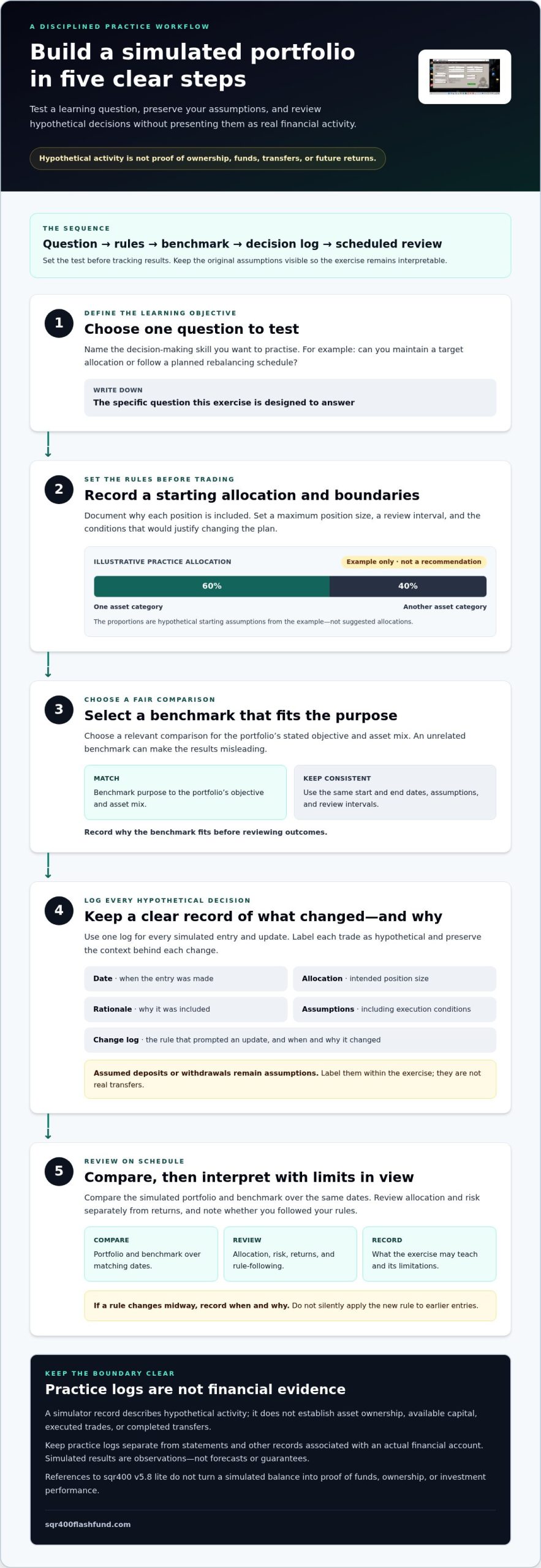
A useful practice portfolio starts with a testable question, not a target return. Decide what you want to learn, define the rules before recording trades, and preserve the original assumptions for later comparison. Label every entry as hypothetical.
Set a learning goal and portfolio rules
Choose one primary question, such as whether you can maintain a target allocation or follow a planned rebalancing schedule. Write down the hypothetical starting allocation and why each position is included. For example, an illustrative portfolio could assign 60% to one asset category and 40% to another. Those proportions are practice assumptions, not recommendations.
Set boundaries in advance: a maximum position size, a review interval, and conditions that would justify changing the plan. Without these controls, repeated adjustments can make it difficult to tell whether the original approach was useful.
Record simulated decisions consistently
Use one log for every hypothetical entry and update. Record the date, intended allocation, rationale, assumed execution conditions, and any rule that prompted a change. If your simulation includes deposits or withdrawals, label them as assumptions within the exercise, not as real transfers. Keep a change log so each review retains the context behind the result.
- 1. Define the learning objective. State what decision-making skill the exercise will test.
- 2. Set the rules. Document the starting allocation, concentration limits, review schedule, and permitted adjustments.
- 3. Select a benchmark. Choose a relevant comparison and record why it fits the portfolio’s purpose.
- 4. Log decisions. Record each hypothetical trade and its assumptions, including the date and rationale.
- 5. Review on schedule. Compare the portfolio and benchmark over the same dates, then note whether you followed your rules and what limitations apply.
Keep the comparison controlled. Use consistent start and end dates, assumptions, and review intervals. If you change a rule midway, record when and why; don’t silently apply the new rule to earlier entries. This keeps the record interpretable instead of rewriting the test after the fact.
Apply the same separation when reviewing sqr400 v5.8 lite: product references and practice records are not evidence of investment results or verified assets. For product context, see SQR400 v5.8 Lite information.
How to assess simulated performance without overstating results
A single hypothetical return figure can conceal how a practice portfolio reached its result. Assess the comparison period, assumptions, allocation, and risk exposure together. A structured review helps you identify what the exercise may teach without treating simulated performance as proof of skill or a forecast.
Choose a benchmark and consistent measurement period
Match the benchmark to the portfolio’s stated objective and asset mix. A portfolio designed to test a particular allocation needs a comparison that reflects that purpose; an unrelated benchmark can make results misleading. Set the start and end dates before reviewing outcomes, then compare both records across the same period and under clearly recorded assumptions.
Use the benchmark as educational context. A simulated result above it does not, by itself, establish investment skill. Differences may reflect the portfolio’s exposures, the chosen dates, or assumptions about how trades would have occurred.
Separate return, allocation, and risk
Review distinct questions instead of relying on one headline number:
- Allocation: Did the hypothetical portfolio follow its target mix, or did positions drift from the plan?
- Risk exposure: Were holdings concentrated in a particular asset, sector, or type of market movement? Consider how the portfolio behaved during adverse periods, not only when results improved.
- Hypothetical return: What change does the record show over the selected dates, and which assumptions shaped that result?
This separation clarifies whether the exercise tested the intended decision rule or simply benefited from a favourable period. Preserve the original assumptions when reporting results. If they change, identify the change instead of blending separate tests into one performance record.
Recognize the limits of backtesting and paper trading
Historical backtesting applies a strategy to past data; it cannot reproduce every future market condition. Paper trading may also differ from live execution. Depending on the method, liquidity, timing, execution delays, and costs such as fees may be omitted or simplified. Behaviour can differ too: hypothetical decisions don’t carry the same emotional pressure as risking real capital.
Past simulated results describe a hypothetical test, not a reliable measure of future performance. Treat any gains as simulated, not realized, and don’t present them as a forecast. A product reference or simulation output associated with sqr400 v5.8 lite does not establish verified holdings or investment results.
Which portfolio simulation method fits your learning objective?
Choose a method based on the decision you want to practise. A simple log makes your reasoning visible, paper trading lets you rehearse a platform workflow, and historical backtesting applies rules to past market data. Each supports a different learning task. None verifies real holdings, available funds, executed transactions, or settlement.
Manual tracking, paper trading, and backtesting
Manual tracking gives you direct control over what you record. Paper trading uses a platform’s simulated environment to practise entering and monitoring hypothetical trades. Backtesting applies a defined rule set to historical data. It can show how the rules would have behaved in that dataset, but hindsight and data limitations constrain what the result means.
| Method | Suitable learning task | Key limitation |
|---|---|---|
| Manual tracking | Reviewing consistency, allocation choices, and decision rationale | Record quality depends on accurate, disciplined entries |
| Paper trading | Rehearsing an intended trading workflow in a simulated platform | Hypothetical execution may not reflect live market conditions |
| Historical backtesting | Examining how a rule behaved across past data | Past data cannot represent every future condition, and hindsight can distort conclusions |
Match the method to the question you want to answer
If you want to test whether you follow an allocation plan, use a manual log that captures each decision and its rationale. If you want to practise a sequence of actions, paper trading can help you rehearse that workflow without implying a live order occurred. If you want to examine a rule against historical data, backtesting can provide context, not a prediction.
You can combine methods, provided you keep their records and assumptions distinct. For example, track your rationale manually while using a simulated environment to rehearse the steps. Agreement between two hypothetical methods still does not verify an actual transaction or financial balance.
SQR400 Flash Fund’s software is designed to display simulated liquidity and fund balances within banking interfaces for business negotiations and proof-of-funds presentations. A simulated display is not proof of funds, a real account balance, or investment performance. The product name sqr400 v5.8 lite does not establish that it provides portfolio-tracking, paper-trading, or backtesting functions. Review SQR400 v5.8 Lite product information separately from your learning method.
A responsible next-step checklist for simulated portfolio practice
A practice portfolio is useful when its status and assumptions are unmistakable. Use this checklist before sharing a report or drawing lessons from a simulated result:
- Label every record. Mark portfolios, screenshots, exports, and summaries as “hypothetical” or “simulated.”
- Preserve the method. Keep the dates, starting assumptions, rules, and data sources with each performance summary.
- Benchmark consistently. Compare the same time period and retain the reason you chose that benchmark.
- Review limitations. Note where hypothetical execution may differ from real market conditions, including timing, liquidity, or costs.
- Separate documentation. Store practice records apart from real account statements and other verified financial records.
Keep simulation records transparent
Keep labels visible wherever a practice result appears, including when a screenshot is cropped or a report is shared. Don’t alter a simulation to make it resemble a real account record, and never present it as bank-issued evidence. A simulated balance or trade history does not verify funds, asset ownership, a completed transfer, or transaction settlement.
Keep the original assumptions and methodology attached to the output. If a later review changes the dates, benchmark, or rules, preserve the earlier version and identify what changed. This makes the record traceable and prevents separate exercises from appearing to be one continuous result. A reference to sqr400 v5.8 lite does not turn a hypothetical output into proof of financial activity.
Turn practice into a measured learning plan
At each scheduled review, return to the original learning objective. Assess whether you followed the plan, which decisions changed, and why. Record process changes as well as the simulated outcome. A result alone can’t show whether you applied a decision rule consistently or whether the assumptions drove the apparent performance.
Before applying lessons to real investments, consult qualified financial education resources and appropriate professional guidance. Base real financial decisions on verified records and your circumstances, not on simulation outputs. A useful review note states the question tested, the assumptions used, what the exercise revealed, and what remains uncertain. Keep it educational, specific, and separate from claims about real assets or future returns.
Make Your Next Portfolio Test More Rigorous
A simulated portfolio is most useful as a documented learning exercise. Define a clear objective, record your assumptions and decisions, and compare results with a relevant benchmark over consistent dates. Review allocation, risk, and hypothetical returns separately so one result doesn’t hide the limits of the test.
Keep every practice log, screenshot, and report clearly labelled as simulated. Neither sqr400 v5.8 lite nor a simulation record establishes real holdings, available funds, completed transfers, or future performance. Base real investment decisions on verified records and appropriate professional guidance.
For product information, review SQR400 v5.8 Lite details. For independent investor education, visit Investor.gov resources. Keep your next practice review disciplined, documented, and clearly separate from claims about actual funds or returns.
Frequently Asked Questions
Can simulated trades prove that I own an investment?
No. Simulated trades are hypothetical records for practising or studying decisions. They don’t establish asset ownership, an executed order, settlement, or an actual account balance. To verify a real holding or transaction, rely on authentic records from the relevant financial institution or regulated platform. Keep practice logs clearly labelled as simulated and separate from genuine account documents.
How do I build a portfolio with simulated trades?
Start with one learning objective, then document your hypothetical starting allocation and the rules you’ll follow. Choose a relevant benchmark and record each simulated decision with its date and rationale. Use consistent assumptions and review periods. When assessing results, account for costs or execution conditions the exercise may omit. Treat the portfolio as an educational test, not evidence of invested capital or a prediction of future returns.
What is the difference between paper trading and backtesting?
Paper trading usually means practising hypothetical transactions in a simulated environment. Backtesting applies a defined strategy to historical market data. Paper trading can help you rehearse a workflow, while backtesting can show how rules would have behaved in a selected historical dataset. Neither reproduces every live-market condition. Backtests are constrained by hindsight and data quality; paper-trading results may omit execution limits.
Are simulated portfolio returns reliable?
Simulated returns can help compare decisions under stated assumptions, but they aren’t equivalent to live investment results. A simulation may omit fees, liquidity limits, execution delays, taxes, or emotional responses to losses. Before interpreting a result, record the method, dates, benchmark, and assumptions used. Don’t present hypothetical performance as realized, guaranteed, or predictive. Use it to assess the exercise, not to claim future outcomes.
Does SQR400 v5.8 Lite create a real investment portfolio?
No. A simulated display is not a real investment account. A displayed balance or hypothetical trade should not be treated as proof of asset ownership, available funds, completed settlement, or bank verification. References to sqr400 v5.8 lite don’t change that distinction. Keep simulation records labelled and separate from authentic statements.
Can I use simulated trades as proof of funds?
No. A simulated portfolio or practice display is not proof of funds and must not be presented as a bank-issued statement or verified financial record. For a legitimate transaction, use authentic documentation issued through the appropriate financial institution or professional process. Label simulated material clearly as hypothetical, and don’t alter or describe it in a way that could mislead someone about its source or status.
What should I track when practising with a simulated portfolio?
Record your learning objective, starting assumptions, allocation, decision dates, rationale, benchmark, and review period. Note relevant costs or execution conditions the simulation leaves out. Track your process as well as hypothetical outcomes, including whether you followed your rules and why you changed them. This context makes the exercise more useful while keeping its results distinct from verified holdings, real account activity, or promised performance.