


What if the most convincing-looking balance is the least credible evidence? When deciding how to show funds for a yacht purchase, sellers and brokers need documentation they can independently verify, not a screen or record that merely looks persuasive. Authenticity gives proof of funds its weight.
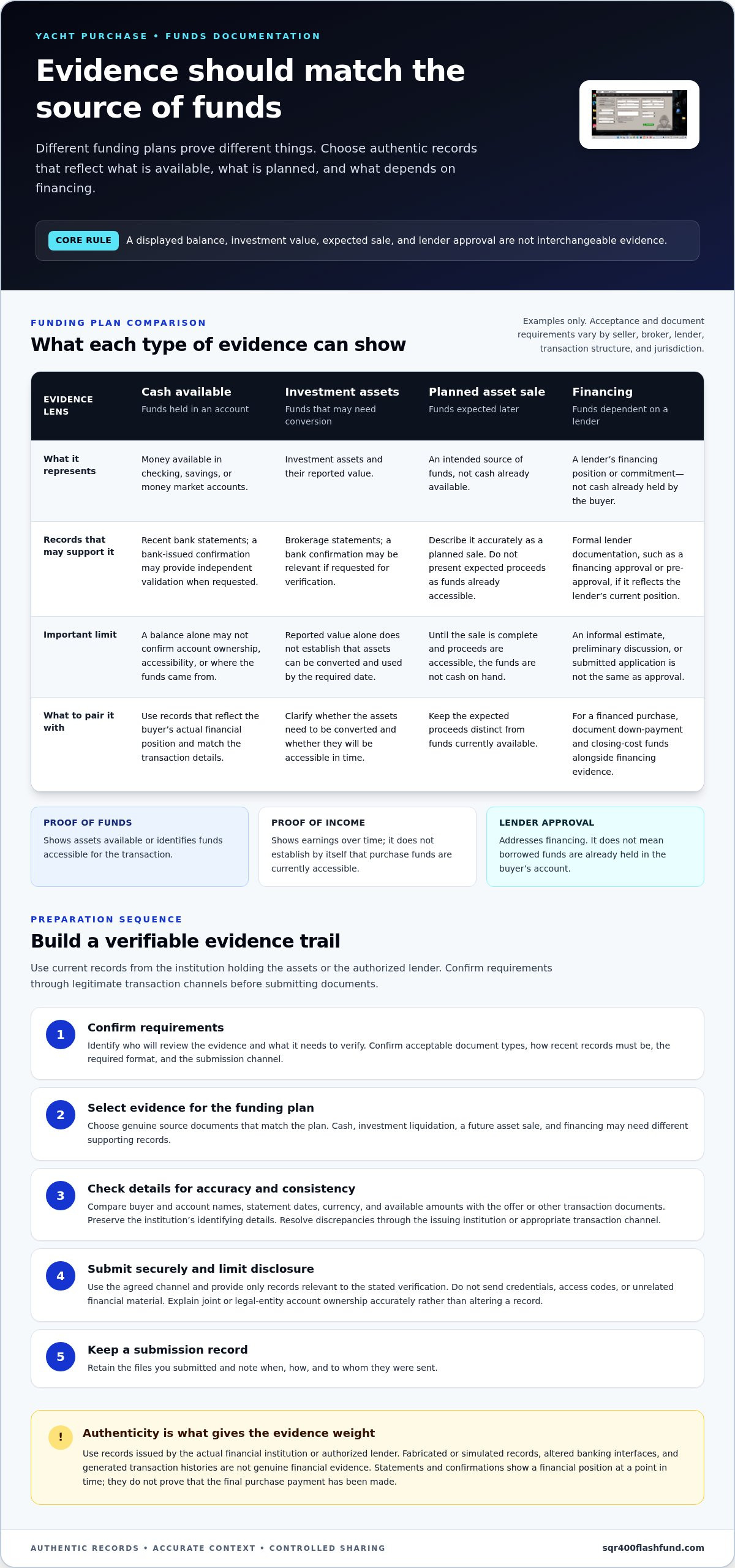
It’s reasonable to be cautious: financial documents contain sensitive information, and acceptance requirements vary by seller, broker, bank, jurisdiction, and transaction structure. Proof of funds is also different from proof of income or a lender’s pre-approval. For a cash purchase, buyers may use recent bank or investment account statements, or a verification letter from a bank officer. Buyers using financing may need to document funds for the down payment and closing costs alongside evidence of financing.
This guide explains how to prepare an authentic, independently verifiable evidence trail while limiting disclosure to information relevant to the transaction. You’ll learn which documents may suit different purchase structures, how to share them through a controlled process, and how to avoid unclear or misleading records that can delay due diligence. Confirm the specific requirements through the transaction’s legitimate channels before submitting documents.
Key Takeaways
- Learn how to show funds for a yacht purchase with authentic evidence that reflects your actual financial position.
- Match documents to the funding plan: available cash, investment assets, a planned asset sale, and financing each demonstrate different things.
- Use documents obtained directly from your financial institution or authorized lender, then check their details before submission.
- Compare bank statements, bank confirmations, investment records, and lender documentation without assuming every seller or broker accepts the same evidence.
- Limit disclosure to relevant information, use an agreed secure channel, and keep a record of what you submit.
What counts as proof of funds for a yacht purchase?
For a yacht transaction, proof of funds is authentic documentation showing that the buyer has money available for the purchase. Evidence of an approved loan is related, but it demonstrates a lender’s financing commitment, not cash already held by the buyer. This distinction matters: documents should accurately show whether the purchase depends on cash, credit, or both. The general concept is outlined in Proof of funds (POF), but the evidence requested for a yacht sale depends on the transaction, its counterparties, and the applicable jurisdiction.
Proof of funds vs. proof of income
Proof of funds shows that assets are available or identifies funds accessible for a transaction. Proof of income shows earnings over time. Income may help a lender assess an application, but it doesn’t establish by itself that purchase funds are currently accessible.
Which documents may demonstrate available funds?
Recent bank statements can show balances in checking, savings, or money market accounts. Brokerage statements may show investment assets, but their reported value alone doesn’t establish that the assets can be converted and used by the required date. These are examples, not universally accepted documents. When requested, a bank-issued confirmation may provide independent validation.
For a financed purchase, use formal documentation from the lender, such as a financing approval or pre-approval, if it reflects the lender’s current position. An informal estimate, preliminary discussion, or submitted application isn’t the same as an approval. A planned asset sale is also different from available funds: until the sale is complete and proceeds are accessible, it represents an intended source, not cash on hand.
What proof of funds does not establish
A displayed balance alone may not confirm who owns the account, whether the funds are accessible, or where they came from. Counterparties may require additional verification based on the transaction and their procedures. Confirm the specific evidence requirements through legitimate transaction channels before sharing documents.
Proof of funds is not proof of income, a complete assessment of creditworthiness, or evidence that the final purchase payment has been made. A lender’s approval addresses financing; it doesn’t make borrowed funds cash already held in the buyer’s account. Statements and confirmations show a financial position at a point in time, not completion of the eventual transfer.
Authenticity is essential. Fabricated or simulated records, altered banking interfaces, and generated transaction histories are not genuine financial evidence. For how to show funds for a yacht purchase, use records issued by the actual financial institution or authorized lender, and ensure they accurately reflect the buyer’s ownership and financial position.
How to prepare verifiable yacht-purchase funds documentation
A reliable evidence package uses current records issued by the institution holding the assets or the lender arranging the financing. Follow a clear sequence: establish what needs to be verified, select suitable source documents, check them against the transaction details, submit them through an agreed secure channel, and keep a copy. This makes how to show funds for a yacht purchase straightforward without overstating what your records prove.
Confirm the evidence requirements before making an offer
Identify who needs the documents and what decision they support, such as assessing cash availability, confirming a down payment, or reviewing financing. Through the transaction’s legitimate channels, confirm acceptable document types, how recent the records must be, the required format, and how to submit them. Requirements vary by seller, broker, lender, transaction structure, and jurisdiction.
Check documents for accuracy and consistency
Use complete records obtained directly from the financial institution or authorized lender. Preserve the institution’s identifying details and check that the account ownership aligns with the buyer named in the transaction. If an account is held jointly or through a legal entity, explain the relationship accurately rather than altering the record. Clearly distinguish cash from investments, financing, and proceeds expected from a future sale.
Use this five-step preparation process:
- Confirm requirements. Record who will review the evidence, its purpose, the requested document type, acceptable date range, format, and submission channel.
- Select evidence. Choose source documents that match the funding plan. A cash purchase, investment liquidation, and financed purchase may need different supporting records.
- Check the details. Compare buyer and account names, statement dates, currency, and available amounts with the offer or other transaction documents. Resolve discrepancies through the issuing institution or the appropriate transaction channel.
- Submit securely. Use the agreed channel and provide only records relevant to the stated verification. Don’t send credentials, access codes, or unrelated financial material.
- Retain records. Keep the submitted files and note when, how, and to whom they were sent. This creates a clear record if the transaction team needs to refer back to the evidence.
Conditional, pending, pledged, or otherwise restricted funds should not be presented as immediately available. State any limitation accurately. A planned asset sale remains a future source until the sale is complete and proceeds are accessible. A financing application or informal estimate is not equivalent to formal lender documentation.
Keep source records intact. Never edit a statement, confirmation, or lender document to suggest a balance, ownership, availability, or commitment that doesn’t exist. For a financed purchase, distinguish the buyer’s available contribution from the lender’s credit decision. Bluewater Yacht Sales outlines examples of financial documentation for a boat loan. Lender underwriting documents may address income and credit as well as liquidity, so they don’t all serve as proof of available purchase funds.
Bank statements, letters, and financing evidence: what should buyers compare?
Different documents answer different questions. A statement may show a balance at a specific time; a bank confirmation may validate account information; investment records show holdings; and lender documents describe a credit decision. None is guaranteed to be accepted in every yacht transaction. Compare each record with the stated requirement, the buyer’s funding plan, and the purchase timing.
Evidence should be authentic, current, and verifiable at its source.
| Document | What it can demonstrate | Key limitation to assess |
|---|---|---|
| Bank statement | Balances and account activity for the period shown. | It may not establish that the full balance is unrestricted, still available, or owned solely by the buyer. |
| Bank confirmation | Information confirmed by the issuing bank, such as an account balance or relationship, depending on its contents. | The scope and date of the confirmation matter. It may not prove funds remain available at closing. |
| Investment evidence | Holdings and their reported value on the statement date. | Market values fluctuate, and holdings may need to be sold or transferred before they become accessible cash. |
| Lender documentation | A lender’s stated financing decision, terms, or conditions, as described in the document. | An application, prequalification, or indicative discussion is not equivalent to formal approval, and approval may carry conditions. |
Cash, investments, and proceeds from an asset sale
Investment holdings can support a funding picture, but their reported value isn’t necessarily the amount available to pay on a specific date. Consider liquidity, possible price changes, and any steps needed to convert holdings to cash. Proceeds from an asset sale are conditional until the sale settles and the funds are documented as accessible. Identify expected proceeds accurately rather than presenting them as current cash.
Also distinguish account ownership from beneficial ownership. An account may be held by a company, trust, or other entity while a buyer claims an interest in the assets. Provide clear, accurate records of the ownership structure when relevant. Requirements for documenting that relationship depend on the transaction and jurisdiction.
Financing approval and third-party funds
Use lender-issued documentation that states the actual status of financing. A submitted application or preliminary estimate shows that financing is being explored, not that credit has been approved. If another person or entity will provide funds, document the arrangement and authorization transparently. The source, ownership, and permitted use of those funds may require additional review under the transaction’s procedures.
Screenshots can omit dates, account-holder details, surrounding context, or the institution’s verification features. A screenshot may be convenient, but it may not let an independent reviewer confirm the record at its source. For how to show funds for a yacht purchase, compare the evidence’s origin, date, ownership information, availability, and relevance to the specific requirement. Acceptance depends on the seller, broker, bank, transaction structure, and jurisdiction.
How to submit yacht-purchase proof of funds without oversharing
Financial evidence should answer a specific verification question, not expose your entire financial profile by default. Before sending documents, identify what the recipient needs to review and share only relevant material. Use a submission method agreed through the transaction’s legitimate channels, and restrict access to authorized participants involved in verification.
Protect sensitive account and identity information
Verify each recipient and delivery destination using contact details obtained independently, such as a known official phone number or established transaction correspondence. Don’t rely solely on a new email address, message, or link supplied with an unexpected request. Avoid sending full statements through public file-sharing links or unverified messaging accounts.
Redaction may reduce unnecessary disclosure, but it must not undermine verification. Don’t remove account-holder details, dates, institution identifiers, or other information the recipient needs to assess authenticity and ownership. If you’re unsure whether a field can be masked, clarify the requirement through the verified transaction channel before changing the document. Preserve the original record and follow applicable privacy obligations and document-handling procedures.
Recognize requests that require extra scrutiny
Pause if anyone asks you to alter a statement, misstate who owns the funds, or present conditional or unavailable money as accessible. A request to bypass ordinary verification is a warning sign, not a shortcut. Don’t submit edited records that could imply a balance, commitment, or source of funds that doesn’t exist.
Cross-border transactions may involve different compliance, privacy, and reporting requirements. Their application can depend on the countries and transaction structure involved. Verify relevant requirements through legitimate channels and consult qualified professionals where needed, rather than relying on assumptions or informal assurances.
Maintain a concise disclosure log. Record which documents you sent, the recipient, the date, the delivery method, and the purpose. Keep copies in a secure location and limit access to people with a transaction-related need. If a recipient asks for additional material, establish what it is intended to verify before sending it.
A controlled process protects sensitive information while preserving a clear verification trail. For how to show funds for a yacht purchase, the goal isn’t to disclose everything. It’s to provide genuine, relevant evidence through a verified channel while preserving the details needed to confirm its source and ownership.
Final yacht-purchase funds checklist: verify, submit, and keep a record
A final review can catch discrepancies before they delay a yacht transaction. Evidence is a dated snapshot, not a permanent statement of financial capacity. It should reflect the buyer’s actual position when provided, including whether funds remain accessible and whether conditions or restrictions apply. Seller, broker, bank, transaction structure, and jurisdiction can affect the evidence required, so follow the requirements established through legitimate transaction channels.
Before sending the evidence package
Confirm the intended recipient, the requested document, what it needs to verify, and the agreed secure delivery route. Review each record against the purchase details, then limit disclosure without removing information needed for valid verification.
- Authenticity: Use original records or documents obtained from the financial institution or authorized lender. Preserve identifying details that allow the source to be assessed.
- Availability: Check whether the stated amount is accessible now. Identify conditions, restrictions, pending transfers, or planned asset sales that affect availability.
- Ownership: Confirm that the account holder and buyer are accurately represented. Explain relevant ownership arrangements rather than implying that another party’s funds belong to the buyer.
- Consistency: Compare names, dates, amounts, and currency across the evidence and transaction documents. Clarify any mismatch before submission.
- Submission security: Verify the recipient and delivery destination independently. Share only relevant information, and redact unnecessary personal details only if doing so preserves authenticity and ownership verification.
After submission and before completion
Keep the original documents securely, along with a record of exactly what was sent, to whom, when, and through which channel. This makes it easier to respond accurately if the transaction team asks about a particular statement or confirmation. Limit access to retained copies to people who need them for the transaction.
If updated evidence is requested, provide authentic source documentation that reflects your current position. Don’t recreate a banking display or alter a record to make it appear more recent, accessible, or conclusive than it is. Resolve discrepancies through the transaction’s legitimate financial and legal channels, and ensure any explanation matches the underlying records.
These controls make how to show funds for a yacht purchase a clear process: verify the evidence, submit only what is relevant, and preserve a reliable record. Never substitute simulated balances or altered records for verifiable financial evidence.
Prepare Evidence That Holds Up to Verification
Strong yacht-purchase documentation is more than a balance on display. It’s authentic, current evidence that reflects who owns the funds, whether they’re accessible, and how the purchase will be funded. Bank records, investment statements, and lender documents each establish different facts, so match the evidence to the transaction’s actual requirements.
To determine how to show funds for a yacht purchase, confirm what the seller, broker, or lender needs, obtain records from the financial institution or authorized lender, and check names, dates, amounts, and currency before submission. Use an agreed secure channel, limit disclosure to relevant information, and keep a record of what you shared. Never edit or simulate a financial record to imply funds or approval that don’t exist.
Financial integrity depends on verifiable information and responsible handling. Review FATF resources on financial integrity for broader guidance. SQR400 Flash Fund develops software for simulated financial visualizations, but simulated balances are not evidence of actual funds, ownership, liquidity, or lender approval. For a yacht purchase, obtain proof directly from the relevant financial institution or authorized lender, and submit only genuine records through a verified channel.
Frequently Asked Questions
What documents can prove funds for a yacht purchase?
Genuine bank or brokerage statements, bank-issued confirmations, and formal lender documentation may help demonstrate funds, depending on how the purchase is funded. No single document is accepted universally. To determine how to show funds for a yacht purchase, confirm the requested document type, date range, and verification process through the transaction’s legitimate channels. Ensure the evidence accurately identifies ownership, availability, and any conditions or restrictions affecting access to the funds.
Is a bank statement enough to buy a yacht?
A bank statement may show a balance and account activity, but it may not establish that the funds are immediately available, belong to the buyer, or meet the recipient’s verification requirements. The seller or broker may request a different document or a more recent record. Use authentic evidence and clearly identify pending transfers, restrictions, or other conditions affecting the balance. Confirm the required format and supporting details before submitting it.
Can I use an investment account as proof of funds for a yacht?
Investment-account records may show assets relevant to your purchase, but their value can fluctuate and may not represent cash available for payment. Explain whether holdings must be sold or transferred and whether those steps are complete. The seller or authorized intermediary may require evidence that proceeds are accessible. Don’t describe investments as settled cash unless they’ve been converted and are available for the transaction.
How recent should proof of funds be for a yacht purchase?
The required date depends on the seller, broker, lender, transaction structure, and applicable jurisdiction. Confirm through legitimate transaction channels how recent the evidence must be before submitting it. Provide a current document obtained from its genuine source. If the transaction is delayed, the balance changes, or access to funds becomes restricted, update the evidence rather than relying on an outdated statement or balance display.
Can a screenshot show proof of funds for a yacht purchase?
A screenshot may omit context, account ownership, document dates, or details needed for independent verification, so it may not satisfy the recipient’s requirements. Use genuine evidence from an appropriate financial institution or authorized lender and submit it through an agreed secure channel. Never edit a screenshot or create a banking display that implies funds exist or are available when they aren’t. Confirm acceptable formats through the transaction’s legitimate channels.
How can I protect my privacy when sharing proof of funds?
First establish who needs the documents, what they’re meant to verify, and how they’ll be received. Share only relevant information, but preserve details required to establish authenticity and ownership. Use a verified, agreed secure channel and limit access to authorized transaction participants. Keep a record of what you sent, to whom, and when. If you’re considering redactions, confirm they won’t prevent valid verification, and follow applicable handling requirements.
What happens if my yacht-purchase funds are not immediately available?
Explain the funds’ actual status and any conditions affecting access. Money dependent on an investment sale, pending transfer, financing decision, or another party shouldn’t be represented as accessible cash. Confirm what authentic records are required for that funding arrangement, then update the evidence when the funds become available. If transaction terms or ownership arrangements are unclear, use the appropriate financial or legal channels and seek qualified professional guidance.