


What if separate account statements make your total funds more credible, not less? The deciding factor is whether each balance can be verified and the combined amount is clear. If you’re unsure how to show proof of funds from multiple accounts, the key is to document each account accurately rather than obscure the trail with unnecessary transfers.
It’s reasonable to wonder which documents qualify, how a recipient will assess several statements, or whether balances should be moved before submission. The answer depends on the recipient’s stated requirements, so a clear package should show genuine, accessible funds without implying that separate balances sit in one account. This guide explains how to select account records, summarize the available total, distinguish proof of funds from source-of-funds evidence, and handle recent deposits transparently. It also covers why screenshots, unexplained transfers, and simulated balances or software-generated visualizations shouldn’t be presented as genuine financial evidence.
For general information about SQR400 Flash Fund, visit https://sqr400flashfund.com; Telegram: https://t.me/Sqr400_FlashFund; email: support@sqr400flashfund.com.
Key Takeaways
- For how to show proof of funds from multiple accounts, start with the recipient’s requirements for document type, date, and account details.
- Use genuine statements or official letters obtained directly from each financial institution, with identifying details and balances visible.
- Compare separate statements, an institution letter, and consolidated funds before deciding how to present the records.
- Lead with a dated summary that lists each documented balance, shows the total calculation, and identifies excluded funds.
- Submit the summary and supporting documents in the requested order, and state only what the records establish.
What counts as proof of funds when your money is in multiple accounts?
Proof of funds is evidence that money is genuinely available to you for a stated purpose. If your balances sit in several accounts, the evidence should let the recipient verify each amount and understand how the figures add up. A projected balance, simulated figure, or software-generated display is not proof of money held at a financial institution. Proof of funds (POF) is a document, like a bank statement, that verifies an individual or company has the financial capacity to complete a transaction or meet a future liability.
For a multi-account presentation, each supporting record should make four details clear: the financial institution, the account holder, the statement or letter date, and the relevant balance. The records form the evidence trail; a summary total is only useful when it can be reconciled to those underlying documents. For example, if you list balances from a checking and savings account, identify each separately and show the arithmetic used to combine them. Don’t present the sum as though it were held in one account.
Acceptable formats depend on the recipient and the transaction. A bank statement or a letter from a financial institution may be relevant, but no single format should be assumed to meet every recipient’s requirements. Check the requested document types and account details before assembling your evidence. That requirement determines how to show proof of funds from multiple accounts without overstating what the records establish.
Which account balances can be shown together?
Checking, savings, and money market accounts can be listed as separate balances when the evidence identifies who owns them and shows access to the funds. Their inclusion does not guarantee acceptance. Money in an account you can use is distinct from an asset that must first be sold, redeemed, or settled. If you include such an asset, distinguish it from accessible cash and avoid counting it as immediately available unless the evidence supports that status.
Ownership matters. If an account is jointly held, or belongs to someone else, the records should not imply that the full balance is solely yours or under your control. Make the account holder and your access clear in the submitted evidence.
What a proof-of-funds document does, and does not, show
A statement records an account balance on a particular date. It does not, by itself, establish that the balance will remain unchanged, that financing has been approved, or that you have a broader level of wealth. Keep those claims separate from what the document actually verifies.
A screenshot or generated display may show figures, but it doesn’t independently verify that funds exist or are accessible. Use records issued or downloaded directly from the financial institution, and make sure the combined total can be traced back to them.
How to gather proof-of-funds documents from each account
Use a controlled collection process. Before downloading anything, identify what the recipient requires: accepted document types, acceptable statement or issue dates, and the account details that must be visible. Requirements can differ by transaction, so don’t assume one institution’s document format will satisfy every request. If instructions are unclear, get clarification from the recipient before preparing the package.
Then create a working inventory. Assign each account a reference number and record its holder, institution, document date, and available balance. Keep the reference number consistent across your inventory, source files, and later summary. This gives each figure a traceable source and makes gaps easier to catch before submission.
- List the relevant accounts. Include accounts you intend to rely on, and note the account holder and institution for each.
- Obtain records at the same stage. Download or request statements or other documents directly from the relevant financial institutions, following the recipient’s requirements.
- Log the evidence. Record the date and balance shown on each document, then match the record to its account reference.
- Reconcile the figures. Compare the inventory against the documents and correct any mismatch before calculating the total.
This sequence supports how to show proof of funds from multiple accounts without relying on memory or an unsupported combined figure. Treat your inventory as a control sheet, not as a replacement for institution-issued evidence.
Request current documents from every institution
Use official statements or institution-issued letters when the recipient requires formal documentation. Check that each record clearly identifies the account holder and institution, and shows a legible statement or issue date and balance. Keep the original document intact unless the recipient specifies an accepted redaction process. If information is missing or unclear, request a corrected record rather than editing the document yourself.
Save each file with a neutral, consistent label, such as “Account 1, Institution, Statement Date.” Preserve the original file alongside any copy prepared for submission. That separation helps you track what came from the institution and prevents accidental changes to the source evidence.
Track transfers between accounts without double-counting
Transfers can appear as a debit in one account and a credit in another. They change where funds are held, but they don’t create additional funds. Review statements covering overlapping periods and match transfer entries by date, amount, and transaction description where those details are shown. Count the balance available across the accounts, not each side of the same transfer as separate money.
If a transfer affects the balance you report, retain the relevant records so the movement can be followed from the sending account to the receiving account. Include those records if the recipient requests a source trail. A clear match between entries reduces ambiguity; an unexplained difference should be resolved before you finalize the inventory.
Should you combine accounts or submit separate statements?
There’s no universally superior format. The right choice depends on the recipient’s instructions, how the funds are held, and whether the evidence preserves a clear record of ownership and movement. Consolidation can reduce the number of account records, but a recent transfer may prompt questions about where the funds came from. Separate statements can show each balance in its original account, while an institution letter may summarize balances if the recipient accepts it.
Use this comparison to identify the trade-offs, then follow the recipient’s stated requirements rather than choosing solely for convenience.
| Format | Best suited to | Key consideration |
|---|---|---|
| Separate statements | Funds remain in distinct accounts and each balance has its own source record. | Provide a clear summary that links each listed balance to its statement. |
| Institution letter | The recipient accepts a formal letter covering relevant account balances. | Confirm that the letter identifies the required accounts, holders, dates, and balances. |
| Consolidated funds | A single account record fits the transaction and the recipient’s documentation rules. | Keep evidence of transfers so the funds’ origin and movement remain traceable. |
These formats aren’t interchangeable by default. A letter may be concise but omit details the recipient needs. Consolidation may simplify the visible balance, but it doesn’t erase the need to explain the transfer trail. Separate documents may involve more pages, yet preserve the original account-level record.
When separate account statements are the clearer option
Separate statements are often the more transparent presentation when funds remain in distinct accounts and each balance can be independently documented. Place a summary sheet before the statements, list each account separately, and map every listed amount to its source document. If account holders differ or an account is jointly owned, describe that relationship accurately. Don’t imply that another holder’s funds are solely yours or freely available to you.
When consolidation may simplify the presentation
Consolidation may be practical if it suits the transaction and the recipient’s documentation requirements. Before moving funds, consider whether the resulting transfer history will need explanation. Retain the sending and receiving account records, including entries that show the amount and timing of the movement. A transfer changes where money is held, not its origin, so a clear source trail remains relevant.
Don’t transfer money solely to create an appearance of funds that aren’t genuinely available. The objective is an accurate account of accessible balances, not a more impressive-looking statement. If the recipient specifies a preferred format, use that direction as the decision rule. This keeps the presentation aligned with the transaction and avoids unnecessary account activity.
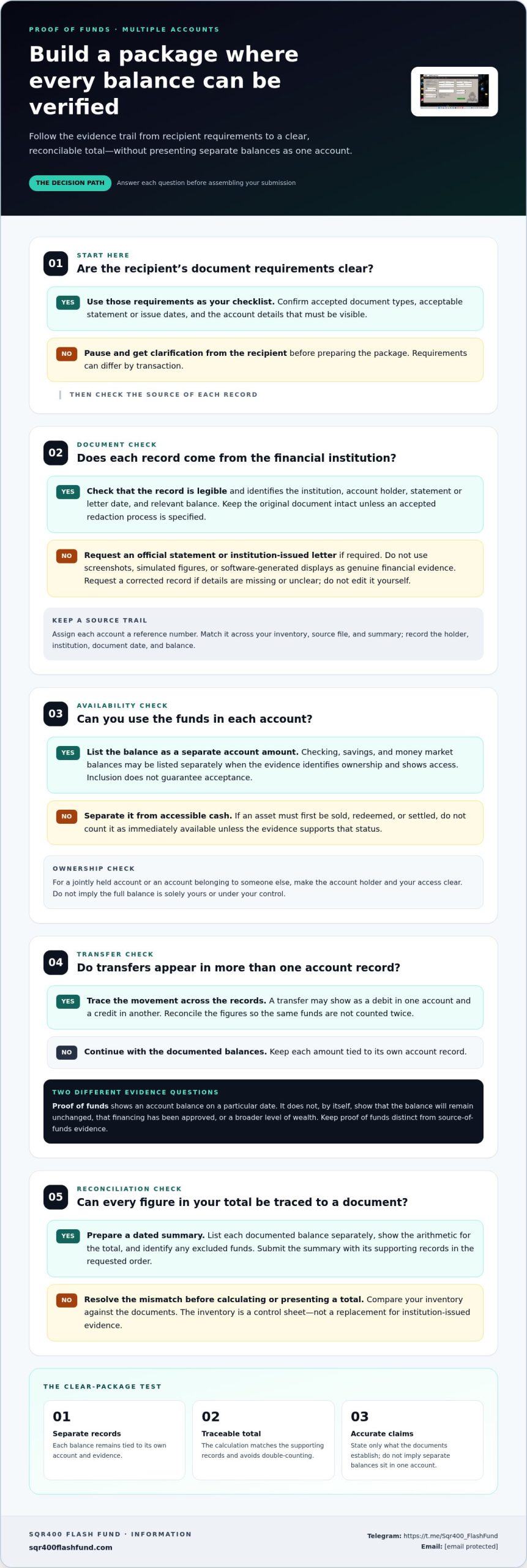
How to assemble a clear, verifiable proof-of-funds package
Build the package so a reviewer can move from the summary to each source record without guessing. Put a dated summary page first, followed by the supporting documents in the same order as the account entries. Use a consistent file label for each statement and repeat that label on the matching summary line. This creates a direct audit trail from the stated total to the records that support it.
A reconciled total is the sum of distinct, documented account balances that are available for the stated purpose, with each included amount traceable to its source record. Show the calculation rather than presenting only a final figure. Clearly identify funds excluded from the total, such as pending deposits or amounts that are restricted or otherwise inaccessible.
Create a simple account-by-account summary
Use one row per account. Include the institution, account holder, document date, relevant balance, and source-file label. Keep the balance consistent with the underlying record, and make clear whether the figure is the full account balance or only the amount you’re counting toward the total. If the records use different currencies, don’t combine them without explaining the conversion basis required by the recipient.
- Institution: Name shown on the source document.
- Account holder: Holder or holders identified in the record.
- Document date: Statement period-end date or letter issue date.
- Relevant balance: The amount included, excluding unavailable funds.
- Source-file label: A matching identifier, such as “Account A.”
Calculate the total by adding only the included balances. Recheck each amount against its document, then verify the arithmetic independently. If an account contains a pending credit or an amount you can’t access, list it separately as excluded rather than silently counting it. The stated total should reconcile exactly to the balances you’ve chosen to include.
Protect personal information while meeting the request
Financial documents contain sensitive information. Before redacting anything, ask the recipient what details must remain visible and whether a specific redaction process is accepted. Removing account identifiers or transaction details without direction can make a record harder to assess. Submit through the recipient’s specified channel, and avoid sending statements through an unrelated route.
Keep an unaltered copy of every original statement and a separate copy of each version submitted. Record which file was sent and when. This preserves a reliable reference if the recipient asks about a figure or requests a replacement document. Never use a generated balance display in place of institution-issued evidence; the package must reflect genuine account records.
A disciplined package makes how to show proof of funds from multiple accounts a traceable documentation process: dated summary, line-by-line calculation, consistently labeled records, and transparent exclusions. Review every link between the summary and its source before submission.
How to submit multiple-account proof of funds and handle follow-up
Submit the dated summary and supporting documents in the sequence the recipient requested. If no sequence is specified, keep the summary first and arrange source records to match its account references. State the combined total and the date of each document plainly. Avoid describing a balance as current beyond the date shown or suggesting funds are available if the records don’t establish that.
Recipient instructions determine which genuine documents complete a proof package.
Use a short cover note to identify the package contents and any relevant qualifications. For example, note that the listed total reflects balances documented on the dates shown, and identify any amount excluded from the calculation. Don’t add claims about financing approval, future proceeds, or funds that have not completed a transfer. The records should carry the evidence; your explanation should make them easier to follow.
A practical submission sequence is:
- Place the summary and account index first, if requested or permitted.
- Attach the source records in the same order as the index.
- Include transfer records only when they help explain a balance or the recipient requests a source trail.
- Retain a copy of the submitted package and note the date and channel used.
This controlled sequence makes how to show proof of funds from multiple accounts a matter of traceable records and precise statements, not presentation claims.
Confirm receipt and resolve document questions
After submission, ask the recipient whether every file arrived and whether the documents are readable. If a page is missing, illegible, or outside the recipient’s date requirements, provide a replacement statement or institution-issued document. Keep explanations consistent with the account records and summary. If asked about a particular total, point to the matching account entry and source statement; if asked about a transfer, identify the related transaction record.
Answer the specific question, then update the package if the response changes a listed balance or document. Avoid sending multiple versions without explaining which one is current. Clear version labels help prevent an older summary from being mistaken for the final submission.
Prepare the next step without overstating the evidence
Balances and account ownership can change while a package is under review. If that happens, revise the summary and provide updated source documents rather than relying on an earlier total. Keep verified account funds distinct from financing, expected proceeds, or transfers that haven’t completed. For official account documentation or a corrected statement, contact the financial institution that holds the account.
Use the same evidence standard throughout follow-up: report what the documents show, identify their dates, and distinguish completed from pending activity. Simulated balances or software-generated visualizations must never be presented as genuine evidence of available funds.
Prepare your next submission with confidence
The next step is practical: request official statements from the financial institutions that hold your funds, then prepare an account-by-account summary for the recipient. Keep the package aligned with the recipient’s instructions, and make sure each stated balance can be traced to its source record. That disciplined process is the foundation of how to show proof of funds from multiple accounts accurately.
Before sending, review the package as a recipient would. Can each balance be matched to a document? Are the dates clear? Does the stated total reflect only funds the records support? Resolve any gaps with the institution that holds the account, rather than filling them with estimates or generated displays.
Clear documentation doesn’t require unnecessary transfers or inflated claims. It requires a consistent record and careful presentation. Request the official documents, build the summary, and submit evidence that reflects your actual accessible funds. With that foundation, you can move forward with a package that is straightforward to review and ready for follow-up.
Frequently Asked Questions
Can I show proof of funds from multiple bank accounts?
Yes, you can present records for multiple accounts if the recipient accepts that format. A useful approach to how to show proof of funds from multiple accounts is to assign each record a clear label, then use the same labels in your summary. For example, identify documents as “Account A” and “Account B” and keep those references consistent if the recipient asks about a particular balance.
Do I need to combine my accounts to prove available funds?
No, combining accounts isn’t always necessary. Separate records can keep account ownership and history visible, while a transfer may require you to explain the movement between accounts. Before moving funds, determine whether the recipient accepts separate documentation. If you do consolidate, retain records that connect the previous account balances to the new one, and don’t describe a transfer as additional funds.
What documents can I use to show funds in several accounts?
Official statements and letters issued by financial institutions are common examples, but the recipient decides which formats meet its requirements. A statement downloaded from an institution’s online banking portal may have a different layout from a mailed statement or formal letter. Compare the document with the recipient’s requested details before submission, and use a replacement or another accepted format if key information is missing.
How do I calculate the total proof of funds across accounts?
Add the eligible, documented balances and show the calculation beside the account references. For example, list each included balance on its own line, then show the resulting total beneath them. Keep excluded amounts separate, rather than silently subtracting or adding them. Before sending the package, compare each entry with its source record and check that the total hasn’t counted a transfer as new funds.
Can I use screenshots as proof of funds?
A screenshot may not satisfy the recipient’s documentation requirements, so don’t rely on one without checking the requested format. A cropped image may omit the account holder, institution, or date needed to interpret a balance. If formal evidence is requested, provide documentation obtained directly from the financial institution. Never edit a balance or use a simulated display as evidence of actual funds.
Should I redact account numbers before sending proof of funds?
Ask the recipient which information must remain visible and whether it accepts redacted records. The correct approach depends on what the recipient needs to identify and review the account. Don’t assume that covering part of an account number is acceptable. Keep an untouched copy of the original, and send any permitted version through the channel specified for the transaction.
What if money was recently transferred between my accounts?
Keep the records that show the outgoing and incoming entries, then explain that both entries relate to the same movement of funds. For instance, if a reviewer asks about a credit in one statement, point to the corresponding debit in the other account’s record. Provide transfer documentation when requested, and make sure the package reflects the completed transfer rather than counting it twice.