

Understanding swift message types for trade starts with a simple distinction: a SWIFT message can communicate that information was sent, but that alone does not prove funds are available. In trade finance, a message code may look conclusive when separated from the transaction and the bank process behind it.
It’s reasonable to expect a code such as MT103, MT760, or MT799 to signal a particular action. But payment messages, documentary-credit communications, and guarantee-related messages serve different purposes. A message or screenshot alone doesn’t establish that a payment settled or funds can be accessed. Read each message in context rather than treating its code as a financial outcome.
This guide explains broad SWIFT categories used in trade, what common message types generally communicate, and where they fit in a transaction. It also distinguishes payment messaging from the MT 7xx trade-finance series as cross-border payments move to ISO 20022, while trade-finance MT messages continue to evolve. You’ll learn what a message can indicate, what it cannot prove, and how to verify transaction-specific details through the relevant financial institution.
Key Takeaways
- Understanding swift message types for trade means identifying a message’s purpose and business context, not treating its code as proof of a completed transaction.
- Distinguish customer-payment and financial-institution transfer messages from trade-finance communications. Their message families serve different functions.
- MT700, MT707, MT760, and MT799 relate to distinct trade-finance communications. Interpret each in light of its specific message and transaction context.
- A displayed message or image alone does not establish authenticity, contractual effect, settled funds, or funds availability. Confirm transaction-specific details through the relevant financial institution.
- For software information, visit the official website, or contact Telegram at SQR400 Flash Fund or email support@sqr400flashfund.com.
What SWIFT message types do in international trade
A SWIFT message is structured financial communication exchanged between financial institutions over the SWIFT network. It carries information in a defined format; it is not money moving through the network. A message type identifies the communication’s purpose, but that purpose alone does not establish that a payment has settled, that funds are available, or that a financial commitment exists.
A SWIFT message describes a financial instruction or communication; it is not the funds, settlement, or contractual commitment it refers to. This distinction is central to understanding swift message types for trade. Interpret a code alongside the message content, sender, status, transaction context, and applicable terms. A category label or copied image, by itself, does not authenticate a message.
How message categories help organize financial communication
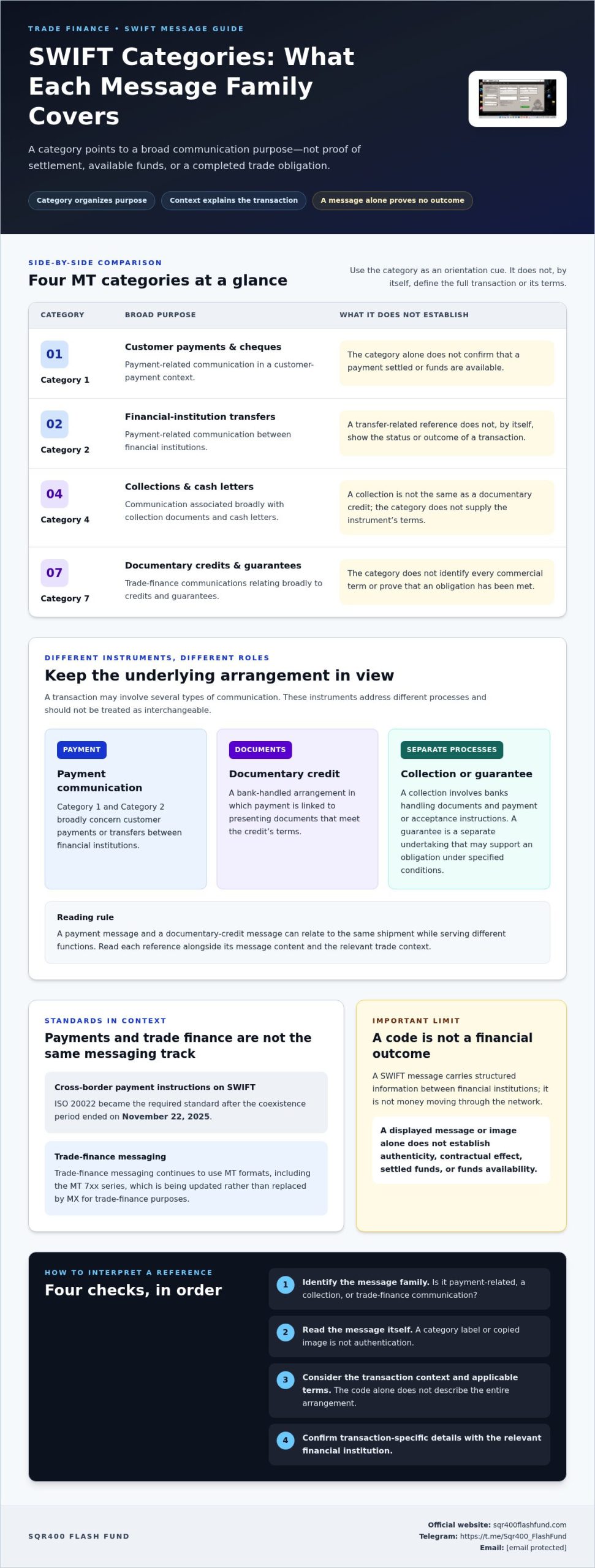
SWIFT MT messages are grouped into numbered categories that broadly organize their business purpose. Category 1 covers customer payments and cheques; Category 2 covers financial-institution transfers; Category 7 includes documentary credits and guarantees. These groupings help readers orient themselves, but they don’t certify transaction status or map every message to a complete trade process. The SWIFT message types overview provides a reference for message composition and category history.
MT and ISO 20022 are distinct standards families, not interchangeable names for the same message format. For cross-border payment instructions on SWIFT, ISO 20022 is now the required standard following the end of the coexistence period on November 22, 2025. Trade-finance messaging continues to use MT formats, including the MT 7xx series, which is being updated rather than replaced by MX for trade-finance purposes.
Why trade finance uses more than one message family
A trade transaction can involve several different needs: transferring payment information, communicating about a documentary credit, or handling a guarantee-related communication. Those purposes do not collapse into one message type. The appropriate message depends on the transaction and the participating institutions. Corporations provide instructions to their banks, and banks create and send messages on their behalf.
Consider a shipment supported by a documentary credit. Payment-related communication and messages concerning the credit address different parts of the business arrangement. A guarantee communication has a distinct context. Recognizing these differences helps prevent a payment reference from being mistaken for a credit or guarantee, or a general message from being treated as an undertaking.
SQR400 Flash Software is a simulation product with SWIFT integration that supports MT103 wire-transfer messaging. A simulated display is not a genuine bank-originated SWIFT message or transaction verification. For software information, visit the official website, or use Telegram at Sqr400 FlashFund and email support@sqr400flashfund.com. These channels provide product information, not confirmation of funds or settlement.
Which SWIFT message categories matter in trade finance?
Trade-related references can point to different SWIFT message categories because a transaction may involve payment instructions, documentary-credit communication, collection documents, or a guarantee. The category narrows the message’s broad function. It doesn’t identify every commercial term, establish which obligations apply, or prove that a transaction is valid.
SWIFT categories organize messages by communication purpose; they don’t establish commercial validity or confirm that an underlying trade obligation has been met. When interpreting a reference, first separate the message family from the financial instrument and commercial arrangement it relates to.
Trade finance, payments, and financial-institution transfers
In the MT message structure, Category 1 is for customer payments and cheques, while Category 2 is for financial-institution transfers. Both concern payment-related communication, but they describe different broad contexts. Category 7 covers documentary credits and guarantees, while Category 4 covers collections and cash letters. A category can orient a reader, but it cannot, by itself, identify the parties’ full roles or the terms of a sale.
For example, a payment message and a documentary-credit message may relate to the same commercial shipment while serving different functions. One concerns payment communication; the other concerns the credit arrangement. Read each reference alongside the underlying trade context rather than treating it as a stand-alone description of the whole transaction.
Documentary credits, collections, and guarantees
These instruments address different risks and processes. A documentary credit is a bank-handled arrangement in which payment is linked to the presentation of documents that meet its terms. A documentary collection involves banks handling documents and payment or acceptance instructions, but it is not the same as a documentary credit. A guarantee is a separate undertaking that may support an obligation under specified conditions. Interpret message references in light of the specific instrument and its terms.
- Payment communication: Category 1 and Category 2 messages relate broadly to customer payments or transfers between financial institutions.
- Documentary collections: Category 4 messages concern collection and cash-letter business, not the same bank undertaking as a documentary credit.
- Credits and guarantees: Category 7 messages relate to documentary credits and guarantees, which have distinct terms and commercial roles.
These are broad category descriptions, not a substitute for checking the current SWIFT Standards documentation. Exact message functions and market practices can depend on the specific message type and applicable version. A reference to Category 7, for instance, doesn’t by itself show whether a communication concerns a credit or a guarantee, or what terms govern it.
Keep the review in order: identify the category, determine the relevant instrument, then read the specific message definition alongside the transaction documents. SQR400 Flash Software provides simulated financial visualizations, not genuine bank-originated messages or transaction verification. Find SQR400 Flash Software information for product details.
How common trade-related MT messages differ
MT identifiers are useful starting points, not complete descriptions of a trade. The table summarizes the broad purpose of commonly referenced messages. Check exact definitions and applicable practices against the current SWIFT Standards documentation, since standards can change.
| Message | Broad purpose | Trade context |
|---|---|---|
| MT700 | Issue of a documentary credit | Communicates the issuance of a credit under its stated terms. |
| MT707 | Amendment to a documentary credit | Communicates an amendment; the applicable credit and amendment terms matter. |
| MT760 | Guarantee or standby letter of credit | Used for a guarantee-related or standby-credit communication; the code alone does not establish the undertaking’s effect. |
| MT799 | Free-format message | Can carry bank-to-bank text, but is not itself a payment undertaking or guarantee. |
| MT103 | Customer credit transfer | Associated with payment messaging, not proof that a trade obligation was fulfilled. |
Letters of credit and documentary-credit messages
MT700 and MT707 relate to different points in documentary-credit communication: issuance and amendment. A code can help identify the message’s stated purpose, but it doesn’t prove that goods were shipped, documents comply, funds are available, or the buyer or seller performed its obligations. Those questions depend on the credit’s terms, relevant documents, and independent confirmation of the transaction’s status.
An amendment message also needs to be read in context. Its existence doesn’t, by itself, reveal the full effect of the change or whether the parties’ records reflect it. The underlying credit and its applicable amendments remain essential to understanding what the message concerns.
Guarantees, free-format messages, and payment messages
MT760 is associated with guarantee or standby-letter-of-credit messaging. Its identifier doesn’t establish the wording, conditions, enforceability, or performance of an underlying undertaking. MT799 is a free-format message. It may convey information between institutions, but it does not itself create a payment guarantee or commitment to pay. Treating an MT799 reference as proof of funds or a bank undertaking is a material interpretive error.
MT103 belongs to customer-payment messaging. A reference to it may relate to a payment transfer, but the message type alone cannot establish successful settlement, access to funds, or completion of a commercial sale. Keep the communication’s stated function separate from evidence that the parties or banks performed.
A message identifies what was communicated; independent evidence is needed to establish whether the relevant payment, undertaking, or trade obligation took effect. Read the code alongside the actual transaction context and authoritative message definition. SQR400 Flash Software includes MT103 wire-transfer support for simulation; product information at the official website is not verification of a genuine bank-originated message or transaction.
What a SWIFT message can, and cannot, confirm
A SWIFT message can communicate an instruction, a bank-to-bank notice, or information about a trade-finance instrument. A displayed message or image alone cannot prove that funds are available, that a payment has settled, or that a trade obligation has been fulfilled. The evidence required depends on the question being asked.
Separate four issues. Authenticity concerns whether the communication genuinely originated through the relevant institution. Message status concerns its position in a messaging or processing workflow. Contractual effect depends on the instrument, its terms, and the relevant circumstances. Funds availability is a matter for the financial institution holding or processing the funds. Don’t infer any of these solely from a message code or screenshot.
Message reference versus transaction confirmation
A message identifier or copy can help parties discuss a communication, but it is not equivalent to independent confirmation from a bank. To interpret a reference, consider the transaction parties, underlying instrument, communication’s provenance, and status reported through appropriate institutional channels.
For confirmation, use established channels to contact the relevant financial institution, rather than relying only on contact details shown in a message or image. Ask the institution to confirm the specific point at issue, such as whether it recognizes a communication or whether funds are credited and available. Appearance alone cannot establish that a document is genuine or fraudulent, so avoid either conclusion based only on visual inspection.
Common interpretation errors in trade discussions
Misreading often begins when a message’s broad function is treated as evidence of a financial outcome. A payment-related message may describe a transfer instruction, but that does not necessarily show completed settlement. A guarantee-related message may communicate information about an instrument, but its code alone does not establish the instrument’s terms or effect.
- Message type is not liquidity: A payment or transfer reference does not by itself show that the beneficiary can access funds.
- Transmission is not settlement: Evidence that a communication was sent or processed is not necessarily confirmation that the payment completed.
- Reference is not performance: A documentary-credit or guarantee message does not prove goods were delivered or that a party fulfilled its obligations.
- Display is not bank verification: A screenshot or software-generated display is not a substitute for confirmation from the relevant institution.
Keep the conclusion narrow: determine what the communication says, then verify the separate financial or commercial outcome through the institution responsible for it. SQR400 Flash Software is a simulation product; its displays must not be treated as authentic bank-originated messages or transaction evidence. Use the official website for software information, not transaction verification.
A practical framework for reading trade-message references
A disciplined review separates what a message appears to describe from what a transaction has actually achieved. Use the sequence below to guide your interpretation, then direct unresolved transaction questions to the institution or trade-finance contact responsible for them. This framework supports understanding swift message types for trade without generating, modifying, or simulating a message.
A four-step reference-checking sequence
- Identify the stated context. Determine whether the reference concerns a payment, documentary credit, collection, guarantee, or another trade-related communication. Treat this as the apparent business context, not proof that goods were delivered, a payment completed, or an undertaking performed.
- Check the identifier against current standards. Compare the message type with current SWIFT Standards documentation and applicable institutional references. Record the message family and its defined purpose. Avoid relying on a copied description, an old reference sheet, or a code viewed without its surrounding context.
- Confirm the relevant transaction status independently. If the question concerns authenticity, processing, settlement, an undertaking, or funds availability, seek confirmation through established channels with the financial institution responsible for that point. Ask a precise question: recognition of a communication and confirmation that funds are available are different checks.
- Log unresolved questions. Note what the reference states, what the standards definition says, and what remains unverified. Direct those specific issues to the responsible banking or trade-finance contact, keeping message interpretation separate from transaction confirmation.
This order reduces category errors. Identifying a payment-related message does not answer whether settlement is complete. Recognizing a guarantee-related message does not establish the instrument’s terms or effect. Current documentation supports accurate interpretation; only the institution with relevant transaction information can address its own status.
Further information and contact details
Use current SWIFT Standards documentation for message definitions, and consult the relevant financial institution for transaction-specific confirmation. Keep records of the reference and the questions raised, but don’t treat a message image, a typed identifier, or an educational display as a substitute for independent verification.
SQR400 Flash Software is a simulation product. Its displays are separate from genuine bank-originated SWIFT communications and cannot verify a transaction, prove funds, or confirm settlement. For general software information, visit the official SQR400 website. Contact the company for product information, not bank transaction verification.
- Telegram: Sqr400 FlashFund
- Email: support@sqr400flashfund.com
The core discipline is simple: interpret the reference, verify its defined meaning, and confirm transaction-specific facts independently. That is the reliable boundary between understanding a message and treating it as evidence of a financial outcome.
Make message review part of your trade controls
Turn understanding swift message types for trade into a consistent review habit. For each reference, record the business question it relates to, the standard definition consulted, and any point that still requires confirmation. This creates a clear handoff between message interpretation and transaction review, helping teams base decisions on documented information rather than assumptions.
As standards and market practices evolve, maintain a process for consulting current authoritative references. For transaction-specific matters, use established channels with the financial institution responsible for the relevant communication or funds. SQR400 Flash Software is a simulation product; its displays are not authentic bank messages or evidence of a transaction.
For general information about the software, visit the official SQR400 website. Product enquiries can also be directed through Telegram or by email at support@sqr400flashfund.com. These contacts provide product information, not bank transaction confirmation.
Keep the distinction clear, and begin your next review with a sound basis for action.
Frequently Asked Questions
What are SWIFT message types used for in trade?
SWIFT message types provide standardized formats for financial institutions to communicate instructions and trade-related information. One shipment might involve separate references for a payment and a documentary credit, each addressing a different part of the transaction. To understand the message, start with the business event being documented, then check the specific identifier’s current definition. Don’t infer payment completion or contractual performance from a category label alone.
Is MT103 a trade-finance message?
MT103 is associated with customer credit transfer messaging, so it may appear in records related to an importer’s payment to an exporter. It isn’t a general proof-of-funds document. For example, a reference in a shipment file doesn’t establish that the beneficiary’s account has received cleared funds. Interpret the message in context, then confirm the payment’s status directly through the relevant financial institution using an established channel.
What is the difference between MT700 and MT760?
MT700 is associated with issuing a documentary credit, while MT760 is associated with guarantee or standby-letter-of-credit messaging. Their purposes point to different trade-finance arrangements: a credit addresses payment under stated documentary terms, while a guarantee or standby instrument has its own conditions. If either identifier appears in transaction records, compare it with the underlying instrument and current SWIFT documentation. Neither code alone proves validity or performance.
Can a SWIFT message prove that funds are available?
No. A message copy, identifier, or screen image alone can’t confirm available funds or completed settlement. A payment reference in a supplier’s file, for example, is not the same as confirmation that the beneficiary can use the funds. Contact the financial institution responsible for the account or transfer through an established channel, and ask about the specific status you need to verify.
How do I identify which SWIFT message type applies to a trade?
Begin with the transaction documents and identify whether the reference concerns a payment, collection, documentary credit, or guarantee. Then compare the message identifier with current authoritative standards documentation. If the documents and message reference appear to describe different purposes, record the discrepancy and raise it with the responsible banking or trade-finance contact. This helps avoid assigning meaning to a code without the transaction details that give it context.
Are SWIFT MT messages the same as ISO 20022 messages?
No. MT and ISO 20022 are distinct messaging standards with different structures and terminology. For cross-border payment instructions on SWIFT, ISO 20022 is now the required standard; trade-finance messaging continues to use MT formats, including the MT 7xx series. Don’t assume an MT identifier has a direct one-to-one MX equivalent. For a particular transaction, check the applicable current standard and the practices of the institutions involved.