


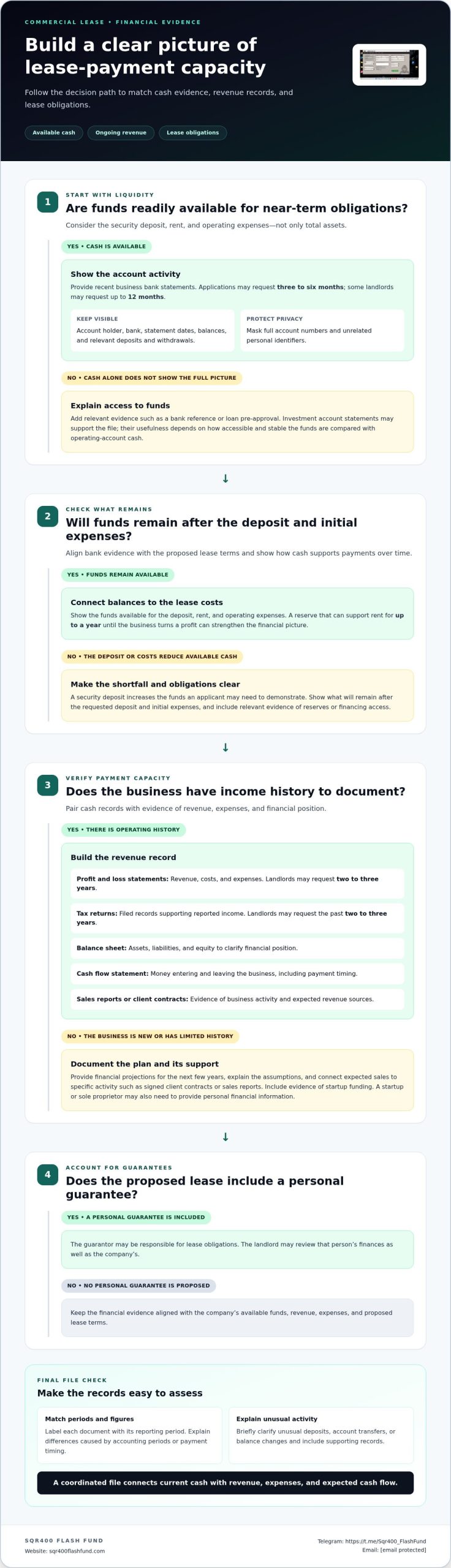
A bank balance is only one part of a landlord’s financial review. To show funds for a commercial lease, provide recent business bank statements, typically covering three to six months, alongside evidence of revenue, financial position, and access to financing where relevant. The documents should show how the business can cover the security deposit, rent, and ongoing expenses.
Cash available now matters, but landlords may also want to know whether the business can sustain payments over time. Clear, consistent records connect current funds with revenue, expenses, and expected cash flow.
This guide explains what landlords look for and how bank statements, profit and loss statements, tax returns, bank references, and loan pre-approval can support an application. It also covers how deposits and personal guarantees may affect the evidence requested, so you can prepare a financial picture that is complete, accurate, and easy to assess.
Key Takeaways
- Use recent business bank statements to demonstrate available cash, and organize them so deposits, balances, and payment activity are easy to assess.
- Pair cash records with revenue evidence, such as financial statements, tax returns, sales reports, or client contracts, to show the business’s ability to sustain rent payments.
- Bank references and loan pre-approval can help explain access to funds when current cash balances don’t show the full financial picture.
- Investment account statements may support an application, but their usefulness depends on how accessible and stable the funds are compared with cash in an operating account.
- Security deposits and personal guarantees can affect the financial evidence a landlord requests; understand how each changes the obligations attached to the lease.
Bank statements as evidence of available funds
Bank statements show the cash held in business accounts and how funds move over time. For a commercial lease, landlords use them alongside other financial statements to assess liquidity, reserves, and payment capacity.
How can a startup or new business prove it can afford a commercial lease? Provide available business statements, financial projections, and evidence of startup funding, then connect projected income to rent and operating costs. Statements covering three to six months show account activity, while reserves help demonstrate how the business plans to cover expenses before it turns a profit. How should sensitive information be redacted? Mask full account numbers and unrelated personal identifiers, but leave the account holder, bank, statement dates, balances, and relevant deposits and withdrawals visible. Do requirements vary by state or city? Requested documents can differ by landlord, property, and lease terms, so tailor the application to the specific commercial space.
Liquidity and Cash Reserves
Liquidity means business funds that are readily available for near-term obligations. Landlords assessing a commercial property want to see funds that can cover a deposit, rent, and operating expenses, not just assets that may take time to convert to cash. Statements show the difference through balances and transaction history.
Present statements for each relevant business account, with a clear period and account holder. Landlords may request statements for the last 12 months, while some applications request recent statements covering three to six months. A reserve that can support rent for up to a year until the business turns a profit can strengthen the financial picture.
Deposits and Guarantees
A security deposit is cash held against lease obligations, increasing the funds an applicant may need to demonstrate. A personal guarantee can make the guarantor responsible for lease obligations, so the landlord may review that person’s finances as well as the company’s.
Show that funds will remain available after accounting for the requested deposit and initial expenses. A larger deposit or guarantee may support an application, but each changes the cash required or obligations assumed. Make sure the bank evidence aligns with the proposed lease terms.
Bank statements are most useful as part of a coordinated financial file. A profit and loss statement summarizes revenue, costs, and expenses, helping the landlord assess whether operations can support recurring rent. A balance sheet lists assets, liabilities, and equity, providing context for the cash balance and the business’s overall financial position.
A cash flow statement offers another view by tracking money entering and leaving the business. A company, for example, may report a profit even though customer payments arrive after rent is due. Comparing cash flow with bank activity clarifies timing, recurring obligations, and the funds available for lease payments.
Organize documents so dates and figures align. Briefly explain unusual deposits, transfers between accounts, or changes in balances, and include supporting records. This helps demonstrate financial stability without relying on a single snapshot to prove ongoing payment capacity.
Proof of income or revenue
A landlord assesses more than cash on hand. Revenue records show whether business activity can support rent and other lease obligations over time. Complete, consistent documents help establish financial stability and standing, especially when a property’s operating costs extend beyond base rent.
Business tax returns and financial statements provide historical context. Landlords may request tax returns for the past two to three years and profit and loss statements covering two to three years. These records help compare reported income with expenses and show whether revenue is stable, rising, or uneven. Keep business and personal records separate where possible.
Organize the financial package around the landlord’s assessment:
- Profit and loss statements: Show revenue, costs, and expenses across the requested period.
- Balance sheets: Present assets, liabilities, and equity to clarify the business’s financial position.
- Cash flow statements: Explain how operations generate and use cash.
- Tax returns: Support reported income with filed financial records.
- Sales reports or client contracts: Document business activity and expected revenue sources.
A newer business may have limited income history. Financial projections for the next few years can explain expected revenue, expenses, and the assumptions behind the estimates. Connect projected sales to specific business activity, such as signed client contracts or documented sales reports. A startup or sole proprietor may also need to provide personal financial information so the landlord can assess the applicant’s individual financial position.
Consistency matters. If a tax return, profit and loss statement, and bank statements show different figures, explain the accounting period or timing behind the difference. For example, a contract may show expected work, while a sales report records completed transactions. Label each document with its reporting period and keep figures accurate and current.
Landlords may also review credit history, including how an applicant has managed debt and made payments. This complements income evidence but does not replace it. Present revenue records alongside a clear account of recurring expenses and lease obligations, so the landlord can assess capacity rather than a single income figure. Accurate, organized documents make the financial picture easier to evaluate and clarify the business’s ability to meet its commitments.
Landlords may request business financial statements covering the previous 1-3 years and the previous 2 years of tax returns. Newer businesses may need projections for the next few years.
Bank references and loan pre-approval
A bank reference and a loan pre-approval document provide different evidence. A reference can describe the business’s banking relationship, while a lender’s letter can show financing approval for a specific amount. Neither automatically replaces clear, accurate financial records. Together, they can help a landlord assess the applicant’s ability to meet leasing costs and other expenses.
Request a bank reference addressed to the landlord or leasing agent. Subject to the bank’s disclosure practices, it can identify the account holder and confirm the banking relationship. A reference does not guarantee that funds will remain available. Pair it with current statements and financial documents explaining the business’s cash position.
For a small business loan, a bank letter showing pre-approval for a specific amount can support the application. The amount should relate to a defined business need, such as tenant improvements or startup costs. Pre-approval indicates that a lender has reviewed the application at a preliminary stage; it does not establish that the loan has been funded.
- Bank reference: Supports the record of the business’s banking relationship.
- Loan pre-approval: Shows a lender’s preliminary approval for a stated amount.
- Business plan: Connects projected revenue and expenses to the proposed commercial space.
- Lease agreement: Identifies the payment obligations the financing is intended to support.
Traditional bank loans are often favored for lower interest rates, but they typically have stricter qualification criteria. Lenders assess credit, revenue, existing debt, and the business plan. Distinguish approved financing from funds already deposited to give the landlord a clear view of current liquidity and financing available for the lease.
Can a letter of credit or bank guarantee replace proof of funds for a commercial lease? It can provide a separate form of assurance, but it does not automatically replace evidence of available funds. The landlord assesses the instrument’s terms, the issuing bank, and whether it covers the obligations in the proposed agreement.
A letter of credit or bank guarantee differs from loan pre-approval. The former provides assurance under specified terms; pre-approval indicates potential borrowing capacity. Present the document with its issuer, covered amount, conditions, and expiration details visible. Do not describe conditional financing as cash in the business account.
When preparing a leasing package, keep the bank reference, financing letter, business plan, and lease figures consistent. For example, explain how a loan supports planned expenses without counting the same funds twice. Accurate documents let the landlord assess the full financing picture, including credit and the business owner’s ability to meet the agreement.
Do commercial landlords accept investment accounts or brokerage statements as proof of funds?
Investment accounts and brokerage statements can support a commercial lease application, but they do not show the same thing as cash in an operating account. A statement lists assets and their reported value at a particular point in time. The landlord may assess whether those assets are accessible enough to cover lease obligations when payments fall due.
Check the statement for details that establish ownership and liquidity. The account holder’s name connects the assets to the applicant or guarantor. Cash balances indicate funds available now, while stocks, bonds, and mutual funds may need to be sold before the proceeds can be used. Because market values can change, a statement is a snapshot, not a fixed cash balance.
Present brokerage records as supporting evidence, not as a replacement for clearly documented business funds. Identify which assets are liquid and which require a sale or transfer. For example, a statement showing both a cash balance and a portfolio of shares distinguishes accessible cash from investments whose value may fluctuate.
- Account ownership: Match the statement name to the business owner, business entity, or guarantor named in the application.
- Statement date: Use a recent, complete statement so the landlord can understand when the balances and valuations were recorded.
- Asset type: Separate cash holdings from investments that require a sale before use.
- Access: Explain whether funds can be transferred to the business account used for lease payments.
Access is central to the assessment. A brokerage balance may look substantial, but the landlord needs to understand whether the funds are accessible without restrictions. If the account includes investments, explain how those holdings relate to the cash available for a deposit, rent, or operating expenses. Do not present an asset’s displayed market value as cash already available.
Keep the documents consistent with the application. If an account belongs to an owner rather than the tenant business, identify that relationship clearly. If the owner plans to contribute funds, explain whether this is a planned transfer or an existing business asset. This distinction clarifies who controls the account and whether the business can use the funds.
Combine investment evidence with business records showing income, expenses, and payment activity. A brokerage statement can strengthen the financial picture when its owner, asset type, valuation date, and accessibility are clear. For a commercial lease, the key question is not simply what an account is worth, but how its assets could support the tenant’s obligations.
How do commercial lease security deposits and guarantees affect proof-of-funds requirements?
A security deposit increases the cash a tenant must show is available before signing. A commercial lease applicant may be asked for a rent security deposit. One or two months’ rent is described as typical, though a landlord may consider three, four, or even six months’ rent. The proposed deposit therefore affects the funds the applicant needs to demonstrate.
Calculate the deposit using the rent stated in the proposed lease, then account for startup and operating expenses separately. For example, if the landlord asks for a deposit equal to several months’ rent, statements should show that paying it will not use funds reserved for ongoing obligations. Keep the calculation aligned with the lease terms and the figures in the financial documents.
A larger deposit may strengthen an application by providing the landlord with additional security. It also ties up more of the tenant’s available cash. Compare the proposed deposit with the business’s reserves and expected cash flow rather than treating the deposit amount as the sole measure of financial capacity.
- Deposit evidence: Show available funds that account for the proposed security deposit and other initial expenses.
- Business applicant: Identify whether the lease names an LLC, corporation, or individual tenant.
- Personal guarantee: Understand which owner or executive accepts personal responsibility under the guarantee.
- Guarantor finances: Prepare a personal financial statement if requested to show the guarantor’s assets.
When an LLC or corporation signs a lease, the landlord may request a personal guarantee from the business owner or key executives. If the business defaults, the guarantee can make the signer personally liable for lease obligations. This creates personal financial exposure beyond the company’s funds, so distinguish business assets from the guarantor’s personal assets.
A landlord may request a guarantor’s personal financial statement to assess those assets. Provide accurate information that identifies the guarantor and distinguishes assets from liabilities. A guarantee is not cash in the tenant’s account, so do not describe it as proof of immediately available business funds. It is a separate commitment supporting the lease.
Assess each option against the lease’s actual obligations. A larger deposit uses more cash upfront; a personal guarantee places potential responsibility on the guarantor. If offering either, make sure the application documents explain the arrangement and align with the proposed lease. Software information is separate from lease evidence and does not establish a tenant’s available funds.
SQR400 Flash Fund: SQR400 v5.8 Pro
SQR400 v5.8 Pro is not evidence of funds for a commercial lease. Simulated financial visualizations cannot establish that cash exists in an account, that revenue was earned, or that financing was approved. Don’t submit simulated or altered records as genuine bank statements, income documents, or lender correspondence.
For a lease application, use authentic statements from the financial institution, accurate business financial statements, and genuine loan documentation. Keep account ownership, balances, dates, and transactions unaltered. If a document contains sensitive information, redact only details that are not needed to assess the application, while preserving its accuracy and provenance.
Prepare Your Next Lease Application with Clear Evidence
A commercial lease application should reflect verifiable financial records, not simulated balances or transaction imagery. SQR400 Flash Fund offers SQR400 v5.8 Pro, SQR400 v5.8 Lite, and SQR400 v7.8.4, but these software offerings are not substitutes for authentic bank statements, revenue records, or lender documents. Don’t present simulated financial material as genuine proof of funds.
A reliable next step is to align each document with the lease obligations it supports and preserve its accuracy. That gives the landlord a clear basis to assess the application and helps you proceed with confidence. Use this practical standard to guide how to show funds for a commercial lease: every document should be genuine, relevant, and consistent with the business’s financial position.
For information about the software, visit SQR400 Flash Fund, or contact the team through Telegram or at support@sqr400flashfund.com. Move forward with accurate records and a clear application.
Frequently Asked Questions
What Do Landlords Look For?
Landlords look for evidence that a tenant can meet the lease’s financial obligations. They assess available funds, revenue, business expenses, payment history, and credit history. For example, a business with strong sales but significant recurring debt has a different financial profile from one with similar revenue and fewer obligations. The proposed rent, security deposit, and any personal guarantee also shape which records help explain the application.
How many months of rent do commercial landlords require as proof of funds?
There is no single rent-reserve period required across commercial leases. Landlords may assess whether a business can cover six to twelve months of rent during the upcoming year, particularly when evaluating its ability to sustain operations. A security deposit is separate: one or two months’ rent is described as typical, while a landlord may consider three, four, or six months. Distinguish the upfront deposit from funds reserved for ongoing rent.
Can bank statements be used to show funds for a commercial lease?
Yes. Business bank statements can show account balances, deposits, withdrawals, and cash availability. Provide statements for the relevant business account, with the account holder and statement period visible. If a large deposit appears shortly before applying, for example, include a clear explanation and supporting record showing its source. Landlords may ask for statements covering recent months or the last twelve months for relevant accounts.
What financial statements and tax returns do landlords request from commercial tenants?
Commercial tenants commonly provide profit and loss statements, balance sheets, and cash flow statements, alongside personal or business tax returns. Landlords typically request tax returns covering the past two to three years; business financial statements can also span two to three years. A startup without that operating history can provide financial projections for the next few years. Keep reporting periods clear so the records can be compared accurately.