


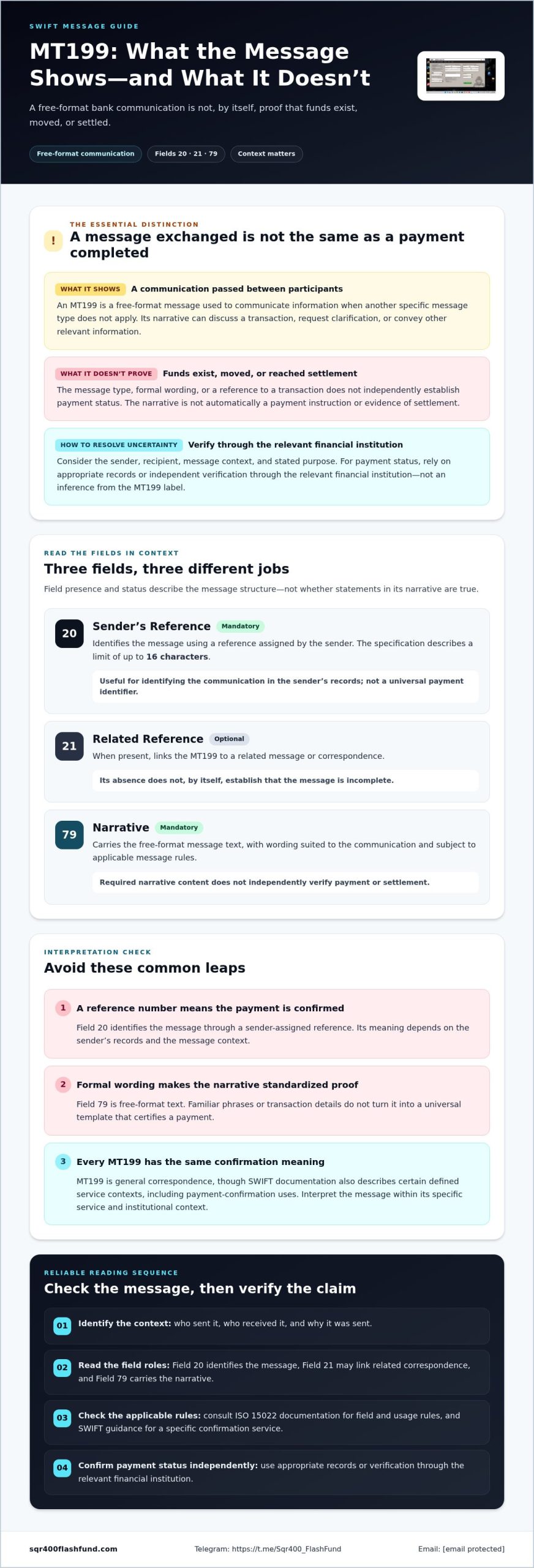
A SWIFT message that looks like a payment confirmation may establish only that banks exchanged a message. That distinction matters when interpreting the swift mt199 message format: its free-text narrative can describe a transaction, but the wording alone doesn’t prove that funds exist, moved, or settled.
MT199 has identifiable fields, including Field 20 for a transaction reference, Field 21 for a related reference, and Field 79 for the narrative. But those labels don’t turn the narrative into a standardized payment instruction. Its meaning depends on the message context and the institutions involved.
This guide explains the MT199’s purpose, how its key fields work, and what a message can and can’t establish. You’ll also learn why an MT199 should be treated as correspondence rather than proof of funds or completed settlement, and when independent verification through the relevant financial institution is necessary.
Key Takeaways
- Use the swift mt199 message format to identify a bank-to-bank free-format communication, not as evidence that a payment was initiated or settled.
- Read each documented field in context, including its official name and whether it is mandatory under the applicable message rules.
- Distinguish general MT199 correspondence from confirmation messages used within SWIFT Universal Confirmations’ defined service context.
- Consider the sender, recipient, context, and stated purpose, then rely on independent financial-institution verification for payment status.
- Consult ISO 15022 documentation for MT199 field and usage rules, and SWIFT guidance for the specific confirmation service.
What Is a SWIFT MT199 Message, and What Is It Used For?
Under the ISO 15022 message framework, MT199 is a free-format message used to communicate information when another specific message type does not apply. SWIFT documentation also describes MT199 in defined service contexts, including certain payment-confirmation uses. In practical terms, it gives financial institutions a structured way to exchange a message whose content does not fit a more specialized format. The SWIFT network carries financial messages between participants, but neither the network nor the message type, by itself, proves that a payment occurred.
The label “free-format” can be misunderstood. It refers to the text content of the message, not to unlimited authority to state or establish any financial fact. An MT199’s purpose depends on why it was sent, its relationship to other messages, and the payment or correspondence context. Its narrative may discuss a transaction, request clarification, or convey other relevant information. The wording alone doesn’t make it a payment instruction or evidence of settlement.
An MT199 identifies a communication format, not a completed transfer of funds. When reviewing a message that mentions a payment, separate the fact that a message was exchanged from any claim about the underlying transaction’s status. Establish payment status through appropriate records or verification, not by inferring it from the MT199 label.
What does free-format mean in MT199?
In an MT199, the narrative field carries the message text. The sender can use that space to convey relevant information in wording suited to the communication, subject to the applicable message rules. This flexibility is useful when no more specific message type fits. It does not create a universal transaction template with standard wording that independently certifies a payment. Interpret the narrative in the context of the full message.
Two MT199 narratives can serve different purposes even though they share the same message type. A field’s presence identifies where information belongs; it doesn’t make every statement in that field an independently validated fact. Familiar phrases, formal formatting, or references to a transaction are not proof of an outcome.
Who uses MT199 in documented contexts?
ISO 15022 describes MT199 for communication between financial institutions and, where applicable, between a corporate and its financial institution. This is institutional messaging, not an open channel available to every customer. Whether a corporate can participate depends on the relevant arrangement and messaging access. The message type itself doesn’t establish who sent a particular message or authenticate a document presented outside its original channel.
MT199 can support correspondence about a transaction when a more specific message type is not applicable. The payment context helps explain why the message was sent, while the narrative states what the sender is communicating. Read those elements together, and distinguish the message’s role from the transfer process itself. A message can report or discuss an event without being the event.
How the MT199 Message Format Organizes Its Documented Fields
The swift mt199 message format combines defined fields with a narrative area for the message’s content. Each field has a distinct role: identifying the message, linking it to related correspondence, or carrying the text. A field’s status tells you whether it is required or optional under the message specification. It doesn’t establish the truth of statements in the narrative.
| Field | Official name | Status | Role |
|---|---|---|---|
| 20 | Sender’s Reference | Mandatory | Identifies the message using a reference assigned by the sender. |
| 21 | Related Reference | Optional | Links the message to a related message or correspondence. |
| 79 | Narrative | Mandatory | Carries the free-format message text. |
Check field names, status, and permitted formats against the current ISO 15022 specification and relevant SWIFT documentation. This matters when interpreting a displayed message or a version-specific implementation: field rules come from the standard, not from an informal sample.
Field 20: Sender’s Reference
Field 20 is the sender-assigned reference used to identify the MT199 message. It helps the sending institution distinguish and track the communication in its own records. It is not a universal payment identifier: its meaning depends on the sender’s recordkeeping and the context in which the message was exchanged. Standard field specifications describe a limit of up to 16 characters. Verify that format against the applicable current documentation before relying on it.
Fields 21 and 79: Related Reference and Narrative
Field 21 is optional. When present, it points to a related message or reference and helps connect the MT199 to earlier correspondence. Its absence does not, by itself, establish that the message is incomplete. Whether a related reference is relevant depends on the communication.
Field 79 is the mandatory narrative field. It contains the sender’s free-format text, so interpret its wording in context rather than assuming it follows a universal transaction template. The field’s required presence means the message includes narrative content, not that the content independently verifies a payment or settlement.
Field 20 identifies the sender-assigned message reference, Field 21 optionally links related correspondence, and Field 79 carries the mandatory narrative. Read their roles together: the reference identifies the message, the related reference may connect it to another message, and the narrative explains its stated purpose. Interpret none of these fields in isolation from the message context.
SQR400 Flash Fund offers SQR400 Flash Software, a transaction simulation tool designed to display simulated liquidity and fund balances. A simulated display is not a genuine SWIFT message or independent evidence of funds or payment status. For more information, visit the official website. Contact the team on Telegram at Sqr400_FlashFund or by email at support@sqr400flashfund.com.
MT199 Versus Payment Confirmation: What the Message Does, and Does Not, Show
An MT199 can carry information about a payment, but its message type alone doesn’t identify the payment’s final status. SWIFT also documents MT199 use within specific Universal Confirmations contexts, including gCCT. That defined use is different from treating every MT199 narrative as a confirmation. Interpret the message by considering its source, service context, and applicable confirmation process.
| Record or use | What it can indicate | What it does not establish by itself |
|---|---|---|
| General MT199 communication | A financial-institution message conveying information in its narrative. | That funds are available, credited, transferred, or settled. |
| Defined Universal Confirmations use | A confirmation or status report within the applicable SWIFT service context. | That the same interpretation applies to every MT199 message. |
| Settlement evidence | Payment status supported through appropriate institutional records or verification. | It cannot be inferred solely from a message label or copied narrative. |
An MT199 is a message. Independently verified payment status is a separate determination based on the relevant institution’s records and process. This distinction prevents the flexible swift mt199 message format from being mistaken for a universal proof-of-payment template.
When is MT199 used for payment confirmations?
SWIFT documents MT199 as a confirmation mechanism in defined Universal Confirmations use cases, including gCCT. In that context, the message participates in a specified payment-status reporting process. Its meaning comes from that service framework, not from the MT199 type in isolation. Eligibility, message handling, and implementation details can depend on current SWIFT service rules, so consult official SWIFT materials for the applicable context.
A message presented outside that framework cannot be assigned the same confirmation meaning merely because it is labelled MT199 or contains confirmation-like wording. Check what service the communication belongs to and what status the process is designed to report. Don’t generalize a narrow, documented use into a claim about all MT199 messages.
Why is an MT199 not standalone proof of funds?
The narrative records what the sender communicates. By itself, it does not provide independent access to the recipient’s account records or establish that funds have been credited or settled. A payment may be discussed in a message without the message itself serving as proof of the payment’s final outcome.
Apply the same caution to screenshots and copied message text. A visual representation or excerpt may omit surrounding context, and its appearance alone doesn’t independently verify its origin or status. For a consequential decision, verify the relevant payment status through the financial institution and applicable process, rather than relying only on a document supplied by another party.
Keep three questions separate: who sent the message, what process it belongs to, and what status that process actually confirms. This preserves the distinction between communication and settlement evidence while recognizing MT199’s legitimate, service-specific confirmation role.
How to Read an MT199 Reference Without Overinterpreting It
Assess an MT199 in sequence, not by its appearance or a prominent phrase. First identify the stated sender and recipient. Then establish the message context and purpose, and examine its references alongside the surrounding correspondence. Finally, verify any claimed payment status through an independent channel. This approach separates what the document says from what the underlying transaction records establish.
- Identify the parties. Note who the message says sent it and whom it addresses. A name or institution shown in a copy provides context, not independent authentication of origin.
- Establish the context. Determine whether the communication concerns an inquiry, transaction information, related correspondence, or a confirmation process with a defined scope.
- Read references in context. Treat Field 21 and any UETR reference as links to other records, not proof of a payment outcome.
- Verify the claimed status independently. Use the relevant financial institution or established payment channel to confirm account credit or transaction status.
Check the message context and references
Read the sender, recipient, message purpose, and surrounding transaction context together. Field 21 may point to a related message; a UETR may appear in user-header Field 121 in specified circumstances. Neither reference can be interpreted reliably without the associated record and applicable process. A reference is a traceability clue, not a standalone settlement record.
The swift mt199 message format can look technically precise, but formatting, field labels, and financial terminology alone don’t establish authenticity or show that a transaction reached a particular stage. Compare the stated purpose with the context in which the message is said to have been sent. If that relationship is unclear, treat the document as unverified rather than filling gaps with assumptions.
Verify payment status through an independent channel
For a claim about funds credited or payment status, use an institution-controlled channel associated with the relevant account or payment relationship. Keep that verification separate from files, screenshots, or copied message text supplied by a counterparty. Those materials may help you identify what to ask about, but they are not a substitute for confirmation through the institution’s own records and process.
If the verified status conflicts with the MT199 wording, pause before acting on the document. Preserve the relevant correspondence and raise the discrepancy through the established financial relationship. Avoid relying on contact details supplied only within the disputed material; use the channel already associated with your institution instead.
Use a consistent rule: interpret the document, then verify the transaction independently. For general information about SQR400 Flash Software, visit the official website. Simulation software is separate from verification of genuine SWIFT messages or payment status.
Where to Check Current MT199 Standards and Confirmation Guidance
Use the source that governs the question. For the message definition, field requirements, permitted formats, and usage notes, consult the current ISO 15022 documentation and relevant SWIFT standards material. For a confirmation claim tied to a particular SWIFT service, consult that service’s guidance. This keeps the swift mt199 message format grounded in its standard and prevents service-specific rules from being applied to every MT199.
Third-party explainers can make technical language easier to follow, but they are secondary references. If a summary conflicts with the official specification, rely on the applicable official documentation. Copied message samples may reflect a particular context or implementation and should not replace current field rules.
Use official references for message specifications
In ISO 15022 documentation, focus on the MT199 definition, scope, field status, and field-format rules. Confirm whether each field is mandatory or optional, and read its usage notes alongside the broader message definition. Check the version or release relevant to the message under review, since the specification governs how its fields are defined and used.
Use SWIFT standards material to understand how the message operates within the SWIFT environment. If a third-party article offers a useful plain-language interpretation, compare its specific claim with the official field or usage rule rather than relying on the summary alone. A reference that explains a field is not a replacement for the standard.
Understand Universal Confirmations in their specific context
SWIFT’s Universal Confirmations guidance describes payment-status reporting within that service. MT199 may be used as a confirmation mechanism in defined contexts, including gCCT. That does not make every MT199 a Universal Confirmation or give all MT199 narratives the same status meaning. Review SWIFT’s Universal Confirmations guidance for current service information, including the relevant confirmation method and implementation context.
Keep adjacent message topics separate as well. A neutral comparison with an MT103 simulation tool guide may help distinguish discussions of different message types. A simulation or explanatory display, however, is not evidence that a genuine payment was sent, received, or settled.
For a practical review, match each claim to its source: use ISO 15022 for message fields and usage, SWIFT standards for network and service details, and Universal Confirmations guidance only for that defined service. Then verify a claimed payment status independently through the relevant financial institution or established payment channel. Standards explain message structure; appropriate institutional verification establishes the payment status relevant to a specific transaction.
Make Message Review Part of Your Payment Controls
Build a disciplined review process around the swift mt199 message format: document what the message states, identify what remains unverified, and route payment-status questions through the established institutional process. This creates a clear record of how decisions were made without treating message wording as a substitute for independent verification.
For service-specific confirmation information, review SWIFT’s Universal Confirmations guidance. For information about SQR400 Flash Software, visit the official website. Contact the team on Telegram or by email at support@sqr400flashfund.com.
Keep the distinction between communication and verified payment status central to every review. With a consistent process and the right reference materials, you can assess MT199 documentation with greater clarity.
Frequently Asked Questions
What is an MT199 message in SWIFT?
An MT199 is a SWIFT message type used for free-format financial correspondence when another specific message type is not applicable. For example, an institution may use it to communicate transaction information or request clarification. The message type identifies the format, not the real-world outcome being discussed. To interpret a particular MT199, consider who sent it, whom it addresses, and the business context recorded around it.
What information appears in the MT199 message format?
The MT199 format includes reference fields and a narrative. When reviewing a document, compare the sender’s reference with the institution’s own correspondence record, then check whether a related reference connects the message to earlier communication. The narrative contains the message text. Field labels help you locate information, but they don’t independently validate the text or establish a transaction’s status.
Is an MT199 message proof that money has been transferred?
No. An MT199 by itself doesn’t prove that funds were transferred or settled. A message might discuss a payment or describe a status, while the recipient’s account records show something different or no credit. Treat the message as correspondence to investigate, not as a substitute for transaction records. Verify the claimed outcome through the financial institution responsible for the relevant account or payment process.
Can an MT199 confirm that a beneficiary has received funds?
It can communicate a beneficiary-related status in a defined confirmation process, but an MT199 label alone doesn’t establish receipt. Check what status the message reports and whether it belongs to the relevant SWIFT confirmation service. A statement that a payment was sent is not necessarily confirmation that the beneficiary’s account was credited. For a specific claim, rely on the institution’s applicable records and verification process.
What is the difference between MT103 and MT199?
MT103 is a customer credit transfer message, while MT199 is a free-format message for financial correspondence. Their purposes differ: MT103 carries a structured payment instruction, and MT199 communicates text when another specific message type is not applicable. Comparing the formats can clarify their roles, but neither a description nor a simulation of a message should be treated as evidence that a real payment was completed.
How can a recipient verify an MT199 payment claim?
Use an institution-controlled channel tied to the relevant account or payment relationship, and ask for the transaction status to be checked against the institution’s records. Keep that verification separate from documents or screenshots supplied by the sender. If the bank’s recorded status differs from the claim, pause any decision based on the message and raise the discrepancy through the established financial relationship.
What does field 79 mean in an MT199 message?
Field 79 is the narrative field where the sender’s message text appears. For example, it may contain an explanation or request related to correspondence, but the exact wording depends on the message’s purpose. Read it alongside the sender, recipient, and related records. A statement in Field 79 remains a statement in the message; it doesn’t independently verify account credit, payment completion, or settlement.