


The word “flash” can describe two different funding mechanisms, and confusing them can undermine a deal plan. To understand how to use flash funds for deal leverage, distinguish blockchain flash loans, which must be repaid with the applicable fee in the same transaction or the transaction reverts, from transactional funding. Flash cash lenders typically expect repayment within 1 to 3 days.
A funding gap can put a viable transaction under pressure, but short-term capital helps only when repayment is clearly mapped out. This guide explains atomic repayment, how transactional funding can support deal leverage, and the constraints to consider before relying on either approach.
You’ll learn how these mechanisms differ, where leverage comes into play, and why repayment timing and execution risk matter.
Key Takeaways
- Separate blockchain flash loans from transactional funding: one must repay within the same transaction, while the other supports a short-term deal-closing timeline.
- Map the repayment source and timing before relying on temporary capital to bridge a funding gap.
- Understand how end-buyer contracts and proof of funds can affect transactional funding for a property deal.
- Assess leverage against fees, execution risk, and the consequences of a failed transaction.
- For software information, visit SQR400 Flash Fund. Contact via Telegram or email support@sqr400flashfund.com.
How transactional funding works
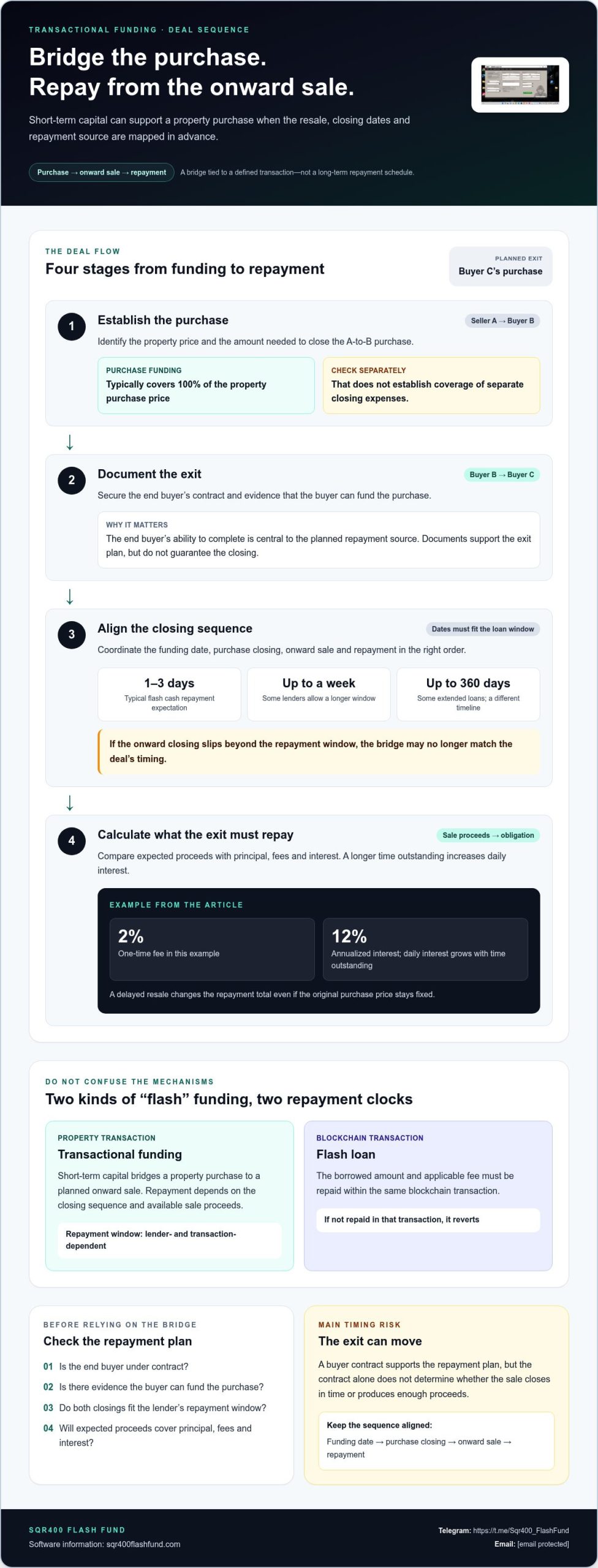
Transactional funding provides short-term capital for a property purchase when a planned resale or onward transfer will repay it. A typical structure connects a purchase from seller A to an onward sale to buyer C, with funding bridging the B-to-C transaction. Transactional lenders typically require an end buyer under contract and evidence that the buyer can fund the purchase. These documents support the repayment plan, but both closings still need to be coordinated.
The funding period is tied to the transaction, not a long-term repayment schedule. Flash cash lenders typically expect repayment within 1 to 3 days, although some allow up to a week. Some lenders offer extended transactional loans for as long as 360 days, which is a different timeline from a brief closing bridge. The key planning question is whether the onward sale can close in time to repay the advance.
- Establish the purchase. Identify the property price and the amount needed to close the A-to-B purchase. A flash cash loan typically covers 100% of the property purchase price, but that does not establish that separate closing expenses are covered.
- Document the exit. Secure the end buyer’s contract and proof of funds for the B-to-C transaction. The buyer’s ability to complete is central to the planned repayment source.
- Align the closings. Set the funding date, purchase closing, onward sale, and repayment sequence. If the second closing moves beyond the lender’s repayment window, the bridge can fail to match the deal’s timing.
- Calculate the obligation. Include the fee and interest in the amount the onward sale must cover. The example below shows why duration affects the total.
In one example, a flash cash lender charges a 2% fee plus 12% annualized interest. The fee is a one-time charge in this example, while daily interest increases with the time outstanding. A delayed resale therefore changes the repayment total even when the original purchase price stays fixed.
Transactional funding works as a bridge between a purchase and a defined repayment event. Before using it, map the closing sequence, verify the end buyer’s funding evidence, and compare expected proceeds with principal, fees, and interest. A contract supports the exit plan, but the timing and available proceeds determine whether it can repay the advance.
Blockchain flash-loan activity follows a different repayment rule from a property closing bridge: the borrowed amount and applicable fee must be repaid within the same blockchain transaction or the transaction is reverted. The paper reports that the maximum volume of FLD transactions using AAVE was 698.13 ETH in its analyzed statistics.
Some individual blockchain flash-loan transactions have involved hundreds of millions of dollars. Those figures do not establish the amount, cost, or availability of funding for a particular property purchase.
How do flash funds provide leverage in a deal, and how does the process work?
Flash funds can provide leverage by supplying temporary capital for a transaction that exceeds the buyer’s immediately available cash. The funding itself creates no profit. A deal’s value depends on the asset, transaction sequence, and a workable repayment or exit plan. To understand how to use flash funds for deal leverage, first identify the mechanism that fits: transactional funding can bridge a property purchase, while a blockchain flash loan supports operations within a single transaction.
The leverage calculation differs by structure. A property bridge supplies purchase capital against a planned exit. In decentralized finance, a leveraged position may reuse borrowed assets, within protocol limits such as loan-to-value, or LTV. A simplified model describes leverage as 1/(1−m) times the initial amount, where m is LTV. At an LTV of 0.5, that model produces 2x leverage. It describes a relationship, not a guaranteed return.
Consider an Ethereum position using collateral to borrow assets and increase exposure. In one model, borrowing $100 is described as optimal at an LTV of 0.5 under a fee function constrained by the leverage limit. That result depends on the model’s assumptions. In practice, liquidity, protocol fees, asset prices, and transaction costs shape whether the planned operation can execute as intended.
- Define the transaction. Identify the asset or position, the capital required, and the action expected to create value.
- Set the leverage boundary. Calculate LTV and the distance from the liquidation threshold. Maximum leverage leaves no buffer, so a lower LTV reduces exposure to price changes.
- Map execution. Specify the required contract calls, swaps, or settlement steps. A failed step can stop the planned sequence.
- Establish the exit. Identify the sale proceeds, refinancing, or on-chain operation intended to close the funding obligation. Include fees and execution costs in the calculation.
A contracted buyer can provide a defined exit for a property deal, while a leveraged crypto position depends on market value and protocol conditions. The risks differ: a delayed closing can disrupt repayment, while a falling asset price can move a DeFi position toward liquidation. Robust oracle designs, such as decentralized feeds, TWAP or medianization, and circuit breakers, can help sensitive contract logic avoid relying on a single pool’s spot price.
For professionals assessing how to use flash funds for deal leverage, the key is matching the funding structure to the transaction’s actual timeline and exit. Digital transaction simulation software can support analysis of proposed transaction workflows.
Can flash funds be used for down payments or to meet proof-of-funds requirements?
The answer depends on the funding type and the transaction’s requirements. Transactional funding provides short-term capital for a purchase, while a blockchain flash loan must be repaid within the same transaction. That atomic structure makes a flash loan unsuitable for funds needed at a later property closing or for a deposit. A temporary on-chain balance is not capital available at settlement.
For a property deal, flash cash funding typically covers 100% of the purchase price, rather than only a down payment. The funding structure therefore differs from a conventional deposit contribution. The critical distinction is whether funds are actually provided for the purchase and whether the closing sequence can complete the transfer and repayment. A displayed balance or transaction simulation does not itself fund a purchase.
Proof of funds serves a practical purpose: it gives a seller or transaction counterparty evidence that the buyer can make the planned payment. For transactional funding, lenders typically require an end buyer under contract and evidence of that buyer’s funds for the B-to-C transaction. This supports the exit plan. It is different from proof that the initial buyer has cash to complete the A-to-B purchase.
- Identify the requested evidence. Determine whether the seller needs proof for a deposit, the full purchase price, or the onward sale. Each request refers to a different payment obligation.
- Match evidence to the source. Show the actual funding arrangement and the relevant party’s available funds. A screenshot or temporary balance alone does not explain who supplies the money or when it can be transferred.
- Align the timing. Compare the purchase closing, onward sale, and repayment dates. Transactional lenders typically expect repayment within 1 to 3 days, although some allow up to a week.
- Reconcile the documents. Ensure the purchase contract, buyer contract, funding source, and repayment plan describe the same transaction sequence.
For example, an end buyer under contract might provide proof of funds for the resale, while a transactional lender supplies capital for the initial purchase. These are separate roles. The buyer’s documents do not prove that the initial purchaser has independently funded the acquisition, and the lender’s advance does not prove that the end buyer can complete the purchase.
Do not present a simulated or momentary balance as lasting purchasing capacity. Blockchain flash loans are designed for atomic execution, not for holding funds through a property closing. For a down payment or proof-of-funds request, check whether the source, amount, recipient, and timing match the actual payment obligation. If any element differs, the evidence does not accurately represent the transaction.
Flash loans
A flash loan is a blockchain loan that must be repaid within the same transaction. The borrower receives assets, carries out the intended contract operations, and repays the principal and applicable fee before the transaction ends. If repayment fails, the transaction reverts and the requested sequence does not complete successfully. This atomic condition defines the instrument: funds exist only briefly within that single transaction.
That execution model changes how DeFi borrowing can be composed. Before 2020, DeFi borrowing generally required borrowers to provide more collateral than the amount borrowed. Flash loans instead make repayment part of the same transaction’s success condition. They became widely used across DeFi protocols during 2020–2021, enabling operations that could otherwise require multiple funding steps.
Consider a contract designed to use borrowed assets across a sequence of operations. It can obtain liquidity, execute the planned operations, and direct the resulting assets toward repayment. The sequence must account for principal, fees, asset availability, and the order of contract calls. If the final balance cannot cover repayment, the transaction reverts. A projected gain is not enough; the transaction must produce the required assets before execution ends.
- Request liquidity. A borrower initiates the flash-loan call through a protocol that supports the operation.
- Execute contract logic. The transaction performs its defined swaps, position changes, or other on-chain operations.
- Settle repayment. The contract returns borrowed assets and the applicable fee within that transaction.
- Complete or revert. A transaction succeeds only when its required operations and repayment are completed as intended.
Without flash loans, building a leveraged position can require 8–10 separate transactions across multiple blocks. Each separate transaction introduces an additional execution point. A flash loan compresses compatible operations into one atomic transaction, but it does not remove market or smart-contract risk. A price can move during execution, a pool may lack sufficient liquidity, or a contract call may fail. If the sequence cannot repay, reversion prevents successful completion, but gas costs for the failed attempt can still matter.
Fees also affect feasibility. Some Aave flash-loan deployments historically charged a fee of approximately 0.09%. That historical figure is specific to some deployments, not a universal current rate. The applicable fee structure, available liquidity, and network execution costs influence whether an operation remains viable.
Flash loans can enable capital-efficient transactions, but they are not a substitute for a lasting funding source. Their defining use is atomic on-chain execution, not holding funds for a property closing or later payment. This is the key difference between DeFi flash loans and short-term transactional funding.
Flash loan
Flash-loan leverage is best understood through the relationship between collateral and borrowing capacity. In a simplified model, borrowing strategy produces leverage of 1/(1−m) times the initial amount, where m is the loan-to-value ratio, or LTV. The equation shows how borrowing can increase exposure, but it does not predict profit. Asset prices, protocol limits, fees, liquidity, and execution costs all affect the outcome.
For example, a 75% maximum LTV corresponds to maximum leverage of 4x in this model. That boundary is not a prudent operating target. At maximum leverage, current LTV sits exactly at the liquidation threshold, leaving no price buffer. A market decline can therefore push a position into liquidation. A lower LTV preserves more distance from that threshold, although it also reduces the borrowing capacity available against the same collateral.
A research experiment illustrates how a model can compare fee behavior under different inputs. It uses an LTV parameter of 0.7 and sets B to 1. Its fee-function experiment tests A values of 1.2, 1.5, 2, 5, and 10, alongside α values of 0.0111, 0.0223, 0.0557, 0.1114, and 0.2227. These are experimental parameters, not universal protocol settings. Their value is comparative: changing model inputs can alter the projected fee relationship and the apparent efficiency of a borrowing strategy.
Network execution costs also change the calculation. The experiment compares gas-price scenarios of 200 Gwei, 100 Gwei, 50 Gwei, 20 Gwei, and 10 Gwei. Higher gas costs can consume more of a strategy’s expected margin, especially when the transaction’s potential gain is narrow. A model that ignores gas may therefore overstate the economic value of leverage. The relevant test is whether the expected transaction outcome covers borrowing costs and execution costs while preserving an adequate collateral buffer.
- Model the LTV boundary. Treat maximum LTV as a constraint, not a target, because the liquidation threshold leaves no price cushion.
- Stress the cost inputs. Compare fee assumptions and gas scenarios instead of relying on one favorable calculation.
- Separate exposure from return. Leverage scales a position; it does not guarantee that the underlying asset moves favorably.
A flash-loan analysis should make its assumptions visible before execution. Explore digital transaction simulation software to examine transaction workflows as part of that assessment.
Many flash cash lenders charge a flat fee of 1% – 2.5%, depending on the loan amount. That charge belongs in the cost assessment alongside execution costs, rather than being treated as a minor detail after a strategy has been selected. A projected gain must be considered against the fee and the costs of completing the transaction; otherwise, apparent profitability may not reflect the amount left after expenses. The fee also makes loan size relevant to comparisons between possible transactions. A sound review should therefore use the applicable charge for the amount being borrowed and test whether the expected outcome still supports the strategy. Even when the collateral buffer appears adequate, borrowing costs can narrow the margin available to absorb an unfavorable price move or execution result.
SQR400 Flash Fund: SQR400 v5.8 Pro
SQR400 Flash Fund offers SQR400 v5.8 Pro as software, not as a lender or source of deal capital. It does not provide cash for a down payment, repay a transactional loan, or establish that funds are available to close a property purchase. Keep software separate from actual funding and proof-of-funds documents. That distinction matters whenever a seller or counterparty needs evidence of capital for a real transaction.
If your next step is evaluating software rather than arranging deal financing, review product information through the official website. For questions, contact SQR400 Flash Fund through Telegram or email support@sqr400flashfund.com, or visit sqr400flashfund.com.
Make the Next Funding Decision Deliberate
Before committing to a structure, define the transaction’s purpose, repayment path, and acceptable execution risk. Using flash funds for deal leverage starts with matching the funding mechanism to the settlement timeline. A blockchain flash loan supports atomic on-chain operations; transactional funding serves a different, short-term property-closing need. Keep the two mechanisms distinct in planning and documentation.
For software information, SQR400 Flash Fund lists SQR400 v5.8 Pro, SQR400 v5.8 Lite, and SQR400 v7.8.4. These are software offerings, not proof that funds are available for a property purchase or a substitute for transaction financing. Results depend on the structure and execution of the individual deal.
To review the software and decide whether it fits your workflow, visit SQR400 Flash Fund. You can also contact the team through Telegram or email support@sqr400flashfund.com. Make the next move with a clearly defined transaction plan.
Frequently Asked Questions
What are flash funds in real estate or business deal financing?
In deal financing, flash funds generally means temporary capital used to complete a transaction before a defined repayment event. The term can also refer to simulated balance displays, which are not funds available to pay a seller or close a deal. For example, a balance displayed in a banking interface should not be treated as evidence of accessible capital. Distinguish actual funding from a simulation before relying on either in negotiations.