

What if the document that appears to prove a buyer can close also exposes sensitive financial data or cannot be independently verified? Proof of funds for business acquisition should establish more than a balance on a page. Buyers need to demonstrate access to appropriate funds, and sellers need evidence they can authenticate rather than judge by appearance alone.
It’s reasonable to want a clear standard: which documents are credible, how current they should be, and how much account information must be shared. This guide explains what legitimate proof of funds can establish, how buyers and sellers can verify it through independent channels, and how to protect confidential details during due diligence.
You’ll learn how to assess bank and money market statements, confirm account ownership and available liquidity, and share records securely. The article also covers warning signs such as inconsistent or outdated documents, unexplained delays, and apparent alterations, along with practical next steps when evidence is incomplete or questionable. Requirements can vary by transaction and jurisdiction, so qualified local legal and financial professionals should confirm what applies.
Key Takeaways
- Assess proof of funds for business acquisition against the deal stage, transaction structure, jurisdiction, and recipient’s requirements.
- Match statements, institution-issued letters, or financing commitments to the specific funds being represented, and account for each document’s limits.
- Verify the issuer using independently obtained contact details. Check the document date, account holder, currency, restrictions, and relevant amount.
- Agree on recipients, purpose, retention, and access before sharing sensitive financial records.
- If evidence has gaps or discrepancies, pause reliance on it and seek clarification through appropriate independent channels before drawing conclusions.
What counts as proof of funds for a business acquisition?
Proof of funds is evidence supporting a buyer’s claim that cash or financing is available for a proposed transaction. The term can refer to different documents and funding arrangements, so assess the evidence in context. A recent account statement may show a balance, while a financing commitment may describe funds a lender expects to provide subject to conditions. Neither automatically establishes that the full amount is usable to close.
Quotable definition: “Proof of funds is credible evidence of financial capacity only when the underlying funds or financing can be independently verified, are attributable to the buyer, and are available for the stated transaction.” A document’s appearance is not proof by itself. The general purpose of Proof of funds (POF) is to give a transaction counterpart confidence in a buyer’s financial capacity. What qualifies for an acquisition depends on the deal and the recipient’s requirements.
Separate funding types carefully. Cash in an account may be subject to a hold, pledge, or other restriction. A financing commitment may depend on underwriting, collateral, or final approvals. An undrawn credit facility that can be withdrawn is not equivalent to cash already available. Proof of funds for business acquisition should make clear what is accessible, what remains conditional, and when the funds can be used.
Why buyers may be asked to demonstrate financial capacity
A seller may request evidence during initial screening to assess whether a buyer appears capable of pursuing the purchase. It may also inform negotiations or financing discussions. A preliminary request is not necessarily formal diligence or a contractual condition. The parties should establish what the evidence is intended to demonstrate, who will review it, and whether more formal verification will follow. Requirements can vary by deal stage, transaction structure, jurisdiction, and recipient. Qualified local legal and financial professionals can confirm applicable requirements.
What proof of funds does not establish
A document alone may not confirm that funds remain available, belong to the buyer, or are free from restrictions. Its date, source, account holder, and stated terms need verification. Screenshots and simulated balances are not independent confirmation of real funds and must not be relied on as acquisition evidence. Even authentic proof of funds addresses financial capacity only. It does not replace legal, tax, or financial due diligence on the buyer, financing, or business being acquired.
Which documents can demonstrate funds for an acquisition?
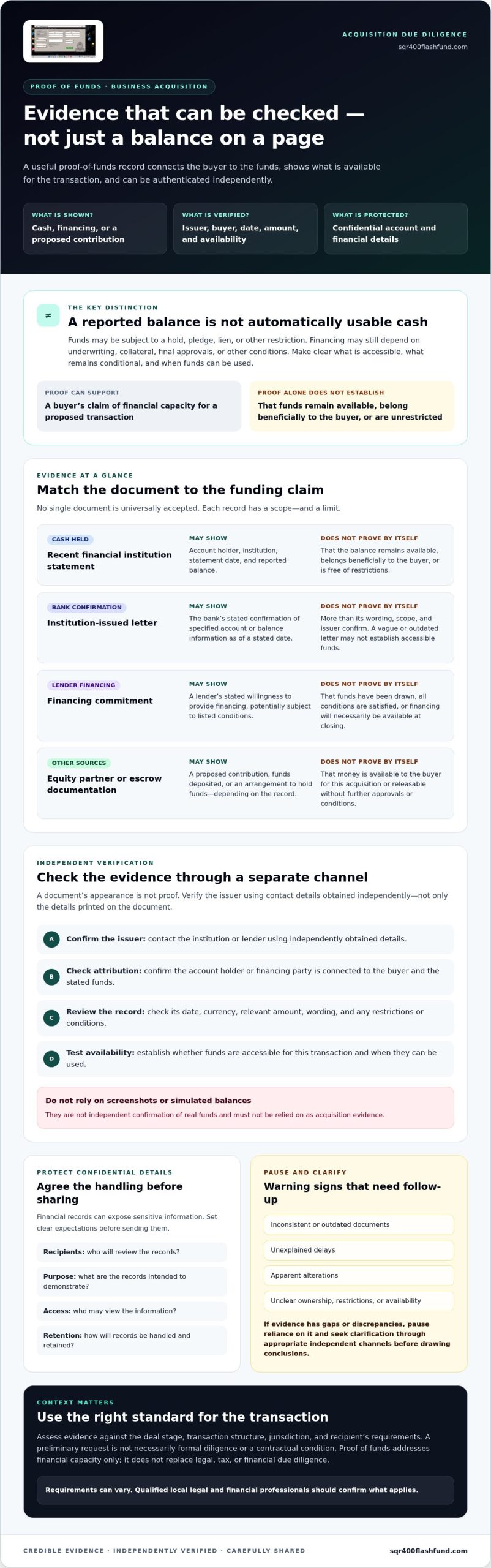
No single document is universally accepted as proof of funds for business acquisition. The right evidence depends on what the buyer is claiming: cash already held, financing expected from a lender, or capital assembled from several sources. The document should match the amount and funding source under discussion, and its limitations should be clear. For example, a statement showing an account balance does not establish that every dollar is unrestricted or intended for the purchase.
| Evidence type | What it may show | What it cannot prove by itself |
|---|---|---|
| Recent financial institution statement | An account holder, institution, statement date, and reported balance. | That the balance remains available, belongs beneficially to the buyer, or is free of holds, liens, or other restrictions. |
| Institution-issued letter | A bank’s stated confirmation of specified account or balance information as of a stated date. | More than its wording, scope, and issuer confirm. A vague or outdated letter may not establish accessible funds for the transaction. |
| Financing commitment | A lender’s stated willingness to provide financing, potentially subject to listed conditions. | That funds have been drawn, all conditions are satisfied, or financing will necessarily be available at closing. |
| Equity partner or escrow documentation | Evidence of a proposed contribution, funds deposited, or an arrangement to hold funds, depending on the record. | That the money is available to the buyer for this acquisition or can be released without further approvals or conditions. |
Cash evidence, account statements, and bank letters
A current statement can help establish the reported balance and account holder, subject to issuer authentication and independent verification. Check whether the funds are liquid and accessible, and whether the account holder is the proposed buyer or an entity funding the purchase. A bank letter is only as useful as its issuer, date, wording, and ability to be confirmed. As Ondato’s guidance on how to verify proof of funds safely reinforces, account ownership and document recency are important verification points.
Financing commitments and other funding sources
Distinguish a final commitment from preliminary lender correspondence. Indicative terms, expressions of interest, and conditional approvals may describe a financing path, not cash ready to deploy. Review the stated conditions and confirm the commitment’s status directly with the lender using contact details obtained independently. If the purchase relies on an equity partner, escrow arrangement, or another funding source, request evidence for that component too. Terminology and document requirements vary by jurisdiction and transaction, so buyers and sellers should confirm expectations with qualified local legal and financial professionals.
Assess the complete funding picture, not just one document. Together, the evidence should account for the proposed buyer, relevant amount, availability, and any conditions that could affect use at closing.
How can buyers and sellers verify proof of funds safely?
Verification should test the evidence against the claim, not simply check whether a document looks official. For proof of funds for business acquisition, confirm the source, ownership, timing, currency, accessibility, and amount through a channel independent of the person who supplied the document. Keep the process proportionate to the transaction stage and mindful of applicable privacy requirements.
Official procedures differ by context. For example, U.S. federal contract-file guidance lists Evidence of availability of funds as a file element. That reference applies to federal contracting procedures, not every private business acquisition. For a private deal, the parties should establish their own verification process.
A practical verification sequence
Agree on the purpose and scope before requesting access. Then use contact information obtained independently, such as through the institution’s official website or a known, separately verified channel. Contact the institution with appropriate consent and in line with applicable privacy rules.
- 1. Define the request. Confirm the transaction stage, the amount or funding source to verify, who may review it, and what evidence is proportionate. Record the agreed scope in writing.
- 2. Verify the issuer. Find the institution’s contact details independently. Don’t rely only on a phone number, email address, link, or contact person supplied with the document.
- 3. Confirm the relevant details. Subject to authorization, ask the issuer or another authorized source to confirm the document’s authenticity, date, account holder, currency, relevant balance or commitment, and any restrictions or conditions. Compare these details with the buyer’s claim and the transaction.
- 4. Document the check securely. Record who performed the verification, when it occurred, and what was confirmed. Retain only information needed for the transaction record, and limit access to authorized recipients.
Only the issuing institution or another authorized source can confirm its records. A screenshot, forwarded message, or image of an online banking interface may help identify what needs checking, but it is not independent confirmation on its own. A visual display, including one showing simulated balances, cannot establish that real funds exist or are available.
Warning signs that require further review
Pause if names do not match, dates are unclear, currencies differ from the transaction, restrictions are unexplained, or documents appear altered. Pressure to bypass verification, unusual guarantees, or insistence that a visual display should be accepted as conclusive evidence also warrants closer review. These signs do not prove misconduct. Ask for clarification through an independent channel and consult qualified legal or financial advisers before relying on the evidence.
How should sensitive proof-of-funds documents be shared?
Sharing proof of funds for business acquisition requires a controlled balance: provide enough information for the agreed review, but do not expose personal or commercial data that is not needed. Before sending anything, agree who will receive it, why they need it, how it will be handled, how long it will be retained, and who may access it. Choose a secure channel with the transaction parties and their professional advisers rather than assuming ordinary email is appropriate.
Minimize exposure without weakening verification
Ask the recipient or adviser which fields are essential before preparing a copy. The right approach depends on the evidence and verification method. Redacting an account number or another field may reduce exposure, but it could also prevent the recipient or institution from authenticating the record. There is no universal redaction rule for every acquisition. Agree on any changes with the recipient in advance, and disclose redactions or limitations clearly.
Keep the original document intact. If a redacted copy is approved, preserve the unaltered record securely for the buyer’s or adviser’s own review where appropriate. Never share online banking passwords, security answers, one-time codes, or direct access to an account. These credentials are not a necessary substitute for an agreed document review or authorized confirmation.
Coordinate expectations before sending evidence
Confirm who will review the material and whether the recipient needs confirmation from the issuing institution or an authorized adviser. Set expectations for secure delivery, access permissions, onward sharing, and deletion or retention. These controls help prevent unnecessary circulation while keeping the verification process clear.
- Recipients: Name the individuals or professional roles authorized to view the evidence.
- Purpose: Specify what the recipient is being asked to verify, such as the account holder or availability of a stated amount.
- Handling: Select an agreed secure transfer method and restrict access to people involved in the review.
- Retention: Establish whether copies will be retained or deleted, subject to applicable obligations.
Do not assume that a request for proof of funds authorizes unlimited disclosure. Privacy, retention, and disclosure requirements vary by jurisdiction and transaction. Ask qualified local legal or financial professionals to resolve those questions, especially if the evidence contains information about other account holders, an operating company, or third-party funding sources.
What should you do when proof of funds is incomplete or questionable?
Pause reliance on the evidence until material gaps are clarified through appropriate independent channels. An outdated statement, missing page, or conditional financing letter may reflect incomplete paperwork rather than misconduct. Treat the issue as unresolved, identify what the evidence does and does not establish, and avoid accusations unless the facts support them.
For proof of funds for business acquisition, a convincing appearance is not a verification result. Screenshots or simulated balances cannot establish that funds are real, belong to the buyer, or are available for the transaction. Do not transfer money, waive safeguards, or make binding commitments solely because a document looks authentic or someone is pressing for a quick decision.
Steps to take before proceeding with the deal
Turn uncertainty into specific questions. If a statement is too old to support the current claim, request updated evidence. If the buyer relies on a lender, ask for confirmation of the commitment’s status and outstanding conditions through the lender or an authorized contact. If several sources contribute to the purchase, clarify which component each document is intended to substantiate.
- List each gap: Note missing information, inconsistent details, unclear restrictions, or unconfirmed funding conditions.
- Request clarification: Use agreed deal contacts and ask for the specific updated document or authorized confirmation needed.
- Consult advisers: Ask whether additional evidence, a revised timeline, or transaction conditions are appropriate.
- Preserve safeguards: Do not release funds, waive protections, or proceed on the strength of an unverified document.
When to involve legal, financial, or compliance professionals
Escalate conflicting records, suspected forgery, unexplained alterations, or pressure to bypass ordinary verification. These indicators warrant review, but they are not proof of wrongdoing on their own. Keep communications factual, retain relevant records securely, and avoid unsupported allegations. A qualified professional can assess the issue in light of the transaction’s jurisdiction, sector, and financing structure, then advise what evidence is appropriate and how confidential information should be handled.
Action checklist: Identify the gap. Pause reliance on the evidence. Request an updated record or independent confirmation. Consult qualified advisers if the discrepancy remains material. Resume the transaction only when the parties understand what has been verified and what conditions remain.
For jurisdiction-specific legal, financial, or disclosure questions, consult a qualified transaction professional before proceeding.
Make verification the standard before moving forward
Credible proof of funds for business acquisition is more than a convincing document. It must support a specific claim about funding, and its issuer, ownership, availability, and any conditions should be confirmed through an authorized source. The appropriate evidence and disclosure process depend on the transaction, its stage, and its jurisdiction.
Use an agreed secure method to share only what reviewers need. If records are incomplete or inconsistent, pause reliance on them, request clarification, and involve qualified advisers before making commitments. Simulated balances and visual displays are not evidence that real funds exist or are available.
Before accepting or sharing sensitive financial evidence, consult a qualified transaction attorney or financial adviser. They can help determine what verification is appropriate for the deal and local requirements. With independent confirmation and disciplined information handling, buyers and sellers can keep due diligence moving on a sounder footing.
Frequently Asked Questions
What documents count as proof of funds for a business acquisition?
Potential evidence includes recent statements from a financial institution, letters issued by that institution, and verified financing commitments. Documents relating to equity partners or escrow may also be relevant if those sources contribute to the purchase. No document is universally accepted. Its value depends on what it confirms, whether the issuer can verify it, and whether the funds are accessible to the buyer for the transaction.
Can a bank statement prove a buyer has funds available?
A bank statement can show an account holder and a reported balance as of the statement date, but it does not prove by itself that the money remains available or is free from restrictions. For proof of funds for business acquisition, verify the statement’s authenticity and confirm relevant details through the institution or another authorized source. The review should establish whether the funds belong to the buyer and can be used as claimed.
How do sellers verify proof of funds safely?
Sellers should first agree with the buyer on the evidence required and who may review it. Verify the issuer using contact details obtained independently, not just details supplied with the document. Subject to consent and applicable privacy requirements, confirm the date, account holder, currency, relevant amount, and any restrictions or financing conditions. Keep a limited record of who verified what and when, without retaining unnecessary sensitive information.
Is a screenshot enough for proof of funds?
No. A screenshot can show what someone is presenting, but it does not independently establish that the information came from a financial institution or that funds remain available. Treat it as an unverified record unless the issuer or another authorized source confirms the relevant details. If the screenshot is the only evidence offered, request appropriate documentation or confirmation through an agreed, independent verification process before relying on it.
Can simulated bank balances be used as proof of funds?
No. Simulated balances or visual displays do not verify that real funds exist, belong to the buyer, or are available for an acquisition. They must not be presented or relied on as proof of funds. Buyers should provide genuine financial evidence that can be authenticated independently. Sellers should pause the review if a visual representation is offered in place of confirmation from the relevant financial institution or another authorized source.
What should I do if proof of funds cannot be verified?
Pause reliance on the evidence and list the specific points that remain unclear. Request updated documentation, clarification from the lender, or confirmation through an authorized channel. Involve a qualified legal or financial adviser if records conflict, appear altered, or the parties are pressured to bypass verification. Treat uncertainty as unresolved rather than proof of misconduct, and do not transfer funds or waive safeguards based only on an unverified document.
How recent should proof of funds be?
Proof of funds should be current enough to reflect the buyer’s position when it is reviewed. A general reference point is a document issued within the past 30 days, but that may not meet every recipient’s requirements or reflect later changes to the funds. Agree on the required date with the seller, lender, or adviser, and seek updated evidence if the transaction timeline extends or the funding position changes.
If you need a clearly identified financial-interface simulation for a demonstration, explore SQR400 v5.8 Pro from SQR400 Flash Fund. Simulated displays are not evidence of real funds and must not be used as a substitute for independently verifiable proof of funds.