


A strong-looking balance is not the same as contract-ready liquidity. When demonstrating liquidity for commercial contracts, buyers need evidence they can verify against the solicitation, not a persuasive snapshot that leaves access, restrictions, or timing unclear.
Which documents will satisfy a buyer depends on the exact requirement. A bank statement may support a claim about available cash, while a committed credit facility or current financial records may help show how obligations can be funded over the performance period. No single document is universally sufficient. Simulated balances and transaction displays are not evidence of genuine funds or financial capacity.
This guide explains how to identify the stated liquidity criterion, assemble authentic and current records, and protect sensitive information by confirming acceptable formats and submission procedures. It also covers when to request clarification from the contracting authority or consult a qualified adviser. The goal is to present traceable evidence that supports your claim and can withstand due diligence.
Key Takeaways
- Start with the solicitation’s exact liquidity criterion. Requirements can differ by buyer and contract.
- Match each financial claim to current, authentic records, then reconcile the figures.
- For demonstrating liquidity for commercial contracts, distinguish accessible cash, working capital, committed credit, and overall solvency.
- Assess whether funds or credit will be available when contract costs arise, not just on the date a balance is shown.
- Before submitting, verify document dates, ownership, completeness, and approved delivery methods. Simulated balances do not prove available funds.
What Does Demonstrating Liquidity for a Contract Actually Mean?
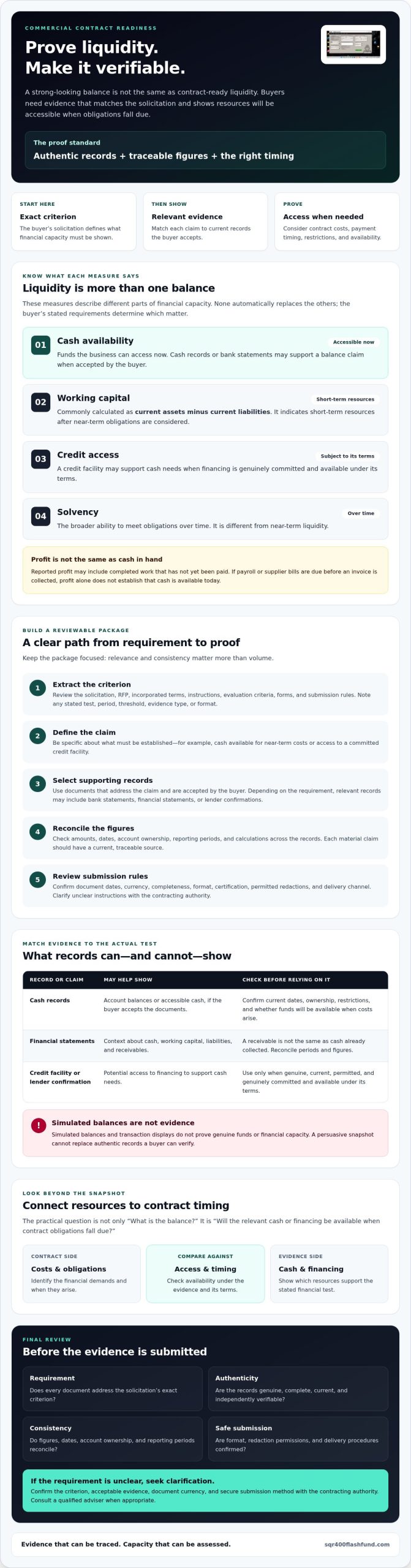
Contract liquidity is the financial capacity a business can access when obligations fall due. It is not simply the balance shown on one account. The buyer is assessing whether relevant funds or financing will be available at the required time and whether the evidence supports that conclusion.
Demonstrating liquidity for commercial contracts means providing authentic, independently verifiable evidence that the business can meet the contract’s financial demands on schedule. This builds on the accounting concept of What is liquidity: the ability to meet cash obligations as they come due. For a contract, the practical test depends on its costs, payment timing, and stated financial criteria.
Keep these measures distinct. Cash availability concerns funds accessible now. Working capital, commonly calculated as current assets minus current liabilities, indicates short-term resources after near-term obligations are considered. Credit access may support cash needs if financing is genuinely committed and available under its terms. Solvency concerns the broader ability to meet obligations over time. None replaces the others, and the buyer’s requirements determine which measures matter.
How is liquidity different from solvency and profitability?
Liquidity concerns near-term payment capacity. Solvency addresses longer-term financial viability. Profitability records whether revenue exceeds expenses over a period, but reported profit may not yet have been collected in cash.
Hypothetical example: A contractor reports a profitable quarter because it completed work and invoiced a customer. If the invoice remains unpaid while payroll and supplier bills are due, reported profit does not establish that cash is available today. A buyer may therefore need evidence of both the amount and timing of resources.
Which contract documents define the financial test?
Start with the solicitation, request for proposal (RFP), and incorporated contract terms. Review the instructions, evaluation criteria, required representations or forms, and submission rules for any specified financial-capacity test, evidence type, date range, or format. Requirements may appear in separate attachments or referenced clauses, so check the complete package.
There is no universal liquidity threshold or document set for every buyer. A bank statement, financial statement, or lender confirmation may be relevant when requested, but don’t assume any one record satisfies the test. If the wording is ambiguous, ask the contracting authority to clarify the criterion, acceptable evidence, document currency, and secure submission method. For U.S. federal procurements, check applicable requirements against the current solicitation and official guidance.
How to Build a Verifiable Liquidity Evidence Package
A strong package connects each claim to records the buyer can review. For demonstrating liquidity for commercial contracts, relevance matters more than volume: submit evidence that addresses the stated test, uses consistent figures, and follows the solicitation’s rules.
Use this workflow:
- 1. Extract the criterion. Identify the exact financial-capacity requirement, evaluation language, required forms, and any stated period or threshold.
- 2. Define the claim. Specify what you need to establish, such as cash available for near-term costs or access to a committed credit facility.
- 3. Select supporting records. Match each claim to documents the buyer accepts. Bank statements, financial statements, or lender confirmations may be relevant when requested.
- 4. Reconcile the figures. Check amounts, dates, account ownership, and reporting periods across the records and your calculations.
- 5. Review submission rules. Confirm required document dates, currency, format, certification, redaction permissions, and delivery channel. Ask the contracting authority if an instruction is unclear.
Checklist standard: Every material liquidity claim should have a current, traceable supporting source.
What records may support a liquidity claim?
Choose records based on the claim and solicitation. Bank statements or other cash records may support a claim about account balances if the buyer accepts them. Financial statements can provide context about cash, working capital, liabilities, and receivables, but a receivable is not the same as cash already collected.
Include a credit facility or lender letter only when it is genuine, current, and permitted by the requirements. Verify whether the financing is committed, available for the relevant purpose, and subject to conditions. The Federal Acquisition Regulation discusses financial condition and available lines of credit in a specific insurance context. Review the applicable federal contractor financial requirements rather than treating that provision as a universal liquidity test. Simulated balance or transaction displays do not verify that funds exist or are available.
How should claims and documents be reconciled?
Confirm that names, account ownership, dates, balances, and reporting periods agree. If a summary combines multiple sources, keep a calculation trail showing how each figure was derived. Identify restricted funds, show receivables separately from collected cash, and exclude conditional financing from claims of immediately available resources.
Preserve original source records and the internal reconciliation for authorized follow-up or due diligence. Submit only the documents and details required through the approved channel. Don’t alter records in a way that changes their meaning.
Can Simulated Balances Demonstrate Liquidity for Contracts?
No. A simulated balance image is not evidence that funds exist or are available. A visual may resemble an account display without establishing a real account, its owner, an accessible balance, or the ability to use those funds for contract obligations. Presenting a simulation as a factual financial record misstates what the image proves.
Only authentic, verifiable records can substantiate an actual liquidity claim. Scenario modeling can have a role in internal planning when clearly labeled as an estimate or projection. It can help a business test cash-flow assumptions, but it must remain separate from evidence submitted to a buyer as fact. Don’t submit simulated transaction or balance displays as proof of financial capacity.
SQR400 Flash Fund offers software such as SQR400 v5.8 Pro that displays simulated liquidity and fund balances. These simulations do not verify real funds or provide actual money transfers. If you use simulation software for a presentation or scenario, label it clearly and never present its displays as evidence of available funds.
For U.S. federal procurement, Federal Acquisition Regulation (FAR) 9.104-1 identifies adequate financial resources, or the ability to obtain them, as a contractor responsibility standard. The solicitation and applicable rules govern the specific evaluation. Misrepresenting financial capacity can damage credibility and may trigger contractual or legal consequences, depending on the facts and applicable requirements. Verify those requirements with the contracting authority or a qualified adviser.
Why is a screenshot not equivalent to financial verification?
Appearance alone doesn’t independently confirm account ownership, available funds, the date a balance was recorded, or whether the displayed amount is restricted or otherwise inaccessible. A screenshot may lack the context needed to assess those facts. Under the buyer’s stated process, evaluators may request source documents or third-party confirmation to verify a claim.
Use original financial records and answer follow-up requests through the approved process. Don’t alter or present a simulated display in a way that could be mistaken for authentic evidence.
How can a business protect sensitive financial information?
Protect sensitive records without compromising verification. Follow the solicitation’s approved submission channel and access controls. Before redacting or modifying a document, ask the contracting authority whether that treatment is permitted and what information must remain visible. Requirements vary, so don’t assume a preferred format or redaction method will be accepted.
Keep complete originals and provide the information required for review. If the requested disclosure appears broader than necessary, seek clarification through the designated contact before submitting. This preserves a traceable record while respecting the buyer’s process.
How to Match Liquidity Evidence to Contract Risk and Timing
A liquidity package should answer the buyer’s stated question and show whether resources will be accessible when contract costs arise. A balance-sheet ratio can add analytical context, but it can’t replace documents or calculations the buyer explicitly requests. The table below is a planning framework, not a universal procurement test.
| Buyer criterion | Relevant claim | Possible evidence | Verification caveat |
|---|---|---|---|
| Cash available for near-term costs | Specified funds are accessible to the business | Accepted bank or cash records | Confirm ownership, date, restrictions, and required reporting period. |
| Working capital or short-term capacity | Current resources support near-term obligations | Financial statements and any requested calculation | Check the buyer’s definitions and treatment of receivables, inventory, and liabilities. |
| Ability to obtain financing | A credit facility can cover a defined funding need | Current lender confirmation or facility documents, if permitted | Review availability conditions, limits, expiry, and intended use. |
Which liquidity measure fits the question being asked?
Ratios provide different views, not automatic qualification tests. The current ratio compares current assets with current liabilities. The quick ratio generally excludes inventory from current assets, while the cash ratio focuses on cash and cash equivalents relative to current liabilities. Definitions and calculation methods can vary, so use the solicitation’s method if it specifies one.
These measures also require interpretation. Inventory may take time to sell, receivables may not be collected by the date funds are needed, and restricted cash may not be usable for performance. Before submitting a calculation, verify whether the buyer requests a particular ratio, underlying schedule, or period.
How do contract milestones change the evidence review?
Map expected outflows against expected access to funds. Consider mobilization expenses, payroll, supplier invoices, and delivery costs alongside the timing of cash on hand, receivable collections, or genuinely committed credit. Payment schedules vary by contract, so don’t assume customer payment will arrive before costs fall due.
Hypothetical example: A contractor may need to pay suppliers before an invoice for completed work is collectible. A cash snapshot alone may not explain that timing gap. A finance or accounting reviewer can test the forecast, particularly if performance depends on delayed receivables or contingent funding. In demonstrating liquidity for commercial contracts, align the claim and evidence with the buyer’s criterion and the contract’s cash-flow demands.
Final Checks Before Submitting Contract Liquidity Evidence
A final review catches mismatches that can weaken an otherwise supportable submission. Before demonstrating liquidity for commercial contracts, compare the complete evidence package against the solicitation, not an assumed standard. Each statement should be accurate, traceable, and limited to what the records establish.
What should the final pre-submission checklist include?
- Criteria: Confirm that the package addresses each stated financial requirement and includes every required form.
- Dates and periods: Check that records meet any specified currency or reporting-period requirements.
- Ownership: Verify that account and financing documents identify the correct business or explain any permitted relationship.
- Reconciliation: Trace each reported amount and calculation to original records. State assumptions only when the submission rules allow them.
- Completeness and format: Confirm required pages, signatures, certifications, file formats, and signatories are present.
- Integrity and delivery: Remove unsupported claims. Ensure no simulation or illustration is presented as an actual financial record, then use the approved submission channel.
An authorized finance reviewer should confirm that every statement is accurate and supported by source records. Keep the reconciliation and complete originals available for appropriate follow-up. Don’t submit a partial extract if the buyer requires a complete document or specific verification details.
When should a business seek professional or buyer guidance?
Ask the contracting authority for written clarification when a criterion, acceptable document, required date, format, or confidentiality procedure is ambiguous. Retain its response with the procurement file where appropriate. Don’t guess at the buyer’s intent or alter documents to fit an unstated requirement.
Consult a qualified accountant or financial adviser if calculations, asset availability, or the timing of funds is uncertain. Seek legal or procurement advice for jurisdiction-specific interpretation, disclosure duties, or concerns about whether a claim could misrepresent the business’s capacity. For U.S. federal opportunities, review current official acquisition guidance alongside the specific solicitation. The solicitation remains central to identifying what this buyer requires.
Final sequence: Verify the instructions, assemble authentic evidence, review every claim against its source, and submit securely through the approved channel. If a requirement remains unclear, pause and obtain clarification before filing.
Submit Evidence That Stands Up to Review
Strong liquidity evidence is specific, traceable, and aligned with the buyer’s stated criteria. Match each claim to original financial records, check that figures and dates reconcile, and assess whether cash or committed credit will be accessible when contract costs arise. A visual representation or simulated balance cannot prove that funds exist.
For demonstrating liquidity for commercial contracts, the standard is accuracy: disclose only what your records support, follow the solicitation’s instructions, and confirm unclear requirements with the contracting authority. Criteria can vary by buyer and jurisdiction, so verify both before submitting.
For U.S. federal opportunities, review official acquisition guidance and confirm the solicitation’s requirements. Then verify the instructions, assemble authentic evidence, review each claim, and submit through the approved channel. A disciplined, transparent package gives evaluators a clear basis to assess your financial capacity.
Frequently Asked Questions
What documents can demonstrate liquidity for a commercial contract?
Documents may include current bank statements, financial statements, cash schedules, or lender confirmations for a genuine credit facility. The right evidence depends on the buyer’s stated criterion. For demonstrating liquidity for commercial contracts, connect each financial claim to an original, traceable record and check that dates, ownership, and figures are consistent. Don’t assume a document will be accepted unless the solicitation permits it or the contracting authority confirms it.
How do you prove working capital for a government contract?
Working capital is generally calculated as current assets minus current liabilities. To support a working-capital claim, use financial statements or schedules that show the underlying asset and liability figures, along with any calculation the solicitation requests. Check the required reporting period, format, and certification instructions. For a U.S. federal opportunity, assess the specific solicitation and current official acquisition guidance rather than assuming one calculation or threshold applies to every contract.
Can a bank statement alone prove liquidity for a contract?
Not necessarily. A bank statement may support a claim about cash recorded in an account, but it may not establish the full financial capacity or working capital a buyer is assessing. The buyer may request additional records, such as financial statements or lender confirmation, and may specify a reporting date or format. Check the solicitation’s evidence requirements and ensure the statement supports the claim you’re making.
Is a simulated bank balance acceptable as proof of funds?
No. A simulated balance does not establish that funds exist, belong to the business, or are available for contract costs. It may be used for internal planning only when clearly labeled as a scenario or projection, not submitted as an actual financial record. Use authentic source documents through the buyer’s approved process. Presenting a simulation as verified funds can undermine credibility and may have further consequences depending on applicable rules.
What is the difference between liquidity and solvency in contract qualification?
Liquidity is the ability to meet near-term payments as they fall due. Solvency concerns broader, longer-term financial viability. A business may hold valuable assets or report a strong financial position yet lack cash available for an immediate payroll or supplier obligation. Buyers assess the financial condition relevant to their stated criteria, so don’t treat solvency, profitability, or a balance-sheet ratio as interchangeable with accessible liquidity.
How current must financial documents be for a contract submission?
There’s no universal document-age rule for every commercial or government contract. The solicitation may specify an “as of” date, reporting period, statement type, or recency requirement. Follow those instructions and confirm acceptable document currency with the contracting authority if the wording is unclear. A record that is accurate but outside the requested period may not address the buyer’s test, so check dates before submission.
What happens if a solicitation does not clearly define its liquidity requirements?
Ask the contracting authority for clarification through the designated procurement channel before submitting. Identify the unclear criterion and ask what claim, evidence, reporting period, format, or calculation the buyer expects. Keep the written response with the procurement file where appropriate. Don’t assume a generic threshold or submit unsupported material as a substitute. For jurisdiction-specific interpretation or disclosure concerns, consult a qualified procurement or legal adviser.
Need a financial simulation for a clearly labeled presentation? Explore SQR400 v5.8 Pro, and keep simulated displays separate from evidence of actual funds.